


- •The best altcoin exchange depends on whether you need new listings, futures markets, liquidity, low fees, or regulated access.
- •Fast altcoin listings can help traders access new projects earlier, but they also bring higher volatility and listing risk.
- •Liquidity matters because thin order books can increase slippage, especially when trading low-cap or newly listed altcoins.
- •Futures trading gives more flexibility for active altcoin traders, but leverage can increase losses during sharp market moves.
Most crypto users eventually reach a point where Bitcoin and Ethereum are no longer the only coins they want exposure to. Or sometimes it is the opposite. You got into crypto because you heard about a smaller coin with serious upside potential, only to realize your regular exchange does not even support it. That is usually where the search for a good altcoin exchange begins.
But not every crypto exchange handles altcoins the same way. Some focus on listing new projects quickly, while others prioritize liquidity, futures markets, security, or regulatory trust. There are also exchanges built more for active traders looking for volatile perpetual markets, while others keep things simple for users who do not want to deal with DEX wallets, bridges, network confusion, or high gas fees.
In this guide, we reviewed the best altcoin exchanges based on factors like altcoin selection, new listings, futures support, liquidity, fees, and overall trading experience.
How We Ranked the Top 8 Crypto Altcoin Trading Platforms
Finding the best exchange for altcoins depends on more than just how many cryptocurrencies a platform lists. Some exchanges are better for accessing newly launched projects quickly, while others stand out because of their futures markets, liquidity depth, platform usability, liquidity depth, KYC requirements, or overall trust profile. There are also platforms designed for traders looking for higher leverage, copy trading tools, or no-KYC access.
To build this list, we compared exchanges based on factors that actually matter to altcoin traders instead of simply ranking platforms by the number of listed cryptocurrencies. We analyzed and curated these exchanges around different trading preferences and use cases, since the best exchange for altcoins can vary depending on whether you care more about new listings, futures markets, low-cap access, liquidity, leverage, beginner-friendly trading, or finding a no kyc altcoin exchange list 2026 that includes platforms with flexible verification requirements. This helps ensure that, regardless of what kind of altcoin trader you are, you can find an exchange that fits your needs better.
Here are the top altcoin exchanges:
1. MEXC
MEXC has built a strong reputation as one of the exchanges with most altcoins available to traders. With more than 1,921+ spot cryptocurrencies and over 925+ futures contracts, the platform is designed for users who want exposure beyond the large-cap names commonly found on mainstream exchanges. This makes MEXC especially popular among traders looking for newly listed projects, lower-cap cryptocurrencies, and fast-moving market narratives before they reach larger platforms.
One of the biggest reasons MEXC ranks among the best altcoin futures exchanges is the sheer number of perpetual contracts available. The exchange currently supports more than 925+ futures markets, giving traders access to a much larger altcoin derivatives selection than most competitors. This also makes MEXC relevant for users comparing crypto exchanges with fast new listings, since newly listed and trending altcoins often become available across its spot or futures markets earlier than on more selective platforms.
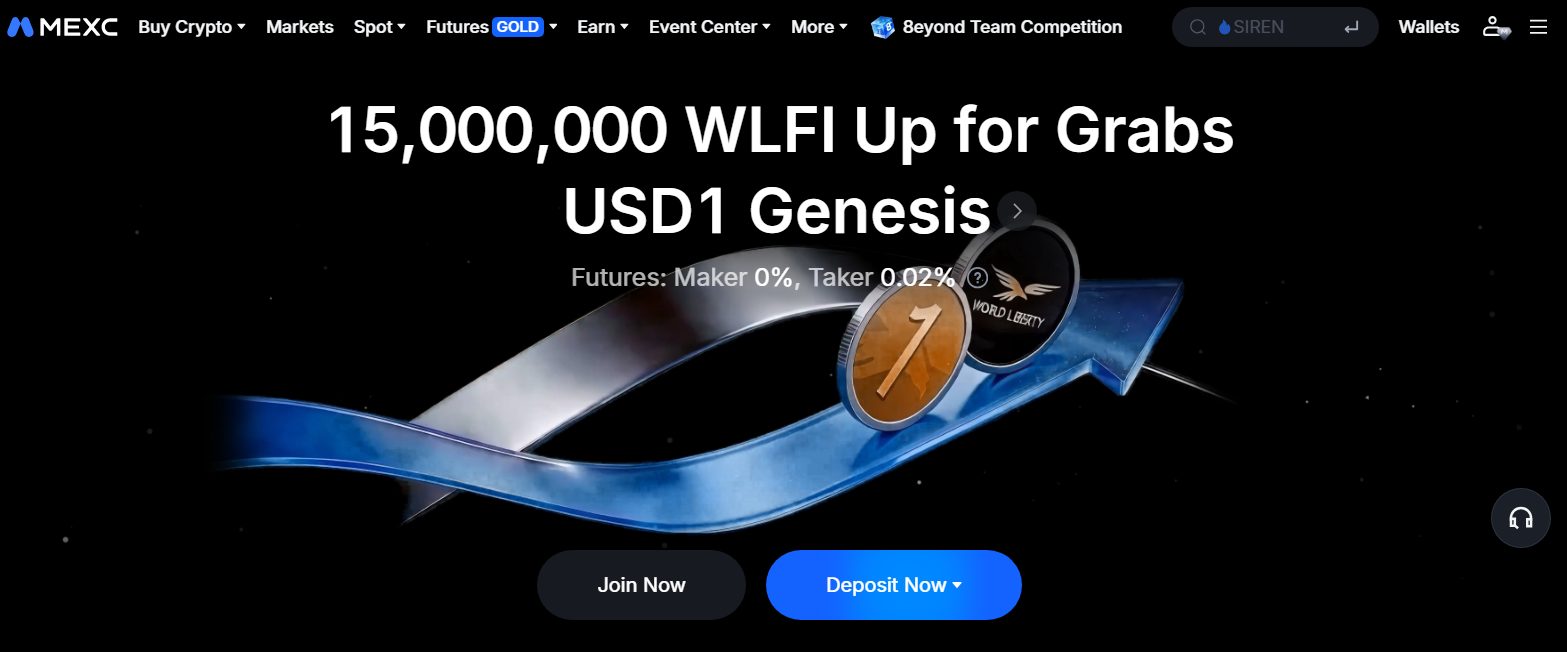
Combined with leverage of up to 500x, MEXC appeals heavily to active traders focused on volatile altcoins and short-term momentum opportunities. At the same time, the platform keeps trading costs competitive with 0.05% spot trading fees and futures fees starting at 0% maker and 0.02% taker.
MEXC also appeals to traders who prefer centralized exchanges over DEXs for accessing emerging altcoins. Instead of dealing with wallets, bridges, network switching, and high gas fees, users can often access trending cryptocurrencies directly through the exchange shortly after listing. Combined with its broad market access and aggressive listing activity, MEXC remains one of the strongest platforms for altcoin trading overall.
| MEXC Key Details | |
|---|---|
| Supported Cryptos | 1,921+ |
| Futures Contracts | 925+ |
| Spot Fees | 0.05% maker / 0.05% taker |
| Futures Fees | 0% maker / 0.02% taker |
| KYC | Required |
2. WEEX
WEEX is a strong altcoin exchange for traders who want access to both spot markets and high-leverage altcoin derivatives. Launched in 2017, the platform now supports 473 spot assets and 731 futures contracts, giving traders a large selection of altcoin markets across both regular buying and futures trading.
The main reason WEEX ranks high on this list is its futures setup. With up to 400x leverage and 731 futures contracts, WEEX gives active altcoin traders more markets to work with across both major and smaller assets. Its copy trading feature also fits this angle well, since experienced traders get more altcoin opportunities to explore, while users who prefer following existing strategies can track traders already active across these markets.

Liquidity is another area where WEEX performs reasonably well. The exchange has moderate liquidity with an average bid-ask spread of 0.69%, which is good for an altcoin-focused platform. This matters because newer projects and minor pairs often have thinner order books, so a tighter spread can help reduce slippage during trades. For users comparing the best altcoin futures exchange with high leverage, WEEX also stands out because it combines 400x leverage with a large futures selection and workable liquidity across altcoin markets.
WEEX also keeps its fee structure competitive. Spot trading fees are 0.1% maker and 0.1% taker, while futures fees are 0.02% maker and 0.08% taker. The maker fee is competitive, although the futures taker fee is slightly higher than some lower-cost alternatives. Users can also get fee discounts through the WXT token.
With optional KYC, a trust score of 8, and cumulative daily volume of more than $10.21B, WEEX is a useful option for traders who want altcoin futures access, high leverage, and a large derivatives market without fully moving into DEX-based trading.
| WEEX Key Details | |
|---|---|
| Supported Cryptos | 473+ |
| Futures Contracts | 731+ |
| Spot Fees | 0.1% maker / 0.1% taker |
| Futures Fees | 0.02% maker / 0.08% taker |
| KYC | Optional KYC |
3. Bitget
Bitget has grown into one of the best altcoin exchanges for traders looking for a balance between spot trading, futures markets, and broader multi-asset exposure. While the platform supports 599 spot cryptocurrencies and 647 futures contracts, one of its biggest strengths is the overall trading ecosystem built around active traders.
The exchange is especially popular among futures traders due to its liquidity, copy trading infrastructure, and leverage support of up to 150x. With spot fees at 0.1% and futures fees at 0.02% / 0.06%, Bitget remains competitively priced for users actively trading altcoins across both short-term and high-volatility markets.
What also helps Bitget stand out as a best platform for altcoins is that it goes beyond regular crypto trading. Alongside cryptocurrencies, Bitget also offers access to commodities, tokenized stocks, and indices, giving traders additional exposure to different markets without leaving the platform. This makes Bitget appealing for users who prefer managing multiple speculative markets from a single trading interface.
Combined with its strong derivatives presence and growing altcoin support, Bitget continues to position itself as one of the more complete platforms for active crypto traders.
| Bitget Key Details | |
|---|---|
| Supported Cryptos | 599+ |
| Futures Contracts | 647+ |
| Spot Fees | 0.1% maker / 0.1% taker |
| Futures Fees | 0.02% maker / 0.06% taker |
| KYC | Required |
4. BloFin
BloFin is a no-KYC altcoin exchange that mainly appeals to futures traders rather than users looking for the largest spot coin selection. The platform supports 521 spot cryptocurrencies and 489 futures contracts, which gives traders a solid range of altcoin markets across both spot and derivatives trading.
Its futures setup is the stronger part of the platform. BloFin offers leverage of up to 150x, with futures fees at 0.02% maker and 0.05% taker. Spot fees are also reasonable at 0.1% maker and 0.1% taker. The exchange has a 0.55% average bid-ask spread, which is better than several low-liquidity platforms on this list, although its overall liquidity rating is still low.
BloFin has no major hack record, which adds some confidence, but traders should still consider its lower trust score before using it for larger balances.
| BloFin Key Details | |
|---|---|
| Supported Cryptos | 521+ |
| Futures Contracts | 489+ |
| Spot Fees | 0.1% maker / 0.1% taker |
| Futures Fees | 0.02% maker / 0.05% taker |
| KYC | Optional KYC |
5. Hyperliquid
Hyperliquid is a different type of platform from most of the best altcoin exchanges on this list. It is not built for beginners who want simple spot buying, fiat deposits, or a normal centralized exchange experience. Instead, it is closer to a high-performance perp DEX for traders who already understand wallets, on-chain trading, and decentralized market access.
The platform supports 238 spot markets and 340 futures contracts, with no KYC requirement and leverage of up to 40x. Its biggest strength is liquidity. Hyperliquid records $7.5B+ daily trading volume and a tight 0.15% average bid-ask spread, which is strong for a decentralized perpetual trading platform. Fees are also low compared to many CEXs, with 0.04% maker and 0.07% taker fees on spot trades, while perpetual fees are 0.015% maker and 0.045% taker. This makes Hyperliquid a strong option for advanced altcoin traders who want speed, liquidity, transparent execution, and early market access without relying fully on centralized exchanges.
HIP-3 has also made Hyperliquid more relevant for altcoin traders because it allows builders to deploy new perpetual markets on-chain. Instead of relying only on the core team or a centralized listing process, market deployers can create and operate new perp markets with their own oracle setup, contract specifications, leverage limits, and settlement rules. This helps Hyperliquid support faster market creation for assets with strong trader demand, including pre-launch tokens, RWA-linked markets, and other in-demand altcoin narratives.
Another major advantage is transparency. Every order, trade, and liquidation is recorded on-chain through its Central Limit Order Book. This gives traders a CEX-style interface with fast execution, while still keeping market activity visible on the blockchain. It also avoids some of the access issues users may face on centralized exchanges during periods of extreme volatility.
| Hyperliquid Key Details | |
|---|---|
| Supported Cryptos | 238+ |
| Futures Contracts | 340+ |
| Spot Fees | 0.04% maker / 0.0% taker |
| Futures Fees | 0.0% maker / 0.0% taker |
| KYC | No KYC |
6. CoinEx
CoinEx is one of the best altcoin exchanges for users who want broad spot market access without mandatory KYC. The platform supports 915 spot cryptocurrencies, which gives traders more altcoin variety than many better-known exchanges. This makes CoinEx useful for users searching for the best platform for altcoins, especially if they care more about spot access than deep futures coverage.
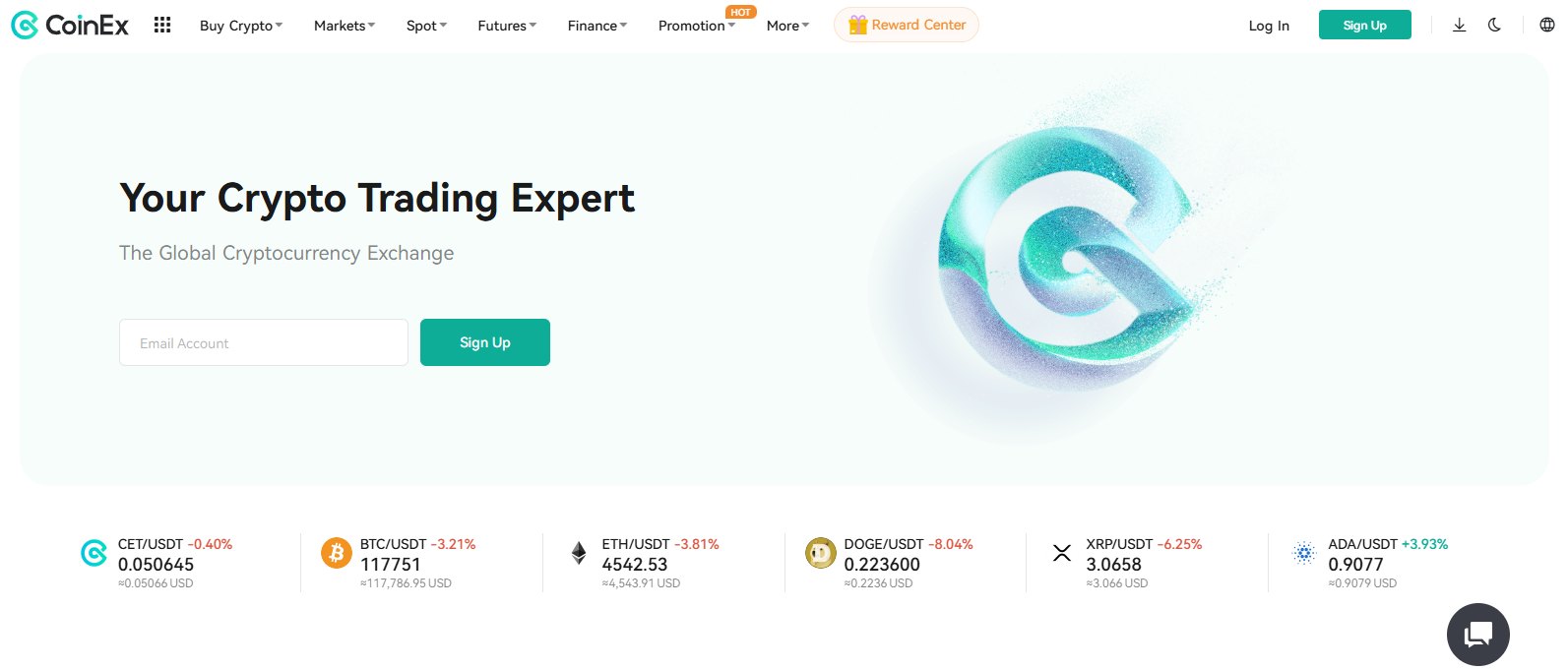
Its futures market is smaller compared to other platforms on this list, with 236 futures contracts and leverage of up to 100x. Fees are fairly competitive, with 0.2% maker and 0.16% taker spot fees, while futures fees are 0% maker and 0.05% taker. However, liquidity is low, with a 0.96% average bid-ask spread, so larger trades need more caution.
| CoinEx Key Details | |
|---|---|
| Supported Cryptos | 915+ |
| Futures Contracts | 236+ |
| Spot Fees | 0.20% maker / 0.16% taker |
| Futures Fees | 0.0% maker / 0.05% taker |
| KYC | Optional KYC |
7. Bybit
Bybit is one of the best altcoin exchanges for traders who care most about liquidity, execution quality, and derivatives market depth. The platform supports 726+ spot assets and 738 perpetual contracts across USDT-M, USDC-M, and COIN-M markets, giving altcoin traders access to a large set of spot and futures pairs from one account.
The biggest reason Bybit stands out is liquidity. It has a 0.246% average bid-ask spread, a high liquidity score, and a perfect trust score of 10. This matters for altcoin traders because tighter spreads and deeper order books can make entries and exits cleaner, especially when trading larger positions or more volatile futures markets.
Bybit is also built heavily around high-volume altcoin derivatives trading. It supports leverage of up to 125x and records more than $11.32B in cumulative daily trading volume. Its perpetual markets cover major altcoins and smaller trading opportunities, while its Unified Trading Account lets users manage collateral across different assets under one account. This can be useful for traders who want to use their altcoin portfolio more efficiently instead of managing separate balances across different products.
The platform also supports advanced trading tools, early-stage altcoin allocation opportunities, and options trading for more experienced users. With over 30M users, mandatory KYC, proof of reserves, strong security standards, and regulated operations in supported regions, Bybit is better suited to traders who want a more established altcoin exchange with deep liquidity and a full derivatives ecosystem.
| Bybit Key Details | |
|---|---|
| Supported Cryptos | 726+ |
| Futures Contracts | 738+ |
| Spot Fees | 0.1% maker / 0.1% taker |
| Futures Fees | 0.01% maker / 0.055% taker |
| KYC | Required |
8. Gate
Gate has consistently remained one of the best altcoin exchanges for traders looking beyond mainstream cryptocurrencies. The platform is especially known for listing a large number of altcoins across both spot and futures markets, making it a strong option for users trying to access smaller or emerging crypto projects before they become widely available on larger exchanges.
With support for 1,719 spot cryptocurrencies and 709 futures contracts, Gate gives traders exposure to a large mix of ecosystems, narratives, and lower-cap tokens. This makes the exchange particularly attractive for users looking for the best crypto exchange for low cap altcoins, especially if they actively trade sectors such as AI tokens, meme coins, DeFi projects, gaming cryptocurrencies, and newly launched altcoins. Its high altcoin availability is one of the main reasons Gate continues to rank among the best altcoin trading platforms.
Another reason Gate remains popular among altcoin traders is its strong focus on early-stage ecosystem participation. Through its GT token and Launchpad ecosystem, users can gain access to various airdrop campaigns, token launches, and early project opportunities before broader market adoption. This gives traders another way to access emerging projects beyond regular spot and futures trading.
Futures traders on Gate can access leverage of up to 200x, while the platform keeps trading fees competitive at 0.1% spot fees and 0.02% / 0.05% futures fees.
| Gate Key Details | |
|---|---|
| Supported Cryptos | 1,719+ |
| Futures Contracts | 709+ |
| Spot Fees | 0.1% maker / 0.1% taker |
| Futures Fees | 0.02% maker / 0.05% taker |
| KYC | Required |
What Are Altcoins and Altcoin Exchanges?
Altcoins are cryptocurrencies other than Bitcoin. The term comes from “alternative coins”, since Bitcoin was the first major cryptocurrency and every other crypto asset came after it. Today, altcoins include everything from large-cap assets like Ethereum and Solana to smaller tokens tied to DeFi, AI, gaming, meme coins, and new crypto narratives.
Altcoin exchanges are platforms that support a strong range of these assets for spot or futures trading. A good altcoin exchange should offer enough coin variety, active liquidity, fair fees, reliable withdrawals, and access to the types of altcoins you actually want to trade.
How To Choose an Altcoin Exchange
Choosing the right altcoin exchange depends on what kind of trader you are. Some users want early access to new coins, while others care more about futures markets, low fees, liquidity, or a simple buying process. That is why the best exchange for altcoins is not always the one with the highest number of listed coins.
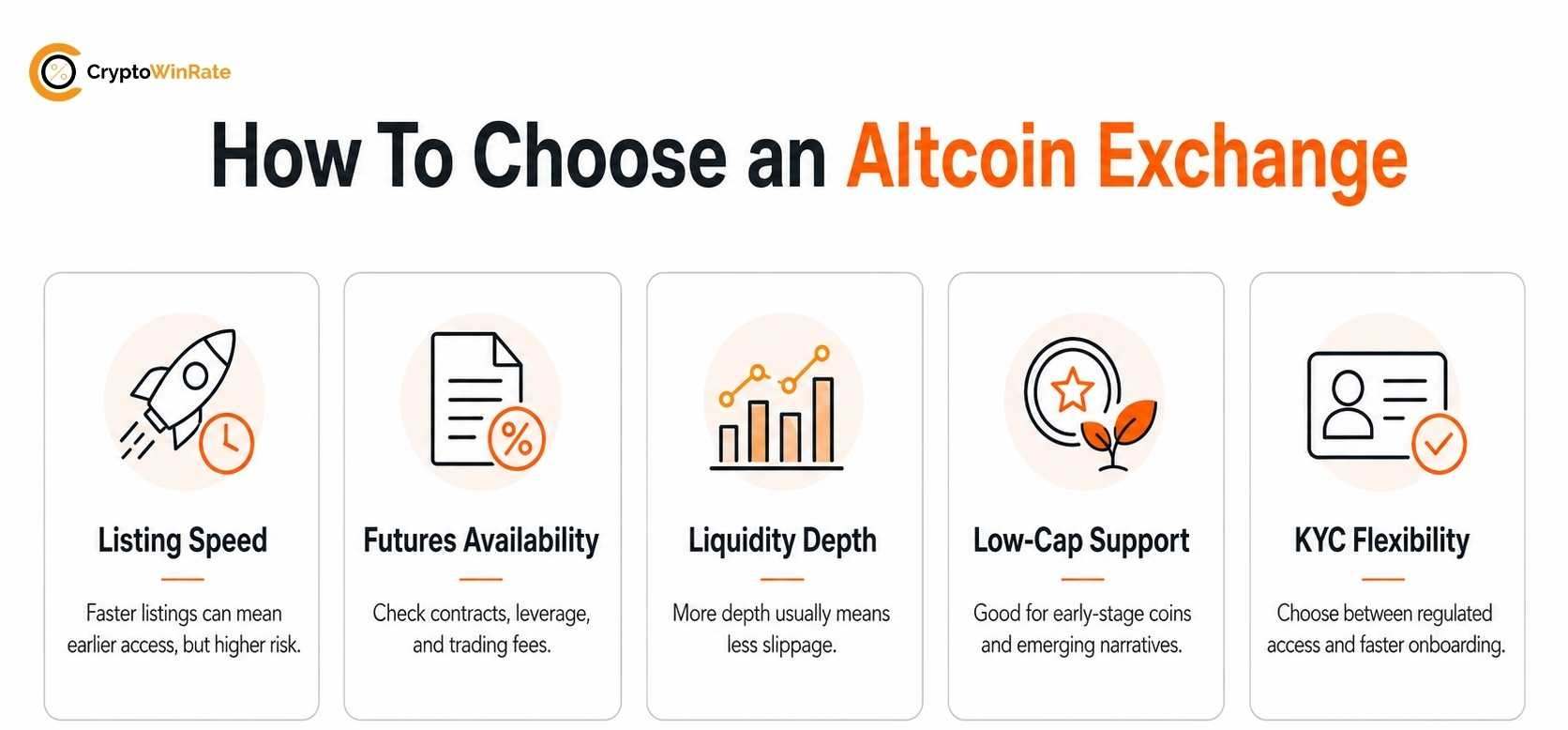
Listing Speed
Listing speed matters if you are looking for new narratives, meme coins, or smaller projects before they reach larger exchanges. Crypto exchanges with new listings can give users earlier access, but faster listings also come with higher risk. Always check the project, volume, and market activity before buying.
Futures Availability
Many altcoin traders now use futures instead of spot markets, especially for short-term trades. If you trade with leverage, look at how many altcoin futures contracts the exchange supports, its max leverage, funding rates, and futures fees. The best altcoin futures exchanges usually offer strong market variety without making execution unreliable.
Liquidity Depth
Liquidity decides how easily you can enter or exit a trade. Thin order books can cause slippage, especially on low-cap altcoins. A good exchange should have active volume, reasonable spreads, and enough depth for the coins you want to trade.
Low-cap Support
If your goal is to find early-stage altcoins, low-cap support is important. Some exchanges list smaller tokens faster, while regulated platforms usually take a more selective approach. Both models have value, depending on your risk level.
KYC Flexibility
KYC requirements also matter. Some users prefer fully verified and regulated exchanges, while others want no-KYC access for faster onboarding. Choose based on your region, withdrawal needs, and comfort with platform risk.
Spot vs Futures Altcoin Trading
Spot trading is usually better for users who want to buy and hold altcoins directly. You own the asset, can withdraw it to a wallet, and are not exposed to liquidation risk. This makes spot trading more suitable for beginners, long-term investors, and users buying smaller projects before they gain wider attention.
Futures trading is built more for short-term traders who want to trade altcoin price movements with leverage. You do not need to own the coin directly, but the risk is much higher because a sharp move against your position can trigger liquidation. This risk becomes even more serious with low-cap altcoins, where liquidity can be thinner and price moves can be more aggressive.
So before choosing an exchange, check whether its strength is spot access, futures depth, or both.
Best Exchange for New Altcoins
MEXC is the strongest pick for new altcoins because it lists trending and low-cap projects quickly across both spot and futures markets. It is also useful for meme coin traders who want early access without using DEXs, wallets, bridges, or paying high gas fees on-chain.
Best Altcoin Futures Exchange
MEXC and Bitget are the strongest choices for altcoin futures trading. MEXC offers a much larger futures selection, while Bitget has stronger liquidity, copy trading tools, and a more polished derivatives platform. Active traders should compare contracts, fees, spreads, and leverage before choosing one.
Best No-KYC Altcoin Exchange
Hyperliquid is the strongest no-KYC option for advanced altcoin traders who want decentralized perpetual trading, fast execution, and transparent on-chain order activity. For users who prefer a more regular exchange experience, CoinEx and BloFin are also worth considering because both offer optional-KYC access with a solid range of altcoin markets.
Best Altcoin Exchange for Liquidity
Bybit is the strongest option for traders who care about liquidity, order book depth, and execution quality. It has a 0.246% average bid-ask spread, a high liquidity score, and 738 perpetual contracts across USDT-M, USDC-M, and COIN-M markets. This makes it more suitable for traders who want a large, established platform for altcoin spot and futures trading.
Final Thoughts
The best altcoin exchanges are not always the ones with the longest coin list. What matters more is whether the exchange fits the way you trade. Some readers may want early access to new altcoins, while others may care more about futures contracts, liquidity, lower fees, no-KYC access, or a regulated trading setup.
That is why this list includes different types of platforms instead of ranking every exchange by coin count alone. If altcoin trading feels too volatile, you can also look into more structured trading styles like day trading. Our guide on the top exchanges for day trading can help you compare better platforms for that approach.
FAQs
1. Which crypto exchange has the most altcoins listed?
MEXC and Gate are the leading crypto exchanges for altcoin variety. MEXC lists the largest selection with over 1,921+ spot assets and 925+ futures contracts. Gate follows closely, offering active traders access to 1,719+ spot cryptocurrencies and 709+ alternative derivatives markets.
2. Are altcoin exchanges safe?
The safety of an altcoin exchange depends entirely on its regulatory posture and custody model. Established, KYC-mandatory exchanges like Bybit and Bitget offer deep liquidity pools, multi-layer security protocols, and verifiable proof-of-reserves. Conversely, while decentralized perpetual platforms like Hyperliquid eliminate centralized counterparty risk, they expose users to smart contract vulnerabilities.
3. Which exchange lists new altcoins quickly?
MEXC, Gate, and Hyperliquid are the fastest platforms for early-stage altcoin listings. Centralized options like MEXC list trending meme coins and low-cap protocols directly on their order books without requiring DeFi gas fees. On-chain platforms like Hyperliquid use decentralized frameworks (like HIP-3) to allow rapid, public deployment of perpetual markets
4. Are altcoin futures riskier than spot trading?
Yes, altcoin futures trading carries significantly higher risk than spot markets due to leverage and liquidation mechanisms. Spot trading gives you full ownership of the underlying asset without the threat of forced closure. Futures trading introduces up to 150x leverage on platforms like Bitget and BloFin, meaning minor price movements can result in total capital liquidation if your margin limits are breached