


-
- •Scalping requires low fees, fast execution, and tight spreads, making futures markets more suitable than spot trading.
- •Bybit, Binance, and OKX offer strong liquidity, leverage, and advanced tools for most scalping strategies.
- •Hyperliquid gives scalpers decentralized trading, no mandatory KYC, transparent on-chain data, and low trading fees.
- •BloFin and WEEX add more options for futures scalpers, with BloFin leaning beginner-friendly and WEEX focusing more on high-leverage trading.
- •The best exchange depends on fees, execution speed, available markets, leverage, and preference for centralized or decentralized platforms.
Scalping cryptocurrencies is arguably the most profitable way of trading. However, there is one key aspect with a massive impact on profitability that is often overlooked.
Finding the best crypto exchanges for scalping is the most important factor to consider. It is important to look out for things such as low fees, tight spreads, deep liquidity, high leverage, and reliability. This ensures the best value for money and that you can get quickly in and out of your trades.
Our traders have tested over 50 tier-1 crypto exchanges, both centralized and decentralized platforms, for scalping cryptocurrencies. In this guide, we will share the top crypto exchanges for scalping.
Top 6 Crypto Scalping Exchanges Reviewed
Below, you will find the 6 best crypto exchanges for scalping strategies.
1. Bybit
Bybit is one of the most popular crypto exchanges among scalpers, largely due to its strong security and reliable trading platform. More than 80 million users trust the exchange for scalping, day trading, swing trading, and long-term crypto investing.
One of Bybit’s biggest strengths is its user-friendly interface, which makes it accessible even for beginners looking to scalp the crypto market. Aside from being easy to use, Bybit also offers advanced trading tools, multiple order types, and features suited to active traders.
The platform supports 726+ spot markets and 578+ futures contracts, giving users a broad range of assets to trade. With leverage of up to 125x on supported futures markets, Bybit remains a strong choice for short-term traders.
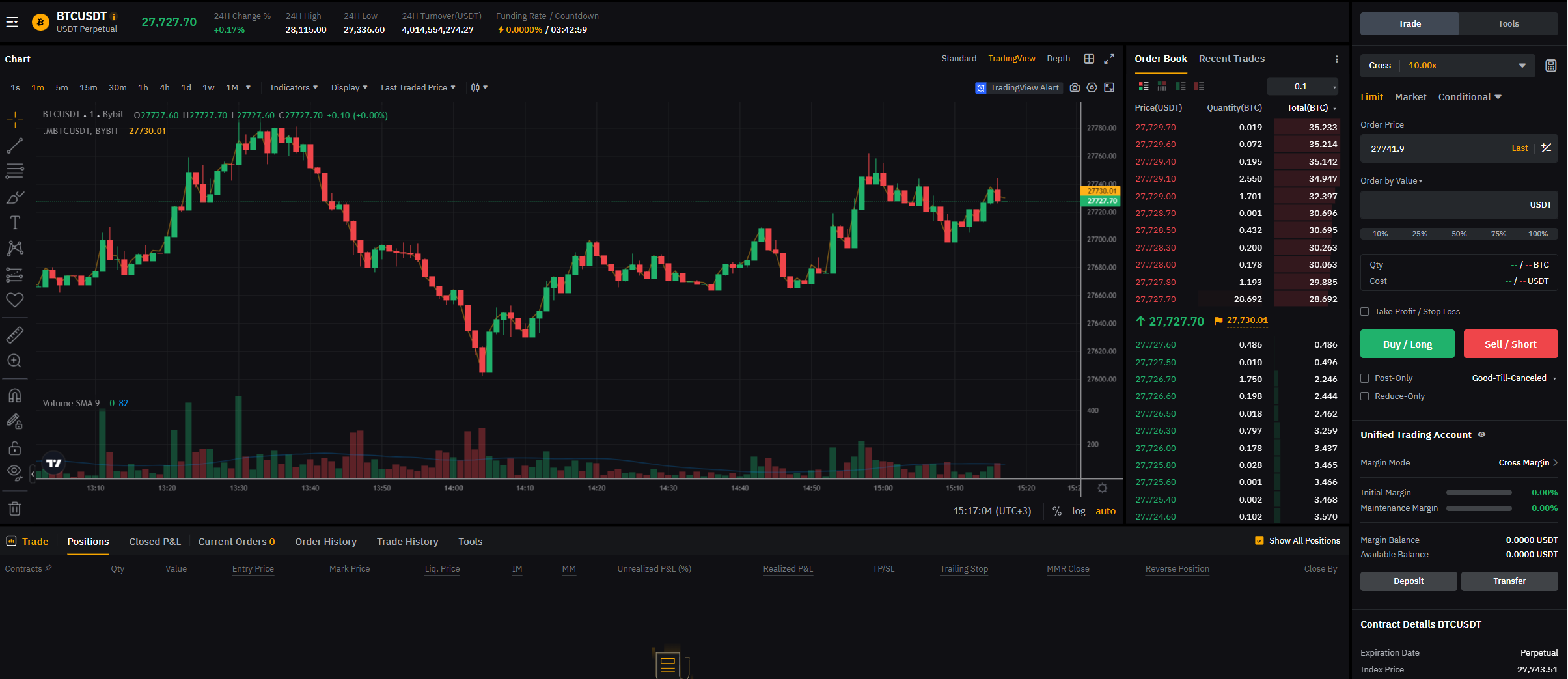
Bybit ranks highly in terms of liquidity, with average 0.1% market depth of over $15 million. This is more than sufficient for smooth scalp trade execution.
In terms of trading fees, Bybit charges 0.02% maker fees and 0.055% taker fees on futures, which remains competitive for frequent traders.
Bybit also supports V5 API access, giving technical traders REST and WebSocket tools for faster order execution and external terminal setups.
Bybit has also strengthened its compliance standards in recent years. KYC is now mandatory, and the exchange holds regulatory approvals and registrations in multiple regions, including MiCAR in Europe, a VASP license from the UAE authorities, and registration with India’s Financial Intelligence Unit.
Beyond crypto, Bybit also gives traders access to tokenized stocks, commodities, and other markets, making it a more complete platform for scalpers who want broader exposure.
Where Bybit stands out most is its new user rewards program. New traders can claim up to $30,000 in trading bonuses using a Bybit referral code during sign up.
Read our full Bybit review to learn more about the exchange.
2. Hyperliquid
Hyperliquid is a decentralized trading platform that has gained attention among active traders, particularly those focused on short-term strategies like scalping. Its structure and execution model address several of the core requirements scalpers look for, especially around fees, transparency, and order execution.
From a cost perspective, Hyperliquid keeps trading fees relatively low, with 0.015% maker and 0.045% taker fees. This matters for scalpers who place frequent trades, where even small fee differences can impact overall profitability. Additional fee reductions are available for users staking HYPE tokens, starting from a 5% discount for holding at least 10 tokens.
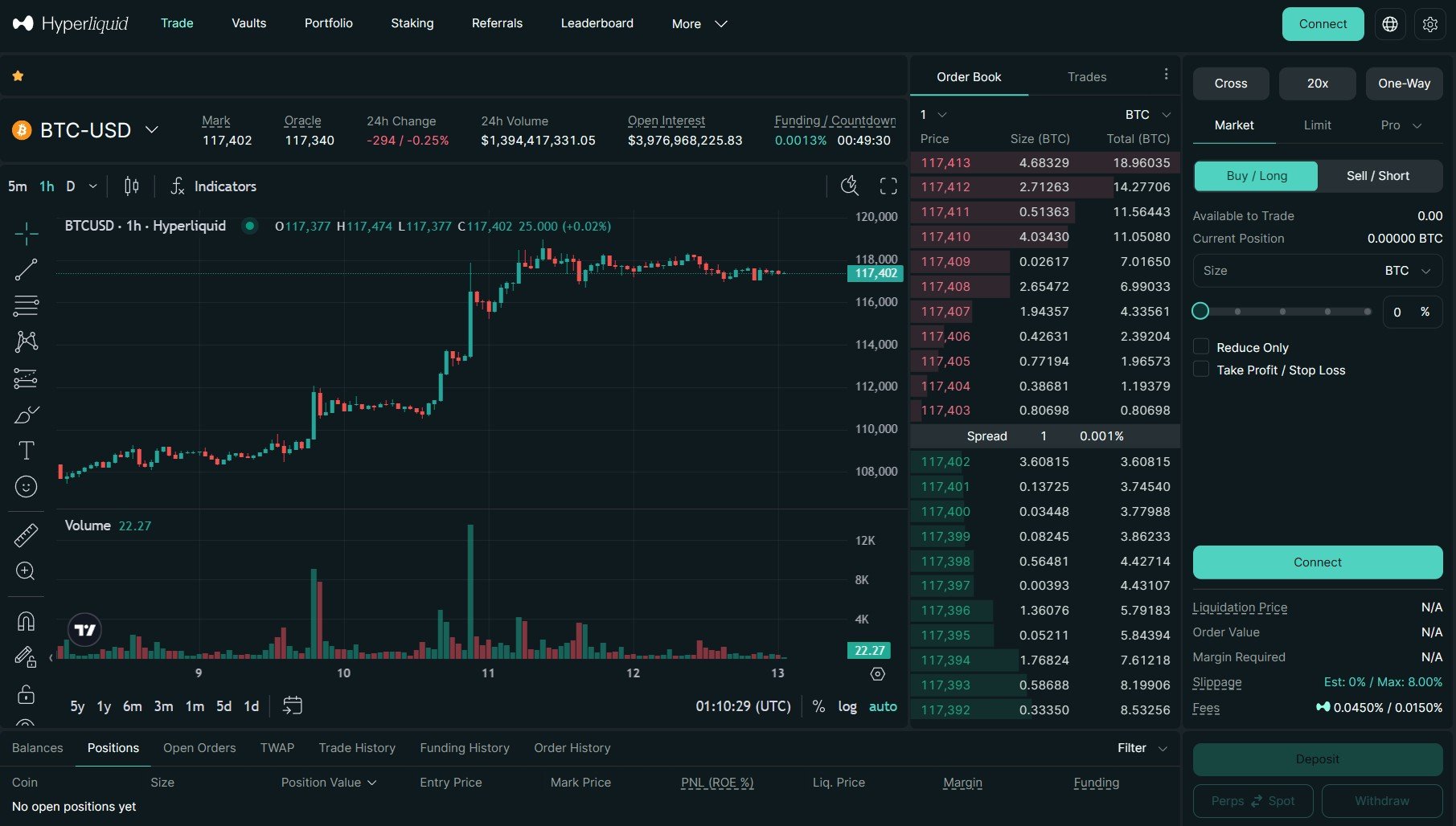
In terms of market access, the platform supports both spot and perpetual trading across crypto and non-crypto assets. This includes tokenized stocks, forex, indices, and commodities. With 354+ perpetual markets and over 291 spot assets, traders have flexibility to shift between different markets depending on volatility and liquidity conditions. Leverage of up to 40x is available on supported pairs, which is commonly used in short-term strategies, although it increases risk.
Liquidity and execution are key for scalping, and Hyperliquid maintains relatively tight bid-ask spreads, averaging around 0.101%. Combined with daily trading volume reaching approximately $4.89B+, this supports smoother order fills and reduces slippage during fast entries and exits.
One structural difference is that Hyperliquid operates without mandatory KYC requirements and remains fully decentralized. Users retain custody of their funds, which removes counterparty risk associated with centralized exchanges, but also places more responsibility on the trader.
Another notable aspect is transparency. Metrics such as funding rates, trading volume, and open interest are available on-chain through Hyperliquid Stats. Since this data is recorded on-chain, it cannot be altered, which gives traders a clearer view of real-time market conditions.
Hyperliquid supports API and WebSocket access for traders who want real-time market data, custom scripts, and more technical execution workflows.
Overall, Hyperliquid aligns well with several key scalping requirements, including low fees, tight spreads, transparent data, and access to multiple markets within a single platform.
Read our full Hyperliquid review to learn more about the exchange.
3. Binance
Binance is the largest crypto exchange in the world, with more than 315 million registered users. With daily trading volume often exceeding $20 billion, Binance remains the most active platform in the market.
What makes Binance an excellent crypto scalping exchange is its wide range of advanced trading tools, order types, and relatively low fees.
The trading interface on Binance is highly comprehensive, making it better suited to experienced and professional traders who need more control over execution.
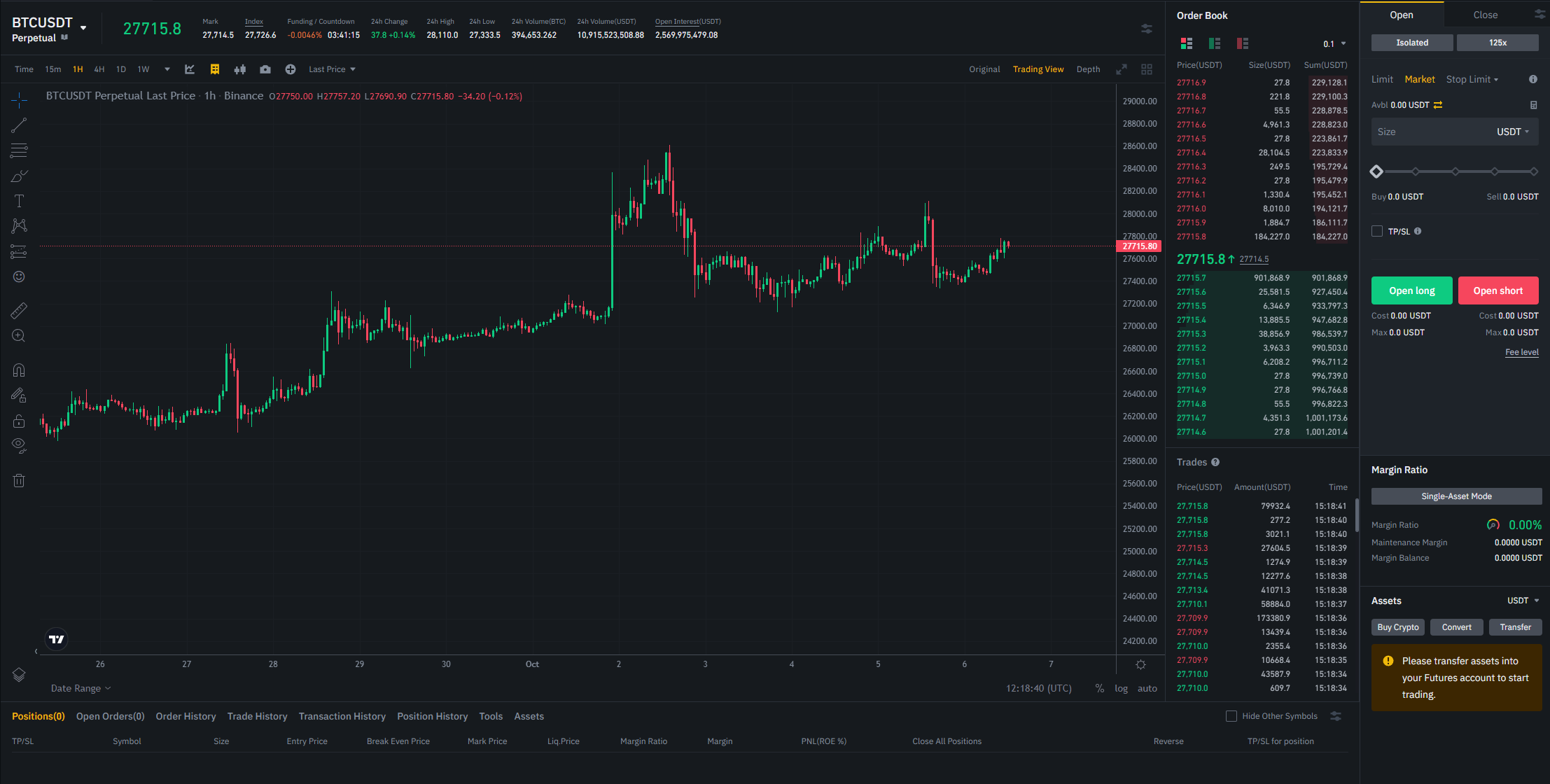
Binance offers strong value for active traders, with futures fees starting at 0.02% maker and 0.05% taker. This fee structure helps keep trading costs low, especially for short-term strategies. Users can also reduce their fees further based on 30-day trading volume and by using its native BNB token to pay trading fees.
Binance remains one of the stronger choices for algorithmic traders, with mature REST and WebSocket APIs, documented rate limits, and support across major crypto trading bots.
Binance also gives users access to one of the widest selections of markets in the industry, with 439+ spot assets and 663+ futures contracts available.
While Binance does not offer incentives on the same scale as some competitors, new users can still claim bonuses worth up to $100 by signing up with a valid Binance referral code.
Overall, Binance remains one of the strongest options for crypto scalping due to its liquidity, low fees, broad market access, and advanced trading tools.
To learn more about the trading platform, you can read our full Binance review here.
4. BloFin
BloFin is a newer crypto exchange launched in 2019, and its main value for scalpers comes from a simple futures-focused setup. BloFin futures trading supports 502 futures contracts, 521 spot assets, and up to 150x leverage, giving short-term traders enough markets to test different setups.
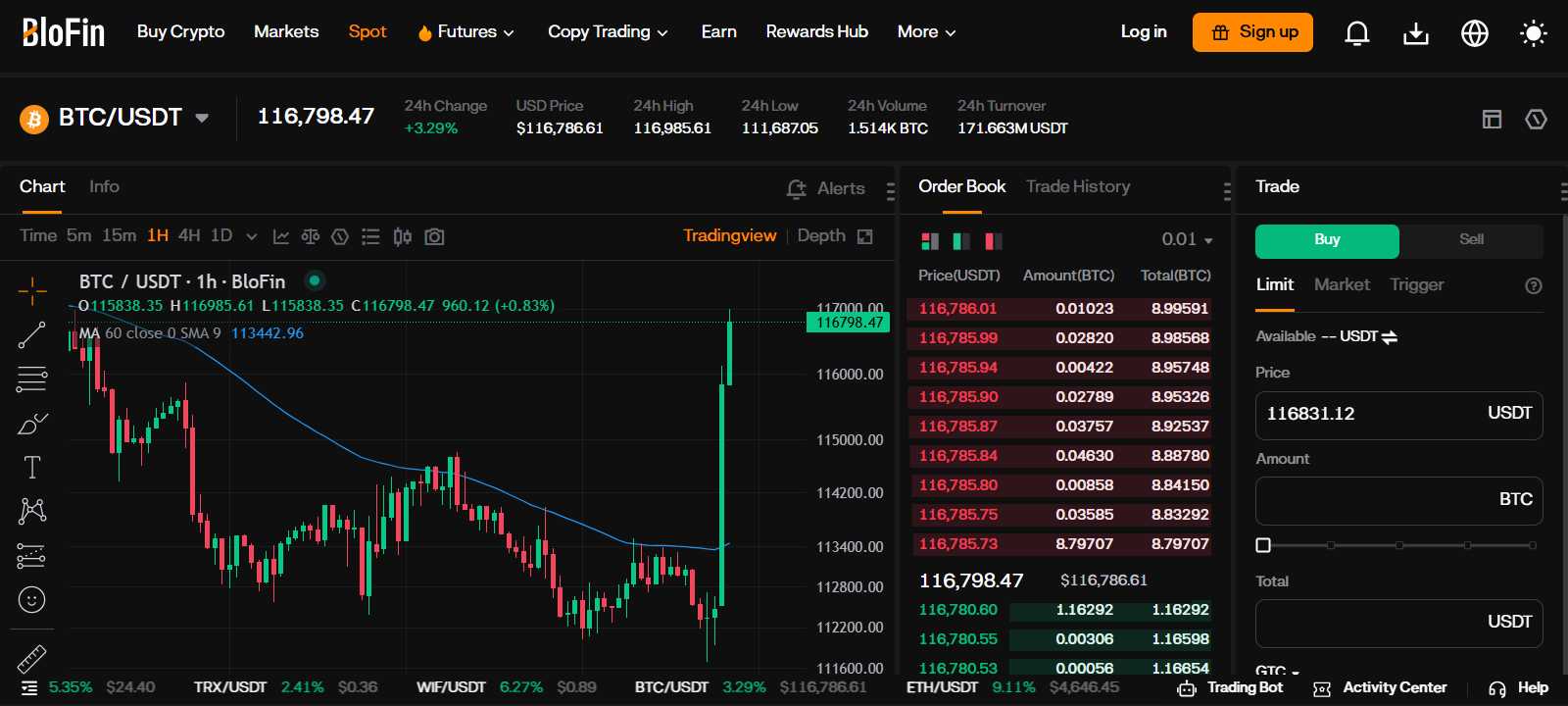
Fees are also reasonable for frequent trades, with 0.02% maker and 0.05% taker fees on futures. Liquidity is moderate rather than top-tier, with an average bid-ask spread of around 0.533% and cumulative daily trading volume close to $2B+ in normal market conditions.
For newer traders, BloFin is easier to approach because KYC is optional and the platform includes demo trading, bots, futures copy trading, and advanced order types. BloFin also supports REST and WebSocket APIs, while still offering native bots and demo trading for users who want simpler automation without building custom scripts.
That makes it useful for testing entries, exits, stop-loss levels, and risk settings before moving into live scalping. It does not offer the deepest liquidity on this list, but it fits traders who want a cleaner, lower-pressure starting point overall.
Read our full BloFin review to learn more about the exchange.
5. WEEX
WEEX is a high-leverage futures exchange for scalpers who want access to more contracts and higher risk exposure. It supports 731 futures contracts, 474 spot assets, and up to 400x leverage, which makes it relevant for high leverage crypto trading and high leverage crypto scalping.
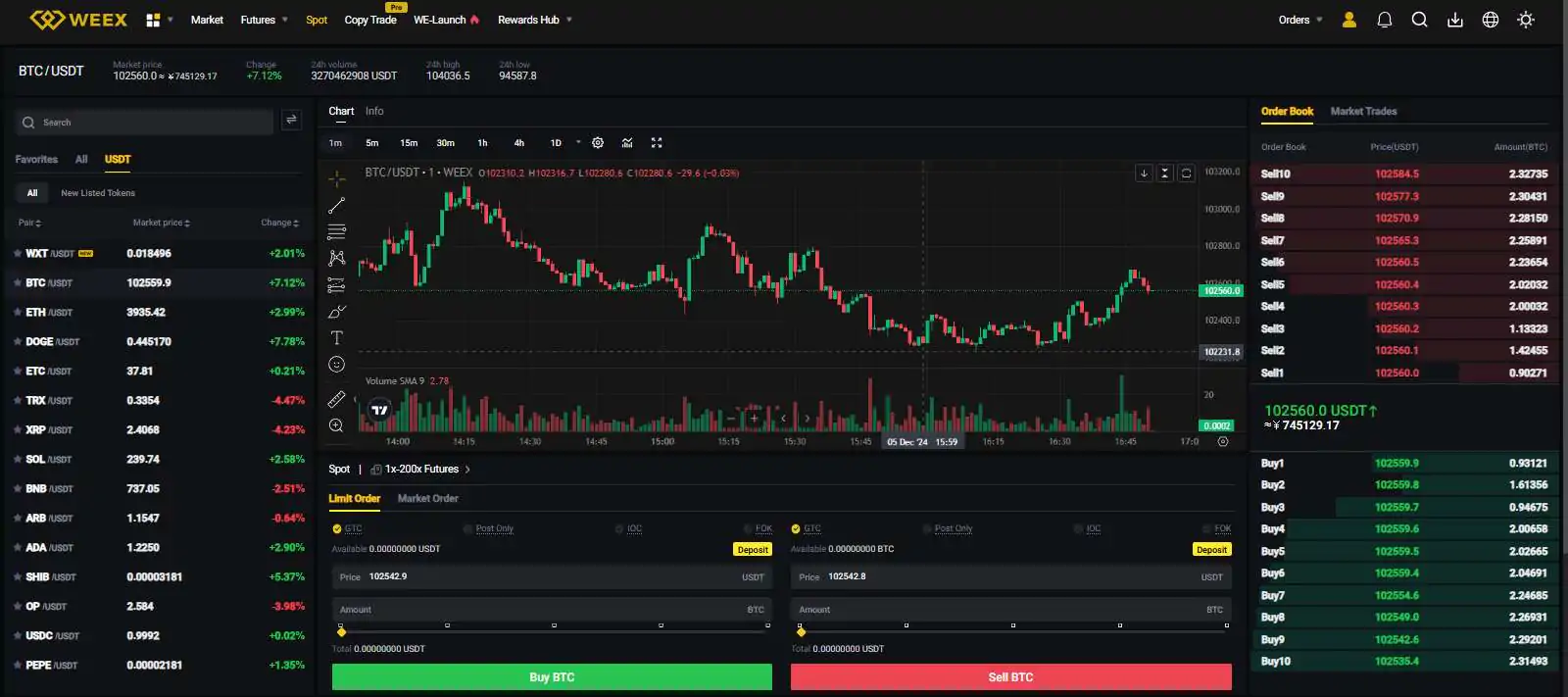
Its futures fees are 0.02% maker and 0.08% taker. That taker fee is higher than some low-fee competitors, so active scalpers still need to factor it into each entry and exit. Liquidity is moderate, with a trust score of 8 and cumulative daily trading volume close to $16B+, mainly driven by retail traders.
WEEX also gives traders access to tokenized stocks, gold, and other RWA products. Its order types are somewhat limited, but the platform still includes an AI trading kit, demo trading, and copy trading for users testing short-term futures strategies. WEEX also offers API access, although its external terminal ecosystem may feel more limited than larger exchanges like Binance, Bybit, and OKX. This makes it better for aggressive scalpers than cautious, fee-sensitive beginners overall.
Read our full WEEX review to learn more about the exchange.
6. OKX
OKX is one of the largest crypto derivatives trading platforms in the world, with average daily trading volume exceeding $28.3 billion. The exchange is best suited to experienced traders looking for advanced tools and deep liquidity.
Crypto scalping on OKX can be done on the derivatives market with up to 125x leverage. The platform supports more than 330 futures contracts, giving traders broad access across major and emerging assets.
Where OKX stands out most is its liquidity. With 0.1% market depth of over $100 million, OKX remains one of the best exchanges for scalpers who need consistent execution on larger orders.
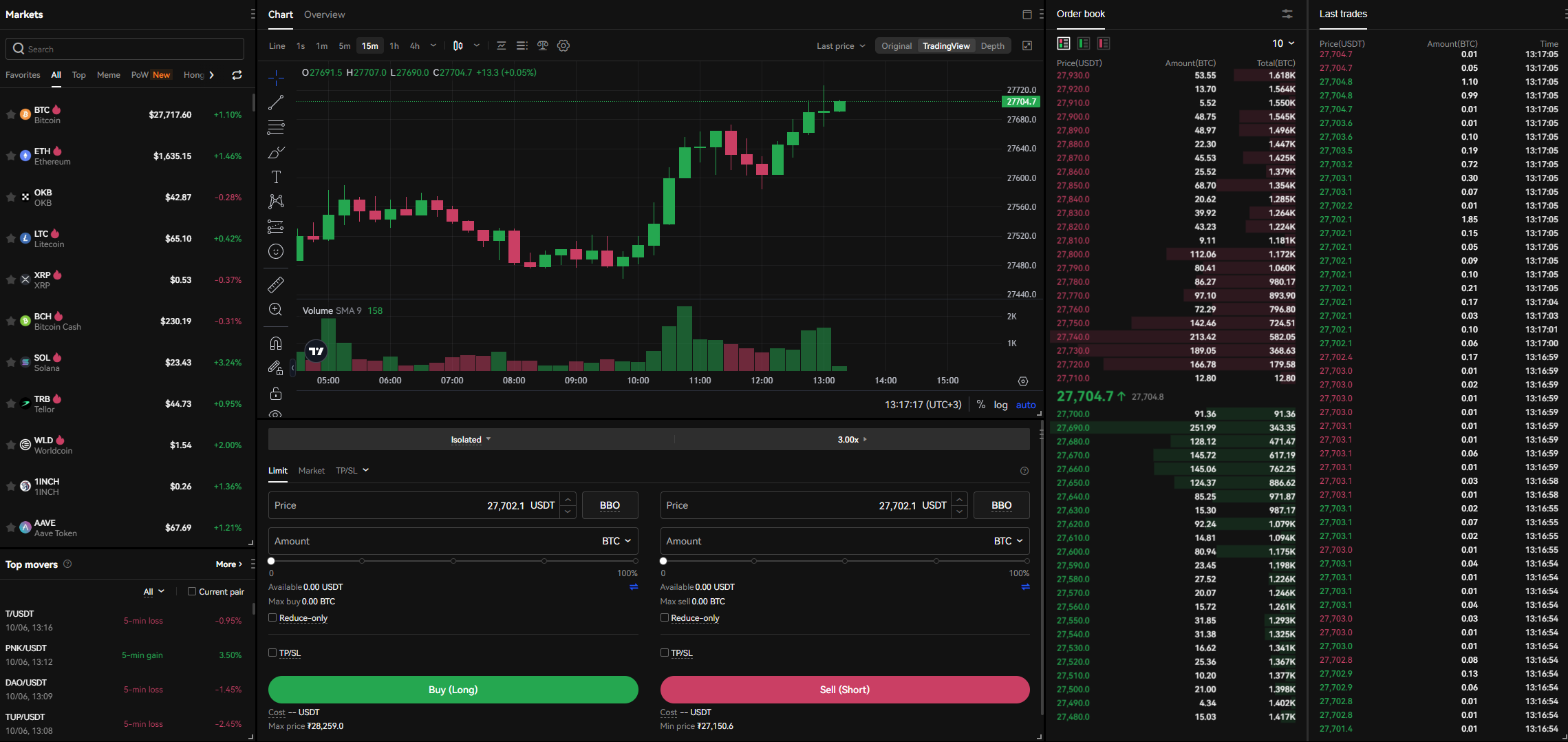
OKX also provides REST and WebSocket API access with structured rate-limit rules, making it suitable for traders using external terminals, bots, or automated scalping setups.
In terms of trading fees, OKX charges 0.02% maker and 0.05% taker fees at the base level. Users can reduce their costs further based on trading volume and by using its native OKB token for fee discounts. The lowest available rates on OKX go as low as -0.005% maker and 0.015% taker, meaning some high-volume makers are effectively paid to place limit orders.
The Bitcoin spread on OKX is around $1, which is slightly higher than some competitors. Even so, this remains a small percentage of the asset’s market price and is still manageable for most scalp traders.
With a well-designed trading interface, strong liquidity, and advanced order tools, OKX remains a solid exchange for executing crypto scalping strategies.
Read our full OKX review to learn more about the exchange.
What is Crypto Scalping?
Crypto scalping is one of the fastest forms of trading, where traders enter and exit positions within minutes or even seconds. The goal is to capitalize on small price movements and short-term market inefficiencies, usually based on technical analysis.
This trading approach requires deep focus and a strong understanding of market structure and short-term price behavior. While scalping can be highly rewarding, it is also one of the riskiest trading strategies in crypto.
You can make money quickly, but losses can build just as fast if the market moves against you. That is why it is important to practice first and understand how fast execution works before trading futures with real funds.
Pros & Cons of Scalping Trading Cryptocurrencies
While making money quickly by scalping the crypto market sounds fantastic, there are also some downsides. Below, we will share the most important pros and cons of cryptocurrency scalping.
Make sure that you are well familiar with all the benefits and risks involved in crypto scalping.
| 👍 Scalping Pros | 👎 Scalping Cons |
|---|---|
| ✅ Most profitable strategy | ❌ Extremely risk |
| ✅ Many daily trading options | ❌ Hardest way of trading |
| ✅ Requires less capital | ❌ Requires most skill and discipline |
| ✅ Fastest way to make money |
Crypto Scalping Fees
If you are wondering which fees you need to account for when scalping cryptocurrencies, the breakdown below covers the main trading costs.
Most crypto scalpers execute trades on the futures market due to better liquidity and lower trading fees compared to spot pairs. Futures markets usually offer tighter execution, which matters more when entering and exiting positions quickly.
Crypto scalpers usually pay the following costs:
- Default trading fee on each transaction (maker/taker fees)
- Spread between bid and ask price
- Slippage when executing large taker orders
- Funding Fee
Trading Fees (Maker/Taker)
The first type of fee crypto scalpers pay is the trading fee. In crypto markets, this is split between maker and taker orders.
Maker orders refer to limit orders. They add liquidity to the order book and help make the market.
Taker orders refer to market orders. They are executed instantly and remove liquidity from the order book by matching existing orders.
Most crypto scalpers usually pay taker fees because they often use market orders to enter and exit trades quickly.
Maker fees usually start at around 0.02% per trade, while taker fees are often closer to 0.06%. However, many exchanges offer lower fees based on your 30-day trading volume or loyalty tier.
Spread
The second type of cost crypto scalpers pay is the spread. This refers to the difference between the bid and ask price. The bid is the highest buy order in the book, while the ask is the lowest sell order.
You can observe the spread by checking the order book on an exchange. For example, if the closest ask on BTC/USDT is $26,740 and the closest bid is $26,739, the spread is $1 per Bitcoin.
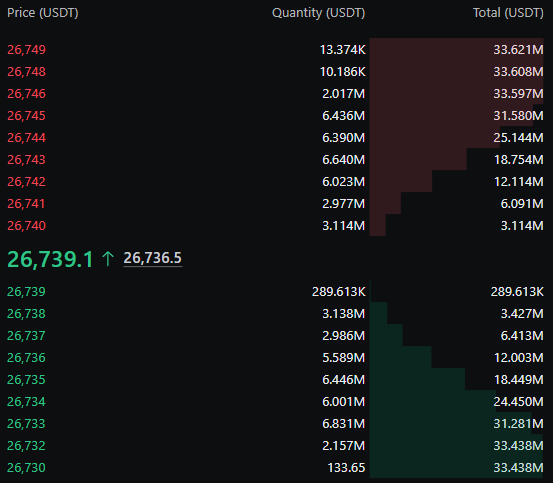
That is a relatively low spread. However, spreads vary by exchange, trading pair, and market conditions, so it is always worth checking before trading. On low-liquidity platforms, spreads can widen significantly and affect your profitability.
Slippage
The third type of cost crypto scalpers pay is slippage.
Slippage refers to the difference between the expected trade price and the actual execution price. It is common in fast-moving markets and can reduce your profitability, especially when placing larger orders.
For example, if you place a $20 million market order and there is not enough liquidity near the best price, your order may fill across multiple price levels. Even if your first fill starts at $26,739.1, later fills may happen at higher prices, increasing your average entry. That price difference is slippage.
Funding Fees
Every 8 hours, crypto futures traders either pay or receive funding fees. However, this mostly matters for longer-held positions rather than scalpers, although it is still something to keep in mind.
Funding fees in crypto perpetual futures are payments exchanged between long and short traders to keep perpetual contract prices aligned with the spot market.
If the funding rate is positive, long positions pay short positions. If it is negative, short positions pay long positions. The rate is usually calculated every 8 hours and depends on the price premium between spot and futures markets.
Funding fees are based on position size. Long-term traders are more affected, while short-term scalpers can often avoid them by closing trades before the next funding interval.
Key Aspects When Looking for a Crypto Scalping Exchange
There are some crucial things to consider before signing up with a crypto exchange for scalping. These factors can directly affect your execution, costs, and overall profitability.
Trading Fees
As crypto scalping strategies often target gains of less than 1%, trading fees are one of the most important factors to consider. If fees are too high, the cost of opening and closing positions can quickly reduce profits over time.
Among crypto scalping exchanges, low-fee futures venues such as Binance, Bybit, OKX, BloFin, and Hyperliquid remain popular because their maker and taker costs stay competitive for frequent traders. Binance and OKX also offer additional fee reductions through volume tiers and native token discounts, which active scalpers often consider.
WEEX has a higher taker fee than some competitors, but it may still appeal to traders looking for high leverage crypto trading and access to a large number of futures contracts. For scalping, the goal is not just low headline fees, but how those fees interact with spread, liquidity, order control, and execution quality.
Liquidity
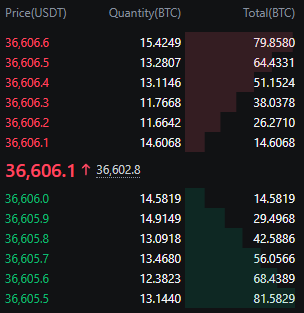
Crypto scalpers often rely on market orders to enter positions quickly, which means they are taking liquidity from the order book. Deep liquidity is important because it helps reduce slippage and ensures smoother trade execution.
In terms of liquidity, OKX stands out as one of the strongest platforms. OKX reports 0.1% market depth of over $100 million, making it well suited for scalpers who need reliable fills.
Platforms like Hyperliquid also provide additional visibility through on-chain data, allowing traders to monitor real-time volumes, funding rates, and market activity more transparently.
Spread
The spread is the difference between the bid and ask prices in the order book. It is an indirect trading cost that many traders overlook. If you are scalping, tighter spreads help protect your margins.
When comparing spreads, deep-liquidity venues such as Binance, Bybit, and OKX tend to remain strong options for scalpers, as tighter spreads can support more efficient entries and exits. On major pairs like BTC perpetuals, spreads can stay very narrow under normal market conditions, though they can widen during volatility or on lower-liquidity contracts.
Volume
You need strong trading volume on an exchange to ensure active markets and more reliable price movement. On lower-volume exchanges, price action can be slower and less efficient, which makes scalping harder.
Binance remains the market leader in trading volume. With daily volume often exceeding $20 billion, Binance continues to offer one of the most active environments for crypto scalpers.

Execution & Order Control
Some platforms also offer extra tools for testing and managing short-term setups. BloFin includes demo trading, bots, futures copy trading, and advanced order types, which can help newer scalpers practice entries and exits before trading live.
WEEX is more limited in order types, but it still offers demo trading, copy trading, and an AI trading kit for users testing short-term futures strategies. These tools do not replace execution quality, but they can help traders manage setups with more structure.
Best Tools for Crypto Scalping Strategies
If you want to scalp crypto more effectively, there are a few tools that can make a real difference. Below are some of the most useful platforms for charting, order flow analysis, and trade tracking.
1. TradingView
TradingView is one of the most widely used charting tools for crypto, stocks, forex, and commodities. It provides real-time market data, technical indicators, drawing tools, and alerts, making it highly useful for short-term traders.
For crypto scalpers, TradingView is especially helpful for monitoring short timeframes, setting alerts, and reacting quickly to price changes.
2. ExoCharts
ExoCharts is a specialized order flow analysis tool built for crypto traders. It provides access to footprint charts, cumulative volume delta, open interest, TPO charts, and other advanced metrics. This type of data can help scalpers understand short-term liquidity shifts and market behavior more clearly.
3. TradingLite
TradingLite focuses on real-time order book data and liquidity heatmaps. It helps traders identify support and resistance zones, liquidity clusters, and possible spoofing activity. For scalpers, this can be useful when timing entries and exits around key levels.
4. CoinMarketMan
A major part of improving as a crypto scalper is tracking your performance over time. CoinMarketMan helps users journal, review, and analyze their trades through automated exchange integrations. This makes it easier to identify mistakes, improve setups, and refine risk management.
Advanced Scalping: API Latency and Bot Integration
Manual trading through a web interface can be too slow for serious scalping strategies. Many advanced scalpers use trading bots, algorithmic scripts, or external terminals to enter and exit positions faster, especially during high-volatility market conditions.
When choosing an exchange for automated scalping, these factors matter most:
- API Latency and Stability: Automated scalping depends on fast and stable REST and WebSocket APIs. Platforms like Binance, OKX, and Bybit are commonly preferred by active traders because they support strong API access, real-time market data, and higher-volume order execution. This helps reduce delays, failed requests, and rate-limit issues during busy trading periods.
- Third-Party Terminal Support: Traders using external platforms such as 3Commas, Coinigy, or Atani should check whether the exchange supports API key integration. Centralized exchanges like Bybit, Binance, and OKX are usually easier to connect with these tools, making them more practical for traders who manage orders outside the exchange interface.
- Built-In Automation vs. Custom Scripts: Some traders prefer writing their own scripts, while others want ready-made automation tools. Hyperliquid can appeal to more technical traders because it supports custom trading through developer tools and SDKs. BloFin and WEEX are better suited to users who prefer built-in automation features, such as futures grid bots, demo trading, and copy trading.
Still, automation does not remove trading risk. A fast API can help with execution, but fees, spreads, slippage, liquidity, and risk controls still decide whether a scalping setup is practical.
Final Thoughts
Each platform in this list serves a slightly different type of scalper. Some are stronger for deep liquidity and larger orders, while others are better suited to newer traders, decentralized trading, or high-leverage futures setups.
At the end of the day, crypto scalping is less about choosing the exchange with the biggest number on paper and more about choosing the one that matches how you actually trade. A platform with deep liquidity may suit larger orders, while a cleaner futures setup may work better for traders still testing their process.
The best approach is to look past leverage alone and compare the full trading environment: fees, spreads, execution quality, order controls, available contracts, and how comfortable you are using the platform under pressure. Scalping leaves very little room for slow decisions, so the exchange should support your strategy instead of making every trade feel harder.
FAQs
1. What is crypto scalping?
Crypto scalping is a short-term trading strategy where traders aim to make small profits from quick price movements, often by entering and exiting positions within minutes.
2. Which type of exchange is best for scalping?
Futures exchanges are often better suited for scalping because they usually offer lower fees, tighter execution, higher leverage, and better liquidity than spot markets.
3. Is scalping crypto legal?
Yes, crypto scalping is legal on most exchanges. However, traders should always check local regulations and make sure the exchange supports users in their region.
4. Do you need high leverage for crypto scalping?
Not necessarily. While leverage can increase potential returns, it also increases risk. Many traders use leverage carefully rather than relying on the highest available amount.
5. Can beginners start with crypto scalping?
Beginners can try scalping, but it is a demanding strategy that requires discipline, fast execution, and strong risk management. It is usually better to practice first before trading with real funds.