


- •Crypto exchanges now offer stocks, gold, forex, commodities, and indices from one account.
- •Kraken offers real U.S. stocks, while most platforms provide synthetic or tokenized exposure.
- •Check ownership, dividends, leverage, fees, trading hours, and liquidity before trading stock-linked products.
Investors today want more than just crypto gains or stock dividends, they want both, ideally on the same platform. In today’s market, ignoring crypto is no longer an option. It’s becoming as essential to understand as traditional finance. And soon, stock investing may feel incomplete without the flexibility and speed offered by crypto-first platforms.
This article explores the best crypto exchanges that supports stocks and gold trading, giving you a clear starting point if you’re looking to manage both assets in one place. We’ve focused on the details that matter: stock availability, trading fees, platform usability, deposit methods, security, and whether you’re earning dividends or other benefits. If you’re ready to trade Tesla and Bitcoin from the same dashboard, this list is your starting point.
Why Choose a Crypto Exchange That Supports Stocks?
A crypto exchange that supports stocks can be useful if you want exposure to different markets without opening several separate accounts. Instead of keeping crypto on one platform, stocks with a broker, and commodities or forex elsewhere, a multi-asset platform lets you manage more of your trading activity from one place.
Key benefits include:
- Access to multiple asset classes from a single account.
- Easier portfolio management without switching between platforms.
- The ability to trade crypto and stock-related products within the same ecosystem.
- Faster funding options for crypto users through stablecoins and digital assets.
However, not all platforms work the same way. Some offer real stocks, while others only provide price exposure through CFDs, tokenized assets, futures, or perpetual contracts. This distinction affects:
- Whether you actually own the underlying shares.
- Eligibility for dividends and shareholder rights.
- Trading fees and funding costs.
- Available trading hours.
- Overall risk exposure.
Can You Earn Dividends on Crypto Exchanges That Offer Stocks?
Yes, you can earn dividends on crypto exchanges that offer stocks, but only if the platform gives you real stock ownership. If you buy real shares through a regulated broker-dealer, eligible dividends may be credited to your account.
If the platform offers stock CFDs, tokenized stocks, perpetual futures, or synthetic contracts, you usually do not own the underlying stock. In that case, you may not receive direct dividends, although some products may reflect dividends through price adjustments, funding rates, or contract rules.
How We Ranked the Top 9 Best Multi-Asset Crypto Exchanges That Support Stocks and Gold Trading
To build this list, we reviewed and tested more than 30 platforms offering access to stocks, forex, commodities, indices, and cryptocurrencies. Our rankings were not based solely on which exchange offered the most markets. Instead, we focused on the overall trading experience.
Key factors included asset availability, liquidity, trading fees, funding options, platform usability, security, and the ease of moving between different asset classes. We also evaluated whether platforms offered real stocks, tokenized stocks, CFDs, or futures, since these products can provide very different experiences.
The result is a tokenized stocks crypto exchange list that prioritizes usability and market access, while also highlighting platforms that can serve as a practical all-in-one solution for traders looking to manage multiple asset classes from a single account.
1. Bybit – Best for Tokenized Stocks and Stock CFDs
Instrument: Tokenized stocks (xStocks) and stock CFDs via MetaTrader 5 (MT5)
Ownership: No traditional share ownership. xStocks provide tokenized exposure; CFDs are synthetic price-tracking contracts
Dividends: No cash dividends. Stock CFDs receive cash-equivalent adjustments; xStocks adjust value via a programmatic token multiplier mechanism
Trading Hours: CFDs run on an extended 24/5 schedule; xStocks trade 24/7 on the spot market
Bybit is mainly known for crypto derivatives and spot trading, but it now offers stock-linked products in two forms: xStock tokens on Bybit Spot and stock CFDs through its TradeFi section, which runs on MetaTrader 5. This makes it one of the more relevant crypto exchanges with stock CFDs, while also giving users access to tokenized stock products from the same platform.
On the tokenized side, Bybit Spot lists 10+ xStock tokens from Backed Finance, including products tied to Apple, Nvidia, Coinbase, Tesla, and other U.S. names. These tokens trade through stablecoin pairs such as USDT or USDC, depending on the market, and give users stock price exposure inside a crypto exchange. Bybit Spot also lists Tether Gold (XAUT), so users can trade tokenized gold alongside crypto and tokenized stock products. Bybit also supports tokenized gold staking through XAUT yield products, adding another option for users who want gold exposure inside the platform.
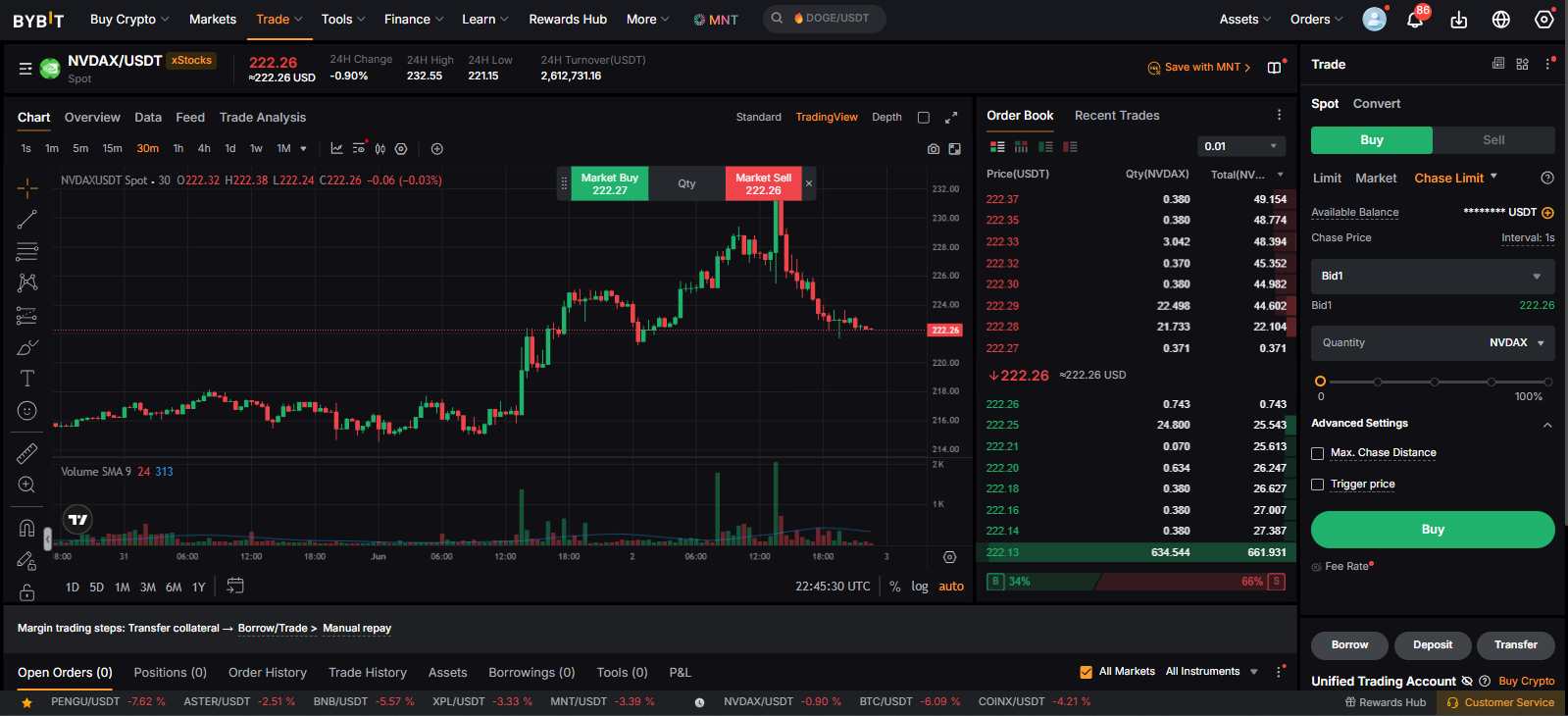
For leveraged stock exposure, Bybit offers U.S. stock CFDs. These synthetic contracts track stock prices, but they do not give users real share ownership or shareholder rights. Bybit separates these CFD markets under its TradeFi section, where users can access 378 stock CFDs, 62 forex pairs, 21 indices, 17 commodities, and more than 7 metals, including gold and silver. U.S. stock CFDs support leverage of up to 5:1, with the maximum lot size capped at 80. Some other CFD markets, including forex, metals, oil, and select indices, support leverage of up to 500:1.
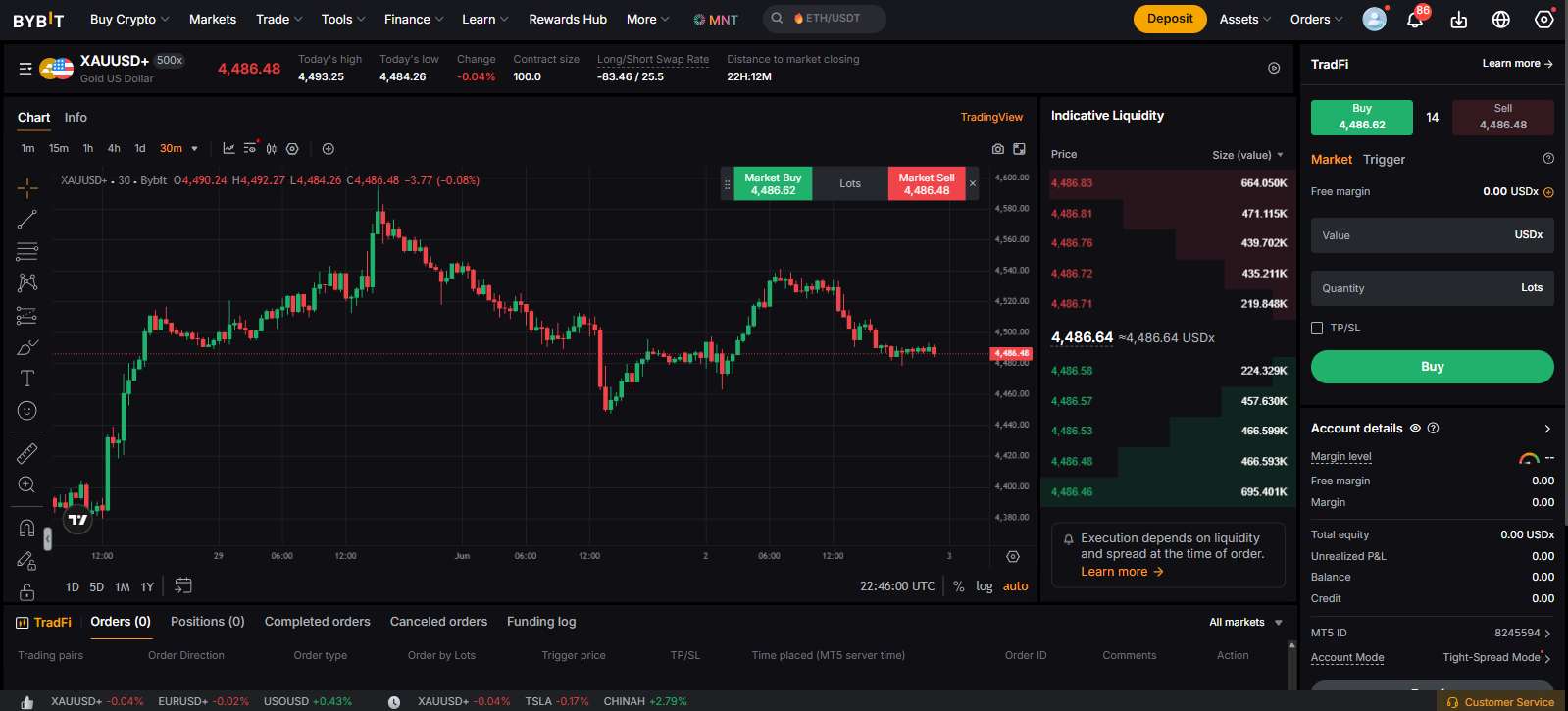
Bybit also fits users who want to trade stock CFDs with crypto because it supports crypto deposits, stablecoin trading pairs, and native fiat ramps, including cards and bank transfers in eligible regions. Trading terms still depend on the product. xStock tokens may offer longer market access than traditional stock sessions, while select stock CFDs follow an extended 24/5 schedule from Monday to Friday. CFD positions may receive positive or negative cash-equivalent dividend adjustments around ex-dividend dates, but these are not direct dividends from owning shares.
Overall, Bybit is best for active traders who want tokenized stocks, stock CFDs, crypto, forex, indices, commodities, and metals from one platform, but not for users who want traditional stock ownership with direct shareholder rights.
Bybit Pros and Cons
| 👍 Bybit Pros | 👎 Bybit Cons |
|---|---|
| ✅ Covers xStock tokens and stock CFDs in one platform | ❌ No traditional share ownership |
| ✅ 378 stock CFDs plus 10+ xStock tokens on Bybit Spot | ❌ No dividends on CFDs |
| ✅ Includes crypto, forex, indices, commodities, and metals | ❌ MT5 platform may feel complex for beginners |
| ✅ Tokenized gold yield options for eligible users | ❌ Product rules vary by instrument |
| ✅ Low minimum fee on U.S. stock CFD orders | ❌ Stock CFDs are not 24/7 |
| ✅ Competitve trading fees on xStock token trades | |
| ✅ Offers up to 5:1 leverage on U.S. stock CFDs | |
| ✅ Fund via USDT, BTC, ETH, cards, ACH or SEPA |
2. Hyperliquid – Best for On-Chain Stock Perps
Instrument: On-chain stock and TradFi perps
Ownership: No real shares; fully synthetic on-chain contracts
Dividends: No payouts; value is factored into index price
Trading Hours: 24/7 continuous trading
Hyperliquid gives users a centralized exchange-style experience while keeping trading fully on-chain. It is a high-performance Layer-1 blockchain with an integrated decentralized exchange for perpetual futures and spot trading, and it is one of the more active perp DEXs by volume and community trust.
For stock-linked markets, Hyperliquid does not offer real shares. It offers on-chain synthetic perpetual futures, so users only trade price exposure. This makes it relevant among decentralized exchanges that support real world asset stocks, especially for traders looking for on chain real world asset stocks without KYC. Users can connect a Hyperliquid-compatible Web3 wallet and start trading. If you are new to the platform, read our Hyperliquid setup guide first.
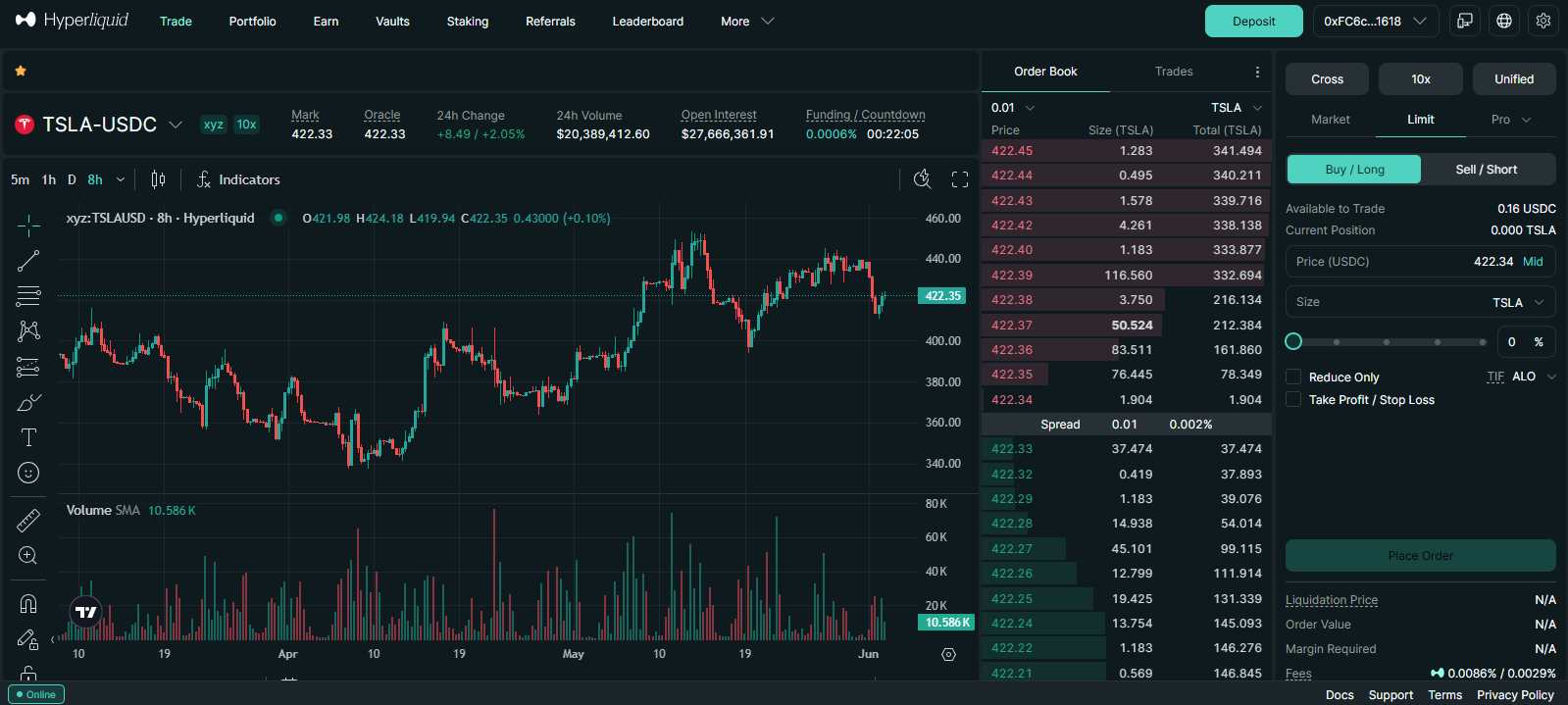
After HIP-3, qualified builders can stake native tokens and launch independent perp markets without centralized approval. The HIP-3 section has 184 perpetual contracts, although many assets repeat across USDT, USDH, and other pairs, so liquidity and spreads can vary.
Hyperliquid also has 120+ USDC-M perpetual contracts in its TradFi section, where liquidity is stronger and spreads are tighter. These include stocks, indices, commodities, gold, silver, copper, and pre-IPO markets such as SpaceX and OpenAI. Its base fee model includes maker rebates and low taker fees, with standard fees around 0.015% maker and 0.045% taker. There are no real shares, no direct dividends, and trading runs 24/7.
Hyperliquid Pros and Cons
| 👍 Hyperliquid Pros | 👎 Hyperliquid Cons |
|---|---|
| ✅ Fully on-chain trading experience | ❌ No real share ownership |
| ✅ No KYC required for wallet trading | ❌ No direct dividend payouts |
| ✅ 24/7 stock perp trading | ❌ Liquidity varies on HIP-3 markets |
| ✅ 120+ USDC-M TradFi perps | ❌ Not beginner-friendly for new wallet users |
| ✅ Includes stocks, metals, and pre-IPO markets | ❌ No spot tokenized stock ownership |
| ✅ Low taker fee at 0.045% | |
| ✅ HIP-3 enables custom perp markets |
3. BTCC – Best for Tokenized Stock Futures
Instrument: Tokenized Equities (xStocks)
Ownership: No real shares; collateralized digital tokens
Dividends: No payouts; reflected in token price appreciation
Trading Hours: 24/7 continuous trading
BTCC is one of the older crypto exchanges on this list, founded in 2011 and used by more than three million users worldwide. It started as a crypto trading platform, but now also offers tokenized stock exposure, metals, forex, indices, commodities, and crypto perpetuals through its spot and futures markets.
For stock exposure, BTCC offers both spot tokenized assets and USDT-M perpetual futures. Its spot market includes 3+ tokenized assets, while the futures market supports 15+ stock contracts tied to major U.S. companies. These products do not give users real share ownership, voting rights, or direct dividend payouts. Instead, they track stock price movements, with dividend effects generally reflected in the token or contract price.
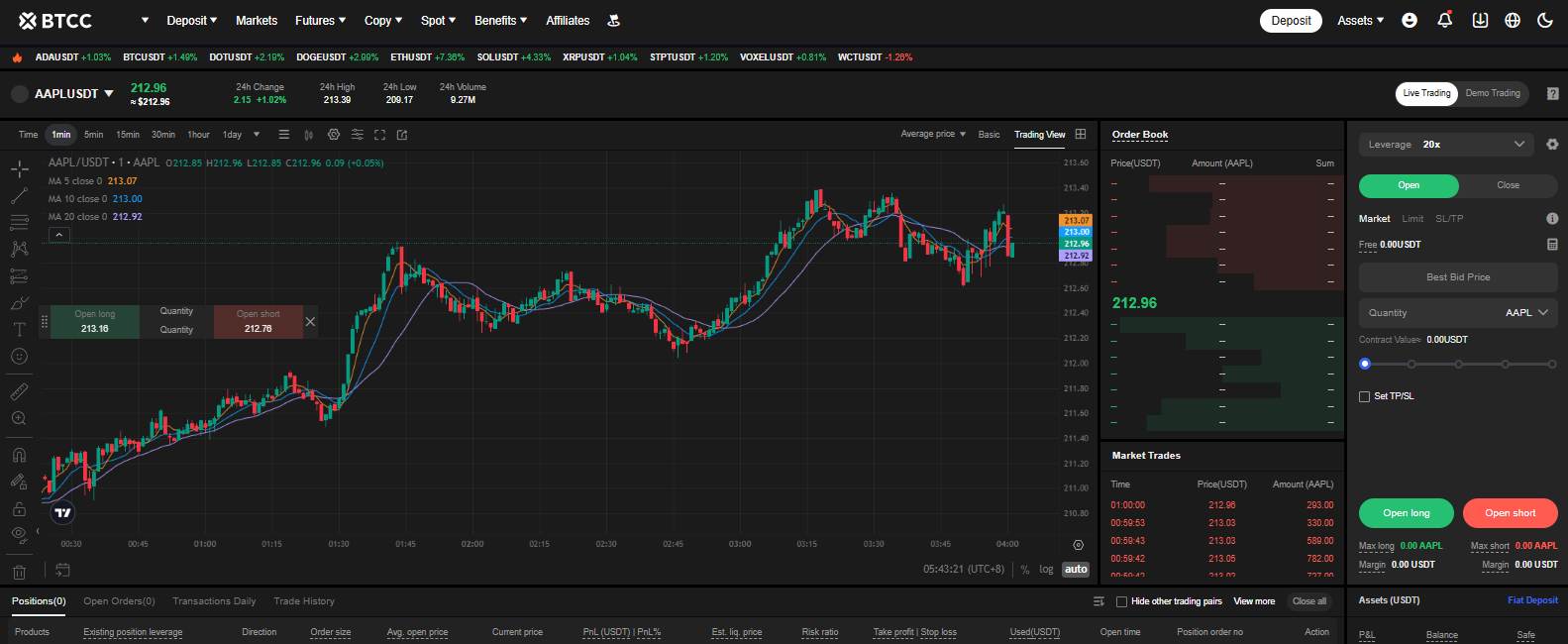
For readers looking at crypto collateralized stock trading, the main point is that BTCC lets users fund their accounts with crypto and trade stock-linked products through the same futures interface used for crypto contracts. Users interested in leverage trading stocks with crypto can access up to 50x leverage on TradFi futures contracts. Beyond stocks, BTCC also supports 5+ metals, including gold, silver, and aluminium, along with 4 forex pairs, 6 indices, and 3 commodities.
Fees follow BTCC’s standard spot and futures structure. Spot trading costs 0.2% maker and 0.3% taker, while futures trading costs 0.03% maker and 0.06% taker. Both spot and futures fees are on the higher side compared with several other crypto exchanges that support stocks and gold trading, especially if you are comparing active trading costs across multi-asset platforms.
BTCC keeps account access flexible with optional KYC. Users can start trading without verification, although completing KYC can raise deposit and withdrawal limits. Its security rating is moderate, and funding options include crypto transfers plus Visa and Mastercard deposits in USD, EUR, KRW, or TWD.
The platform also includes copy trading and demo trading, which helps users follow traders active in TradFi contracts or test the futures interface without using real funds. BTCC is best for traders who want tokenized stock futures, high leverage, crypto-funded access, and simple exposure to stocks, metals, forex, indices, commodities, and crypto from one account. It is not suitable for users looking for real stock ownership or direct dividends.
BTCC Pros and Cons
| 👍 BTCC Pros | 👎 BTCC Cons |
|---|---|
| ✅ 15+ stock futures with up to 50x leverage | ❌ Relatively high trading fees; 0.03%/0.06% |
| ✅ TradFi futures include stocks, metals, forex, indices, and commodities | ❌ No real stock ownership or direct dividend payouts |
| ✅ High leverage (up to 50×) | ❌ Regulatory issues |
| ✅ Copy trading and demo trading available | ❌ Limited stock selection |
| ✅ Optional KYC |
4. Kraken – Best for Real Fractional Stocks
Instrument: Spot Equities (NYSE, NASDAQ, AMEX)
Ownership: Real shares with direct legal ownership
Dividends: Direct cash dividend payouts to account balance
Trading Hours: Traditional stock market hours
Kraken is one of the most established crypto exchanges, with more than 15 million users worldwide. Unlike platforms that only offer stock CFDs, tokenized stocks, or synthetic futures, Kraken gives eligible U.S. users access to real U.S. stocks and ETFs through Kraken Securities.
This makes Kraken a strong option for anyone looking for a crypto exchange with traditional stocks. Users can trade more than 11,000 publicly listed equities across the NYSE, NASDAQ, and AMEX, including fractional shares. These are real shares, not price-tracking contracts, so eligible users get actual ownership and receive dividends when companies issue payouts.
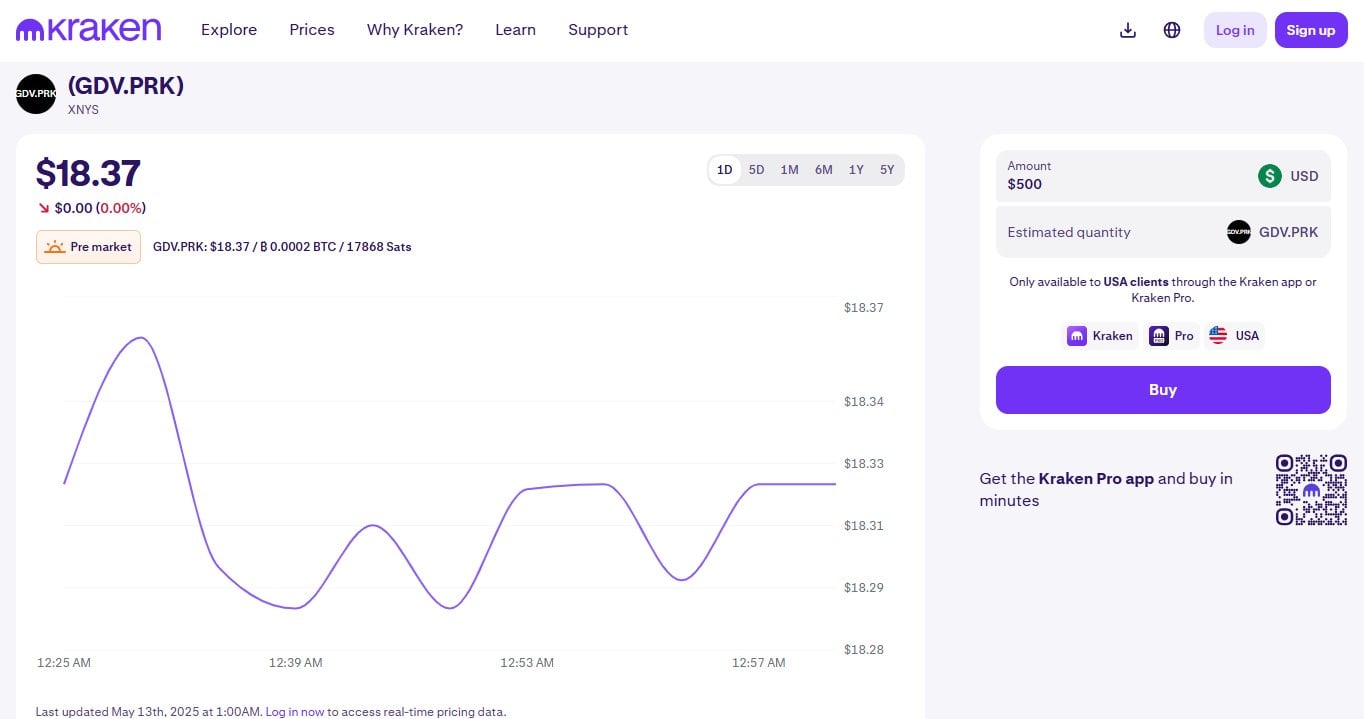
Kraken is also one of the easier platforms for beginners because stock and crypto trading sit inside the same main account experience. Users can manage crypto positions, stock orders, and ETF exposure without moving between a separate broker and crypto exchange. Stock trading is not available 24/7, though, since real equities still follow traditional market hours.
For users asking how to earn passive income with stocks on crypto platforms, Kraken’s main answer is dividends. If an eligible stock or ETF pays a dividend, it can be credited directly to the user’s Kraken account. This is different from CFD or perpetual platforms, where dividend effects are usually adjusted into contract pricing rather than paid directly.
Kraken also fits U.S. users who want crypto, stocks, ETFs, and gold-linked exposure from one platform. Its stock service is limited to eligible U.S. users, while users interested in gold can access supported crypto assets such as tokenized gold products where available.
Fees are simple for stock trading. Kraken offers commission-free stock and ETF trades, although standard regulatory fees may still apply. Funding is also flexible, with support for bank transfers, cards through supported payment partners, crypto deposits, and fiat balances such as USD, EUR, or GBP.
Kraken is best for U.S. users who want real stock ownership, fractional investing, dividend eligibility, and crypto access in one account. It is not the right option for non-U.S. users looking for stock trading or traders who want leveraged stock CFDs.
Kraken Pros and Cons
| 👍 Kraken Pros | 👎 Kraken Cons |
|---|---|
| ✅ Offers 11,000+ real U.S. stocks & ETFs | ❌ Stock trading is only available to U.S. users |
| ✅ Commission-free stock trading | ❌ Reinvest feature limited to manual reinvestment |
| ✅ Dividends paid on eligible stocks, credited automatically | ❌ KYC required |
| ✅ Fully integrated with crypto trading; single dashboard experience | ❌ Not available 24/7 |
| ✅ Beginner-friendly stock and crypto app | ❌ Limited TradFi access outside stocks and ETFs |
| ✅ Supports fractional share investing |
5. Bitget – Best for Copy Trading Equity Derivatives
Instrument: Stock tokens, on-chain assets, perpetual futures, and CFDs
Ownership: No traditional share ownership
Dividends: No direct payouts; effects may be reflected through pricing, funding, or product rules
Trading Hours: 24/7 for spot, perps, and Onchain markets; 24/5 or market-hours based for CFDs
Bitget is mainly known for crypto derivatives, copy trading, and spot markets, but it now gives users several ways to access stock-linked products. Its main TradFi product runs through MetaTrader 5, where users can trade CFDs on stocks, indices, forex, commodities, metals, ETFs, and pre-IPO markets.
The CFD side is built more for active traders than long-term stock investors. Bitget supports 96 stock CFDs, 3 commodities, 6 metals including gold, copper, and silver, plus forex pairs, indices futures, ETFs, and pre-IPO markets. These contracts settle in USD, but only USDT margin is supported, with Bitget automatically converting USDT to USD during trades. Leverage can go up to 100x, and MT5 also supports hedging mode.
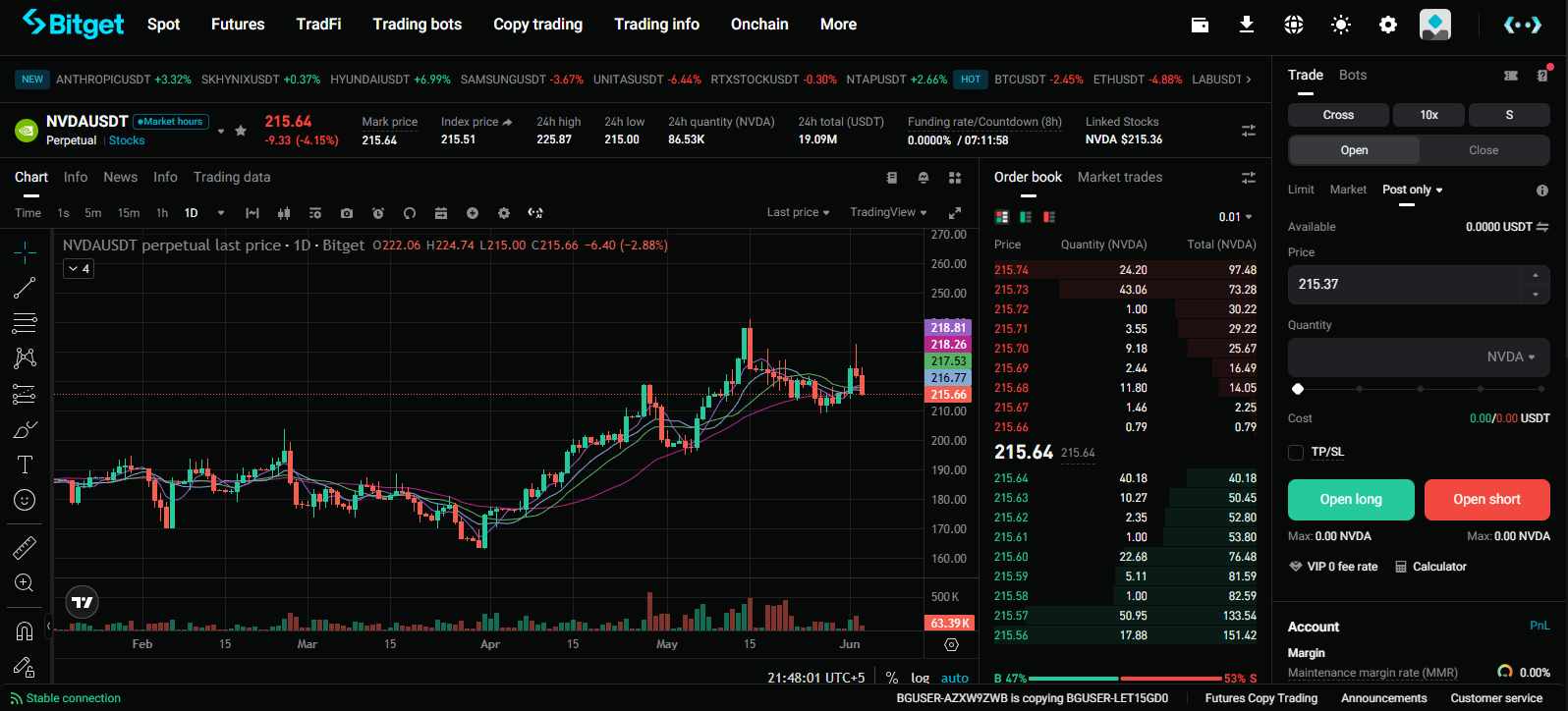
Bitget also gives traders more control over execution. Its TradFi interface includes advanced order types such as Iceberg and Scaled Orders, while the platform shows market hours in a pop-out box next to the asset ticker. This is important because CFD trading follows market hours and is not available 24/7.
Outside MT5, Bitget has an Onchain platform where users can trade stock, forex, commodity, and index-linked pairs across networks such as BNB Chain, Solana, Ethereum, Base, and 3+ more chains. Liquidity can be weaker on some low-volume pairs, so users need to watch slippage and other on-chain trading conditions.
Bitget also lists tokenized stocks and commodities through products such as Ondo Finance assets and rToken products. These trade on spot markets and are available 24/7 with Bitget’s usual 0.1% maker and taker spot fees. For readers searching for the best all-in-one crypto and stock apps or ways to buy US stocks with stablecoins, Bitget is better understood as a platform for stock exposure, not traditional share ownership.
A useful part of Bitget’s setup is that spot, TradFi, and Onchain markets are accessible from the same trading interface. Users can search for the equity or asset they want to trade, then choose from the available spot, TradFi, or Onchain options shown inside the platform.
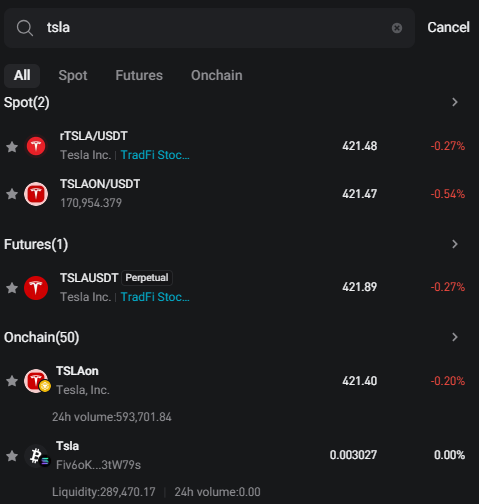
Bitget TradFi is licensed by the Financial Services Commission of Mauritius. The platform is best for traders who want CFDs, tokenized assets, copy trading tools, AI-assisted market updates, and multi-chain stock exposure from one crypto account.
Bitget Pros and Cons
| 👍 Bitget Pros | 👎 Bitget Cons |
|---|---|
| ✅ Multiple stock exposure options across TradFi, Spot, and Onchain | ❌ No traditional share ownership |
| ✅ 96 stock CFDs with up to 100x leverage | ❌ No direct dividend payouts |
| ✅ Supports stocks, ETFs, pre-IPO markets, forex, indices, commodities, and metals | ❌ CFDs follow market hours, not 24/7 |
| ✅ Single trading interface shows Spot, TradFi, and Onchain options | ❌ Slippage risk on low-volume Onchain pairs |
| ✅ Advanced orders like Iceberg and Scaled Orders | ❌ Product rules vary across CFDs, Spot, and Onchain |
| ✅ Supports fractional share investing |
6. Binance – Best for Wrapped TradFi Tracking
Instrument: Synthetic Perpetual Futures
Ownership: No real shares; crypto-margined leverage contracts
Dividends: No payouts; balanced via long/short funding rates
Trading Hours: 24/7 continuous trading
Binance is the largest crypto exchange by trading activity, but among major platforms, it was later to add real world asset markets. Still, because Binance already has a huge futures user base, its RWA perp section is useful for traders comparing the best crypto and stock apps.
Binance currently offers 82 RWA perpetual contracts, all under USDT-M futures. These include stock-linked, commodity-linked, and pre-IPO contracts. They are synthetic perpetual futures, not real shares, so users do not receive ownership rights or direct dividends. Any dividend effect is usually handled through funding, index pricing, or contract rules.
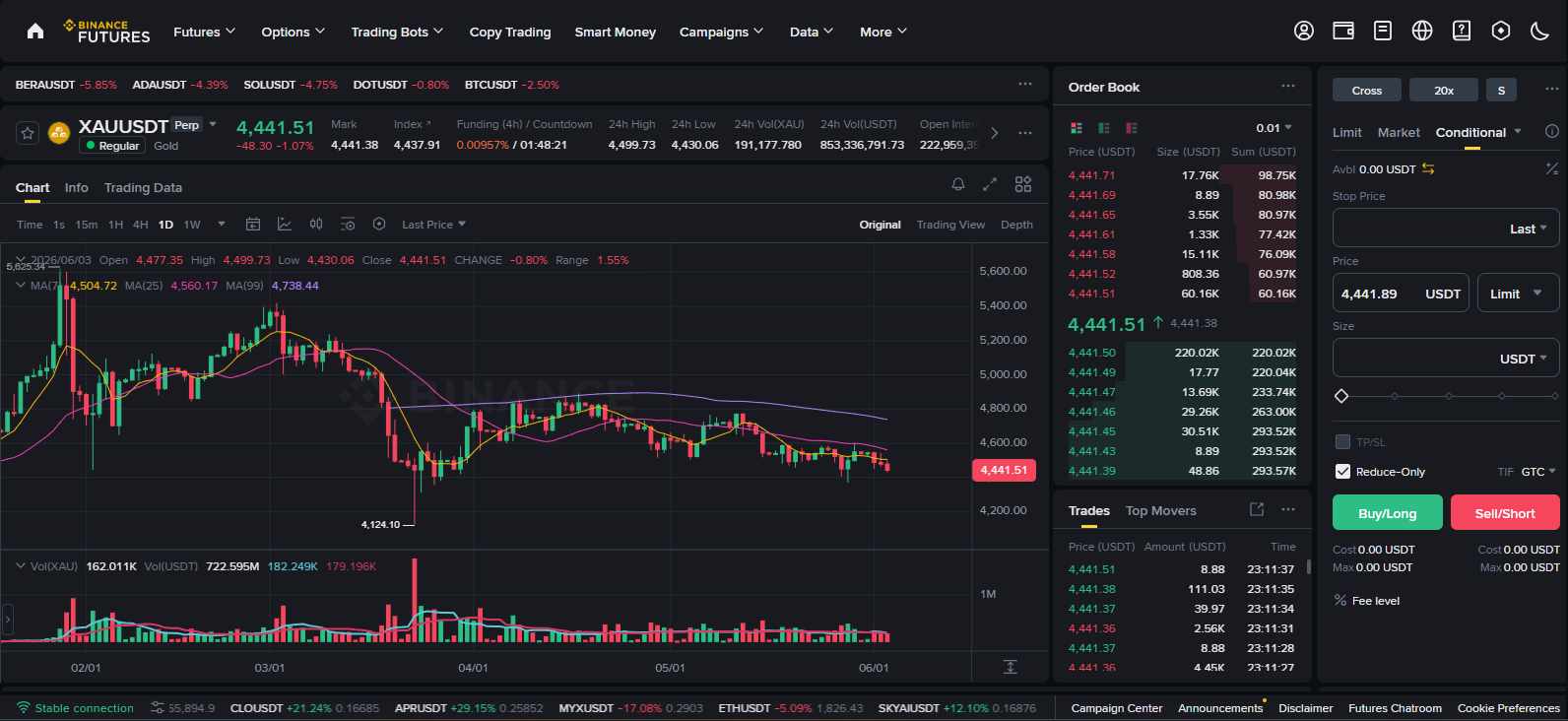
Trading works through the standard Binance Futures interface. This makes the experience familiar for existing futures traders, since RWA contracts use the same order flow as crypto perpetuals. New users can also refer to a Binance futures trading guide to better understand order types, margin settings, and risk management before trading RWA perps. The downside is that all RWA contracts sit inside one TradFi category, so finding a specific stock, metal, commodity, or pre-IPO contract may require going through the full list.
The fee structure is one of Binance’s better points here. TradFi futures currently have 0% maker fees and 0.04% taker fees, making Binance one of the lower-cost options for trading tokenized equities, commodities, and RWA perps through a crypto exchange.
Binance Pros and Cons
| 👍 Binance Pros | 👎 Binance Cons |
|---|---|
| ✅ 82 RWA perpetual contracts available | ❌ No real stock ownership |
| ✅ Includes stock-linked, commodity-linked, and pre-IPO contracts | ❌ No direct dividend payouts |
| ✅ 0% maker fees on TradFi futures | ❌ Limited RWA asset selection |
| ✅ 24/7 synthetic RWA perp trading | ❌ No spot RWA listings |
| ✅ Advanced orders like Iceberg and Scaled Orders | |
| ✅ Supports fractional share investing |
7. Bitunix – Best for Crypto-Collateralized Stocks
Instrument: USDT-settled stock futures
Ownership: No real shares
Dividends: No direct payouts or dividend adjustments
Trading Hours: Stock futures follow NYSE-linked trading hours
Bitunix is a newer crypto exchange with a beginner-friendly interface and moderate liquidity. Its stock exposure is built around USDT-settled futures, making it useful for traders who want to trade stocks with USDT without moving funds to a traditional broker.
Bitunix now offers 45 U.S. stock futures products linked to stock price movements, along with 4 commodity futures contracts, including gold and silver markets. These products are not real shares, so users do not receive ownership rights, voting rights, direct dividends, or shareholder benefits. Stock futures follow NYSE-linked trading hours, with reduce-only periods outside the main session, while some commodity perpetuals may trade continuously.
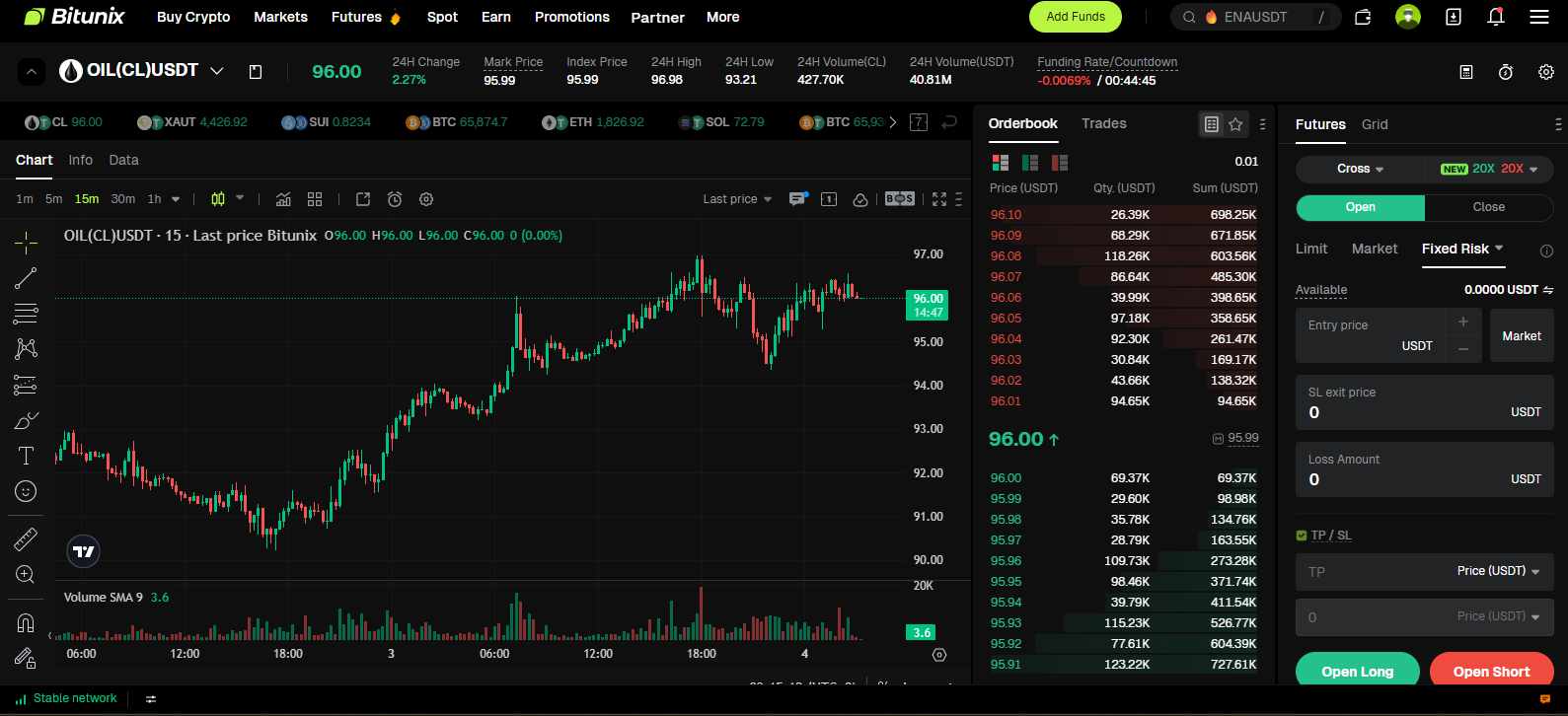
Fees are simple across TradFi futures, with 0.02% maker and 0.06% taker fees. Bitunix also keeps KYC optional, although verification may still be required for higher limits or certain account features. On spot, its real-world asset selection is limited, with tokenized gold available but no full tokenized stock lineup.
Bitunix is best for users who want USDT-settled stock futures, gold and silver exposure, and a simple interface. It is less suitable for users who need deep liquidity, real stock ownership, or direct dividend payouts.
Bitunix Pros and Cons
| 👍 Bitunix Pros | 👎 Bitunix Cons |
|---|---|
| ✅ 45 U.S. stock futures available | ❌ No real stock ownership |
| ✅ Supports 4 commodity futures contracts | ❌ No direct dividend payouts |
| ✅ Trade stocks with USDT collateral | ❌ Stock futures follow NYSE-linked hours |
| ✅ Leverage available up to 200x | ❌ Spot RWA selection is limited |
| ✅ Optional KYC for basic access | |
| ✅ Beginner-friendly trading interface |
8. BingX – Best for Spot Tokenized Equities
Instrument: TradFi Perpetual Futures contracts
Ownership: No real shares; USDT-margined synthetic assets.
Dividends: No payouts; handled via 8-hour funding rates.
Trading Hours: 24/7 trading
BingX offers both spot tokenized assets and USDT-M perpetual futures for users who want stock and commodity exposure inside a crypto exchange. On spot, it lists 34 tokenized stocks from Ondo Finance and xStocks, along with 3 tokenized commodities. These spot markets are available 24/7, with normal BingX spot fees of 0.1% maker and 0.1% taker.
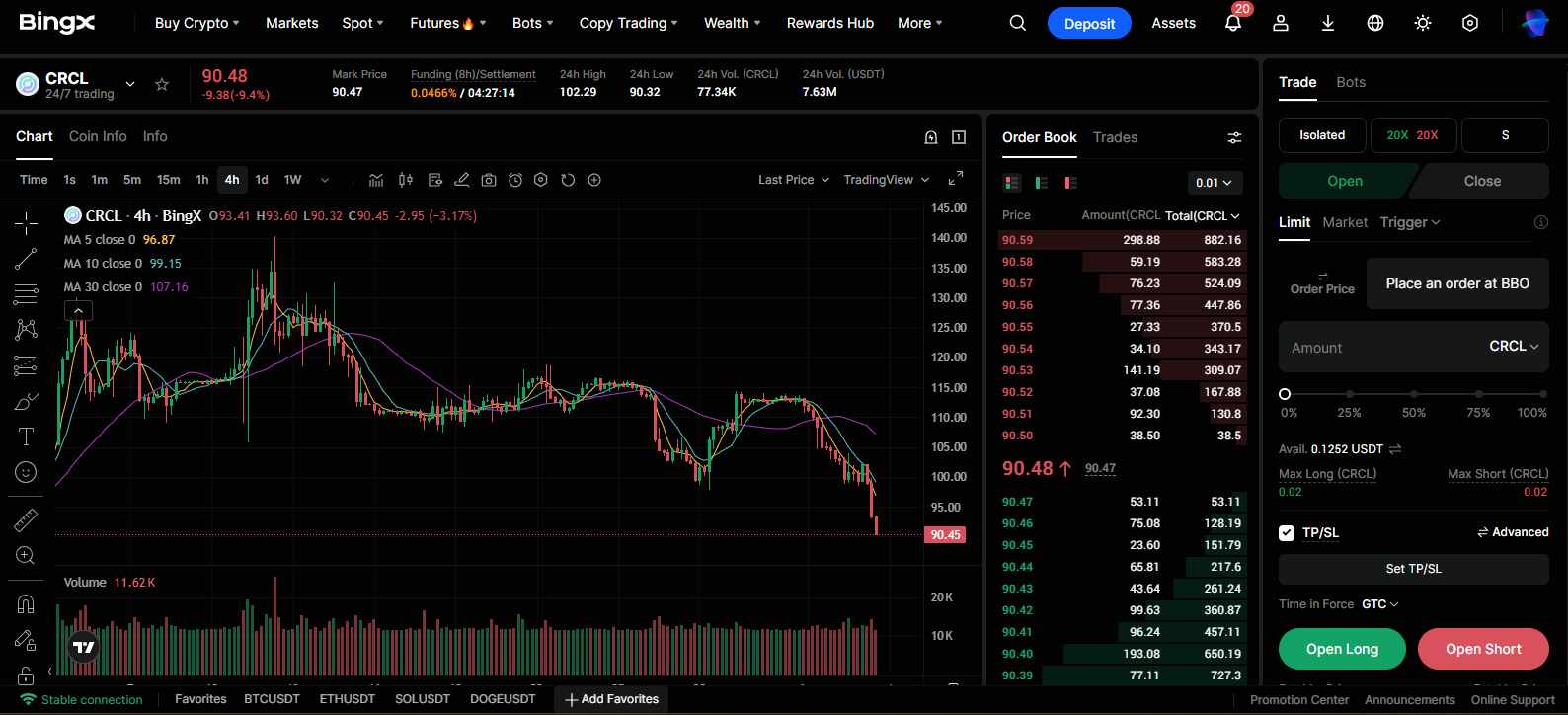
Its futures market is wider, with 81 stock perpetual contracts, 16 stock indices, 28 forex pairs, 26 commodities including gold, silver, and Brent oil, plus pre-IPO contracts. These are synthetic margin products, not real shares, so dividends are not paid directly and are usually reflected through funding or contract pricing. Since they are USDT-M perpetual contracts, trading is available 24/7 rather than being limited to weekday CFD sessions.
Leverage is one of BingX’s more aggressive features. Tokenized gold futures support up to 1000x leverage, while other TradFi futures contracts support up to 100x. This may appeal to high-risk traders, but it also makes position sizing and liquidation control much more important.
BingX also offers zero-fee stock and gold futures trading, while its AI tools provide asset-specific market insights for active traders.
BingX Pros and Cons
| 👍 BingX Pros | 👎 BingX Cons |
|---|---|
| ✅ 81 stock perpetual contracts | ❌ No real stock ownership |
| ✅ Pre-IPO contracts available | ❌ No direct dividend payouts |
| ✅ Zero-fee stock and gold futures trading | |
| ✅ AI-assisted market insights | |
| ✅ 24/7 trading | |
| ✅ Up to 1000x leverage on tokenized gold futures |
9. BloFin – Best for High-Volume Stock Indices
Instrument: Spot tokenized stocks and USDT-M RWA perps
Ownership: No real shares. Users trade tokenized or synthetic exposure
Dividends: No direct dividend payouts
Trading Hours: Limited outside regular market hours
BloFin is a crypto derivatives exchange launched in 2019 with moderate liquidity and a growing real-world asset section. It fits users comparing crypto margin trading platforms with traditional stock indices, especially if they want stock index, equity, and gold exposure through USDT-margined products.
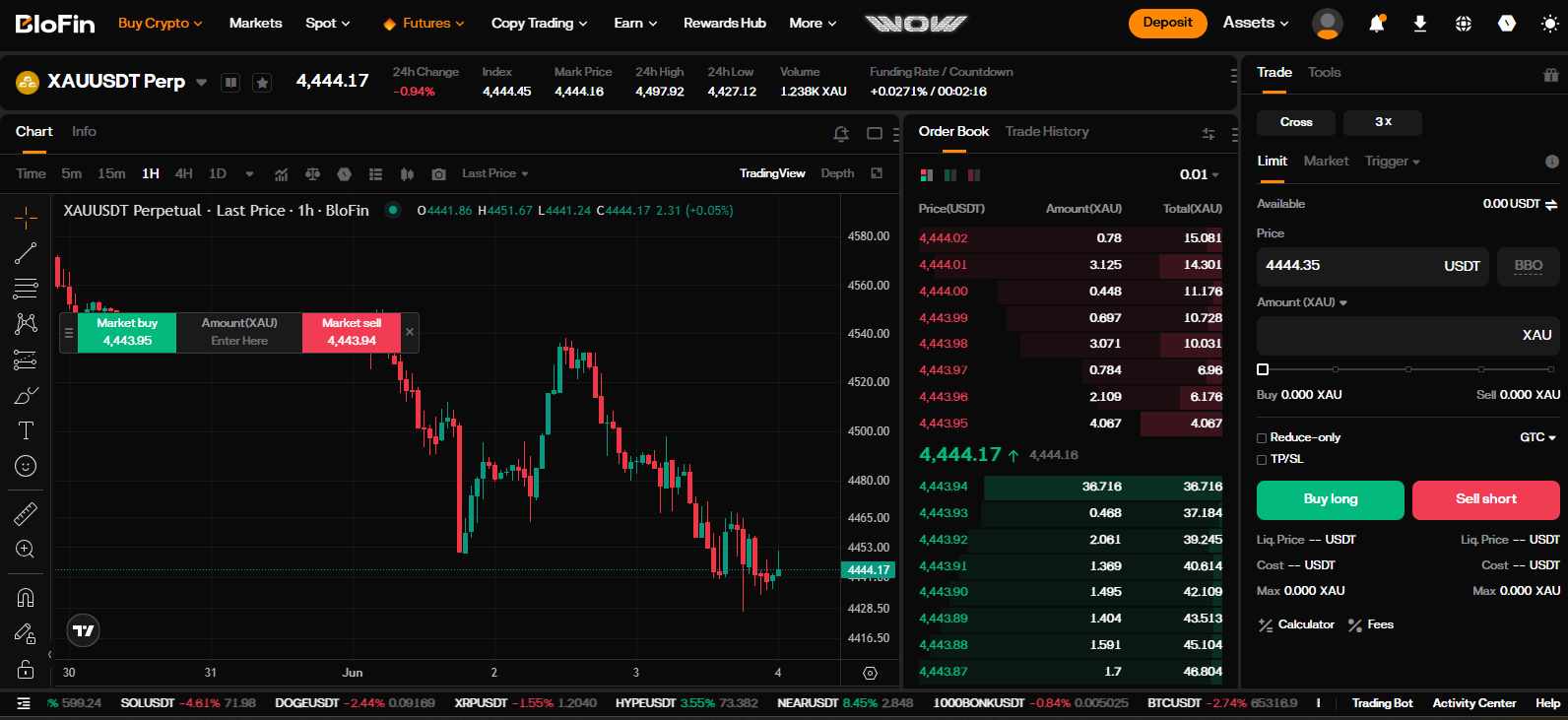
On spot, BloFin offers 10 xStock tokenized stocks and tokenized gold, with standard spot fees of 0.1% maker and 0.1% taker. This gives users access to tokenized stocks on crypto exchanges without buying real shares.
For futures, BloFin supports 43 RWA USDT-M perpetual contracts, with up to 20x leverage on most RWA contracts and up to 100x leverage on tokenized gold. Futures fees are 0.02% maker and 0.05% taker. Trading traditional equities using stablecoin margins is possible here, but market hours can be limited. Outside regular market hours, some orders may be restricted to reduce-only.
BloFin Pros and Cons
| 👍 BloFin Pros | 👎 BloFin Cons |
|---|---|
| ✅ 10 tokenized stocks on spot | ❌ No real stock ownership |
| ✅ 43 RWA USDT-M perpetual contracts | ❌ No direct dividend payouts |
| ✅ Supports stablecoin-margined equity exposure | ❌ Trading hours can be limited |
What is a Tokenized Stock on a Crypto Exchange?
A tokenized stock on a crypto exchange is a crypto-based product that tracks the price of a real stock, such as Apple, Tesla, Nvidia, or Coinbase. In most cases, you do not own the actual share. You are only trading exposure to the stock’s price.
Different exchanges handle this in different ways. Kraken offers real U.S. stocks for eligible U.S. users, so users can own shares and receive eligible dividends. Other platforms use stock CFDs, tokenized assets, stock futures, or equity perpetual contracts instead.
So, what are equity perps? Equity perps are perpetual futures contracts that track the price of a stock, index, commodity, or pre-IPO market. They do not expire, and traders can hold them as long as they have enough margin.
Most stock-linked crypto products are cash-settled. This means you do not receive the actual stock, voting rights, or shareholder benefits. You only gain or lose based on the price movement of the product.
The benefit is flexibility. Some platforms let users trade with crypto collateral such as USDT, USDC, BTC, or ETH. They may also support leverage, long and short positions, and trading outside normal stock market hours. The risk is that prices, fees, liquidity, dividends, and trading hours depend on the platform and product type.
Can I Buy US Stocks Using Crypto Directly?
Yes, you can buy US stock exposure using crypto on some multi-asset crypto exchanges. However, what you get depends on the platform. Some exchanges offer real fractional shares, while others offer tokenized stocks, CFDs, stock futures, or equity perps.
If the platform supports stablecoin funding, you may be able to use USDT or USDC to trade stock-linked products. But this does not always mean you own real shares. Always check whether the platform offers actual stock ownership or only price exposure.
Do I Get Voting Rights With Tokenized Stocks?
No, you usually do not get voting rights with tokenized stocks on crypto exchanges. Tokenized stocks are generally designed to track the price of a real stock, not give you full shareholder rights.
This means you may not receive voting rights, proxy access, shareholder notices, or other corporate benefits. If you want real ownership rights, you need a platform that offers actual shares through a regulated broker, such as Kraken for eligible U.S. users.
Is Buying Tokenized Stocks on Crypto Apps Legal?
Buying tokenized stocks on crypto apps depends on your country, the exchange, and the product structure. Some platforms offer real stocks through regulated broker-dealers, while others offer CFDs, tokenized assets, or synthetic futures.
Regulated stock services are usually limited by region. For example, real stock trading may only be available to eligible users in supported countries. Offshore platforms that offer stock CFDs or synthetic products often restrict users from regions such as the U.S. or EEA because of local rules. Always check your local regulations and the platform’s country restrictions before trading.
What to Expect from Crypto Exchanges That Offer Stocks and Gold
Crypto exchanges that offer stocks and gold do not all work the same way. Some platforms give users real stock ownership, while others only offer price exposure through tokenized stocks, CFDs, stock futures, or equity perps. This means the product may track Apple, Tesla, gold, or an index, but you may not actually own the underlying asset.
The same applies to gold. Some exchanges list tokenized gold products like XAUT on spot markets, while others offer gold through futures, CFDs, or commodity contracts. A few platforms also offer tokenized gold staking or yield products, where eligible users can earn returns on supported gold-backed assets. However, these products depend on the exchange, region, and campaign rules, so users should always check the terms before depositing.
Trading hours can also differ. Spot tokenized assets and perpetual contracts may trade 24/7, while CFDs or stock-linked futures may follow market hours or switch to reduce-only mode outside regular sessions.
The main point is simple: before trading stocks or gold on a crypto exchange, check ownership, fees, leverage, trading hours, dividend treatment, liquidity, and whether the product is spot-based, synthetic, or margin-based.
How to Trade Stocks with Crypto?
If you want to know how to buy stocks with crypto, the first thing to understand is that most crypto exchanges do not sell traditional shares directly. They usually offer tokenized stocks, stock CFDs, stock futures, or equity perps. The exact process changes by exchange, but the basic flow is similar.
1. Choose a Platform That Supports Stock Markets
Start by choosing a crypto exchange that offers the type of stock exposure you want. Some platforms offer real shares, while others offer tokenized stocks, CFDs, futures, or perpetual contracts. This matters because ownership, dividends, leverage, fees, and trading hours can change based on the product.
2. Create an Account and Check KYC Rules
Sign up for the exchange and check whether identity verification is required. Some platforms allow basic trading without KYC, while others require full verification before you can trade stocks, CFDs, or tokenized assets. Regulated stock services usually have stricter rules.
3. Deposit Crypto or Fiat
Most platforms let you deposit crypto such as USDT, USDC, BTC, or ETH. Some also support cards, bank transfers, or local payment methods. If the stock product is settled in stablecoins, you may need USDT before placing a trade.
4. Find the Stock or TradFi Market
Go to the platform’s stock, TradFi, RWA, futures, or spot section. Search for the asset you want to trade, such as Apple, Tesla, Nvidia, gold, or an index. For example, if you are wondering how to use USDT balance to buy Apple shares, search for Apple first, then choose the available product, such as a real share, xStock token, CFD, stock future, or equity perp.
5. Place the Trade
Choose your order type, such as market or limit. If the product supports margin or leverage, set it carefully before confirming the trade. You can usually go long if you expect the stock-linked product to rise, or short if you expect it to fall.
6. Monitor Fees, Funding, and Trading Hours
After entering a trade, keep an eye on margin, liquidation price, funding rates, spreads, and order status. Also check trading hours. Some stock-linked crypto products trade 24/7, while others follow weekday market hours or switch to reduce-only mode outside regular sessions.
Final Thoughts
The exchanges we’ve covered aren’t just about convenience, they actually make investing feel a whole lot more doable. If you’re trading crypto, buying stocks, or just exploring your options, having everything in one place saves time and stress. It’s especially helpful if you live somewhere with limited access to traditional trading apps. Crypto Exchanges that support stock and gold trading offer the flexibility, access, and simplicity many modern investors are looking for. If you want a smoother way to invest, these all-in-one platforms are worth considering.
FAQs
1. Which regulated platforms support both crypto and traditional stock trading?
Platforms like Kraken (via Kraken Securities) are fully regulated multi-asset networks. They partner with SEC-compliant and FINRA-registered broker-dealers to offer legitimate equities and ETFs, while maintaining separate money service business (MSB) frameworks for their cryptocurrency operations.
2. Can I earn dividends from stock investments on crypto exchanges?
You can only collect dividend payouts if you purchase real custodial stocks on platforms like Kraken. On these exchanges, eligible corporate dividend yields are automatically credited directly to your unified cash balance. However, if you trade synthetic stock contracts or tokenized futures on Bybit or BTCC, you are trading price derivatives, meaning you do not own the underlying company shares and will not receive dividends or voting rights.
3. What is the core difference between synthetic tokenized stocks and real equities?
Synthetic or tokenized stocks are derivative instruments (such as CFDs or perpetual futures) that shadow the real-time market spot price of a stock without granting actual asset ownership. Real stocks, conversely, represent direct, fractionally clearable equity ownership maintained within an institutional banking custodian, granting you regulatory legal protections and corporate actions.
4. What’s the difference between synthetic stocks and real stocks?
Synthetic or tokenized stocks, like the ones offered on BTCC, are derivatives. They mirror the price of real stocks but don’t grant ownership, voting rights, or dividends. You’re essentially betting on price movements, much like futures or CFDs.
Real stocks, offered by Kraken, are actual shares purchased through a regulated broker. You own a piece of the company, and you’re eligible for dividends, corporate actions, and even shareholder perks where applicable.
5. Can I buy fractional shares of stocks using stablecoins?
Yes. Modern multi-asset crypto networks allow users to purchase fractional portions of high-priced blue-chip equities like Amazon, Nvidia, or Microsoft for as little as $1. Depending on the exchange architecture, these fractional assets are bought either as real custodial fractions or via synthetic stablecoin-margined price tracking contracts.
6. What should I know about order timing when buying stocks on crypto exchanges?
Order timing depends on the instrument offered by the exchange. Real stocks usually follow regular market hours, while tokenized stocks, CFDs, futures, or equity perps may follow different schedules.
If you place an order outside supported trading hours, the exchange may queue it, reject it, or switch the contract to reduce-only mode. Most platforms show a pop-up, market-hours label, or order notice before you confirm the trade.
Limit orders can help control execution price, especially when liquidity is lower outside normal market hours.
8. Is trading stock futures the same as owning real US stocks?
No, trading stock futures is not the same as owning real US stocks. Stock futures only track price movement, while real shares give you ownership. With stock futures, you do not get voting rights, shareholder benefits, or direct dividends. You are trading a contract, not buying the company’s stock.