


- •Decentralized platforms offer greater control over personal assets, eliminating the need for intermediaries.
- •Users retain full ownership and custody of their funds, enhancing security and reducing risk of third-party breaches.
- •Transparent and trustless environments are created, allowing traders to execute orders without relying on centralized authority.
- •Perpetual DEXs offer more flexible and diverse trading options, making them a popular choice among active traders.
Decentralized trading with features similar to centralized exchanges was something many crypto traders felt was missing in their journey. While centralized exchanges are efficient, the idea of them controlling your funds, coupled with incidents like market crashes where you couldn’t buy or sell coins, raised significant concerns. Perpetual DEXs put control back in the hands of users. Though there are a few drawbacks, they offer a simple and cost-effective way to start your decentralized trading journey. In this guide, we’ll explore the top 9 Perpetual DEX platforms available today, comparing them head-to-head to help you choose the one that best suits your needs.
Top 9 Perpetual DEX
After conducting thorough research and based on personal use, we decided to rank all the Perpetual DEXs based on security, supported chains, fees, and the products and services they offer. Based on this, the following is our list of the Top 9 Perpetual DEXs:
- Hyperliquid – Best for High-Performance Trading
- Aster – Best for High-Leverage Trading
- Lighter – Best for Zero-Fee, High-Leverage Trading
- dYdX – Best for Asset Variety
- edgeX – Best for CLOB Perp Trading
- Extended – Best for Starknet Perps
- Grvt – Best for Yield While Trading
- ApeX Protocol – Best All-in-One Perp Platform
- Ostium – Best for RWA Trading
1. Hyperliquid
Hyperliquid is a decentralized exchange (DEX) built for high-performance trading with a focus on reliability, speed, and capital efficiency. It consistently ranks among the largest perpetual futures exchanges by daily trading volume and offers up to 40x leverage across 365+ perpetual markets and 288+ spot assets. Unlike many decentralized trading platforms, Hyperliquid operates on its own purpose-built Layer 1 blockchain, allowing it to deliver fast execution, low latency, and a traditional order book trading experience without gas fees.
While Hyperliquid started as a crypto-focused exchange, it has expanded beyond digital assets through community-driven spot and perpetual listings. On spot, users can trade RWA-linked markets such as stocks, indices, commodities, and forex pairs. On the futures side, Hyperliquid also supports perpetual contracts tied to stocks, indices, commodities, forex, and pre-IPO assets. These markets are typically paired with stablecoins such as USDC, USDT, and USDH, giving traders exposure to traditional financial assets directly from a decentralized trading platform.
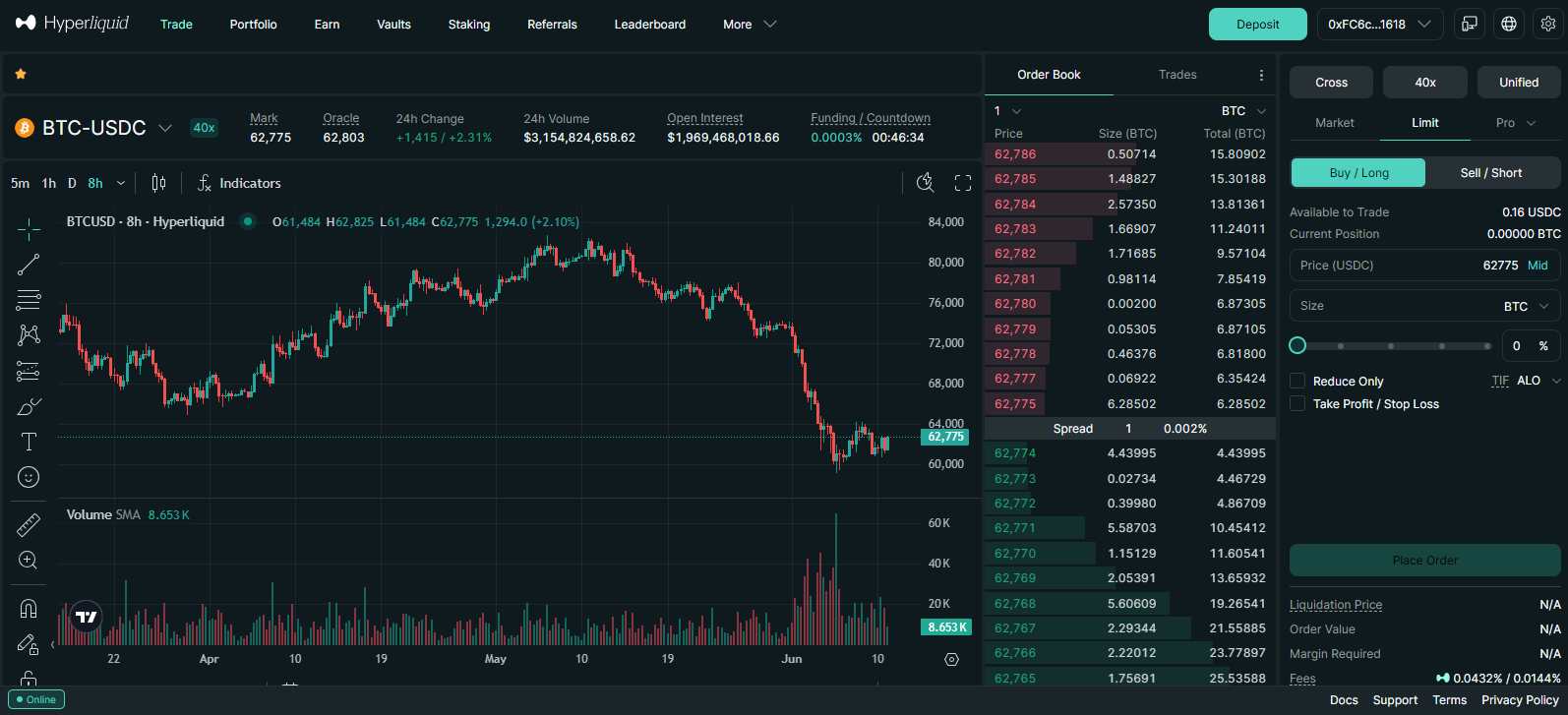
A major reason for this expansion is Hyperliquid’s HIP-3 initiative. HIP-3 introduced a permissionless framework that allows anyone to deploy and operate perpetual futures markets on the exchange. This decentralized listing process has enabled independent teams and market creators to launch perpetual contracts tied to both crypto and real-world assets while raising liquidity and participation around their markets.
Beyond trading, Hyperliquid offers several ways for users to earn passive returns on idle capital. The platform supports HYPE staking, vault strategies that allow users to allocate capital to experienced traders, and a growing ecosystem of stablecoin yield opportunities. Users can also participate in copy trading through vaults, making it possible to gain exposure to different trading strategies without actively managing positions.
Hyperliquid also introduced HIP-4 prediction markets, allowing traders to speculate on off-chain events. These markets use unified margin with spot and perps, native validator-based settlement, and zero fees when opening or minting positions. Fees apply only on closing or settlement.
The platform utilizes the $HYPE native token, which can be acquired directly on Hyperliquid or through major centralized exchanges like Bitget. Hyperliquid also undergoes regular security reviews and maintains a fully on-chain architecture that prioritizes transparency. Built to support up to 100,000 orders per second, the exchange combines the speed of centralized platforms with the self-custody benefits of decentralized finance.
With a 24-hour derivatives trading volume of $18.26B+ and one of the most active on-chain trading ecosystems, Hyperliquid has established itself as more than just a crypto perpetuals exchange, evolving into a broader decentralized marketplace for both digital and traditional financial assets.
Check out our in-depth Hyperliquid review.
Hyperliquid Pros and Cons
| 👍 Hyperliquid Pros | 👎 Hyperliquid Cons |
|---|---|
| ✅ High liquidity | ❌ No real share ownership |
| ✅ Low slippage | ❌ HIP-3 markets can vary in liquidity |
| ✅ Fully decentralized | ❌ Some markets may have higher volatility |
| ✅ HIP-3 permissionless perp listings | |
| ✅ HIP-4 prediction markets | |
| ✅ Stocks and RWA markets supported | |
| ✅ HYPE fee discounts | |
| ✅ Stablecoin yield options |
2. Aster
Aster is a fast-growing decentralized exchange focused on high-leverage derivatives, multi-asset exposure, and fast on-chain execution. It supports 462+ perpetual markets and 44 spot assets, with access to crypto, forex, stocks, commodities, indices, and other real-world asset markets. However, stocks, commodities like crude oil and gold, indices, and other RWA markets are currently available through perpetual contracts only.
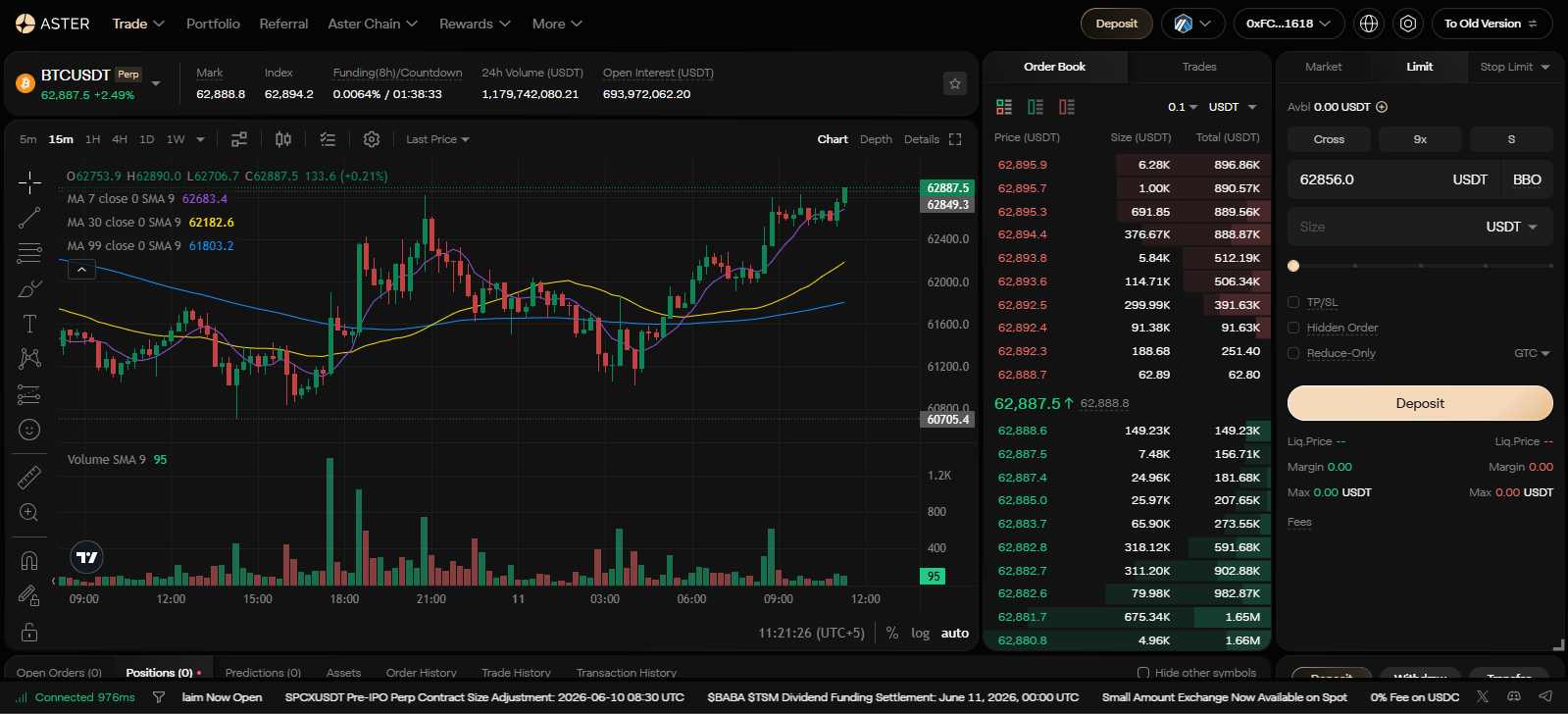
The exchange has recorded more than $2.09B in 24-hour trading volume and offers up to 1001x leverage on BTC and ETH through its dedicated high-risk mode. Aster also includes a newly launched prediction market, although it is still limited and currently only supports Bitcoin future price contracts.
Aster offers two main trading modes. Simple Mode is built for one-click execution with a streamlined, MEV-resistant trading flow. Pro Mode is designed for more advanced users, offering institutional-grade tools, hidden orders, advanced order types, and 24/7 stock perpetuals. The platform also supports grid trading with 80+ pre-built bots and has a fully functional Android mobile app.
Aster is built on Aster Chain, a purpose-built Layer 1 blockchain engineered for derivatives trading. The chain uses PoSA consensus and is designed for 50ms block times, up to 100,000 TPS, and zero gas fees. While liquidity is still developing compared to market leaders, Aster stands out for traders looking for aggressive leverage, automation tools, RWA perpetuals, and fast no-gas execution in a single DEX.
Check out our in-depth Aster review.
Aster Pros and Cons
| 👍 Aster Pros | 👎 Aster Cons |
|---|---|
| ✅ Up to 1001x leverage | ❌ Limited spot market selection |
| ✅ 462+ perpetual markets | ❌ Prediction market still early-stage |
| ✅ Stocks, commodities, and index perps | ❌ No spot stocks or commodities |
| ✅ MEV-resistant Simple Mode | |
| ✅ Pro Mode with hidden orders | |
| ✅ Zero-gas trading | |
| ✅ 80+ automated grid trading bots |
3. Lighter
Lighter is an Ethereum L2 perpetual DEX built around provable execution rather than raw speed alone. Instead of only offering self-custody, it uses zero-knowledge proofs to verify that orders, cancellations, and liquidations are processed correctly. This makes execution behavior auditable, not assumed.

Lighter now supports 185 perpetual contracts and 7 spot assets, with up to 50x leverage and USDC-based settlement. Its market coverage has also expanded beyond crypto, with perpetual contracts for U.S. stocks, ETFs, indices, forex, commodities, and selected Korean stocks such as Hyundai, Samsung, and SK Hynix Inc. Spot trading is still more limited, but the platform now offers more than the earlier ETH/USDC-only setup.
The platform has also improved funding access by allowing users to deposit through debit or credit cards, or transfer funds from centralized exchanges. Retail users trade with zero fees under the standard tier, while professional traders can opt into a premium tier for faster execution and lower latency. Built on Ethereum infrastructure, Lighter prioritizes security, composability, and transparent mechanics over aggressive leverage.
Read our full Lighter review for a closer look.
Lighter Pros and Cons
| 👍 Lighter Pros | 👎 Lighter Cons |
|---|---|
| ✅ Zero-knowledge verified execution | ❌ Only 7 spot assets supported |
| ✅ Zero-fee trading for retail users | ❌ Smaller ecosystem |
| ✅ 185 perpetual contracts | |
| ✅ Stocks, ETFs, forex, and commodities | |
| ✅ Korean stock perpetuals available | |
| ✅ Debit and credit card deposits | |
| ✅ Premium low-latency trading tier |
4. dYdX
dYdX is a well-established decentralized exchange focused mainly on perpetual futures trading. It supports 110+ perpetual contracts with up to 50x leverage and has recorded more than $138.9M in 24-hour derivatives trading volume. The platform also offers limited exposure to stocks, indices, and forex through perpetual contracts, although this side of the market is still smaller compared to newer multi-asset perp DEXs.
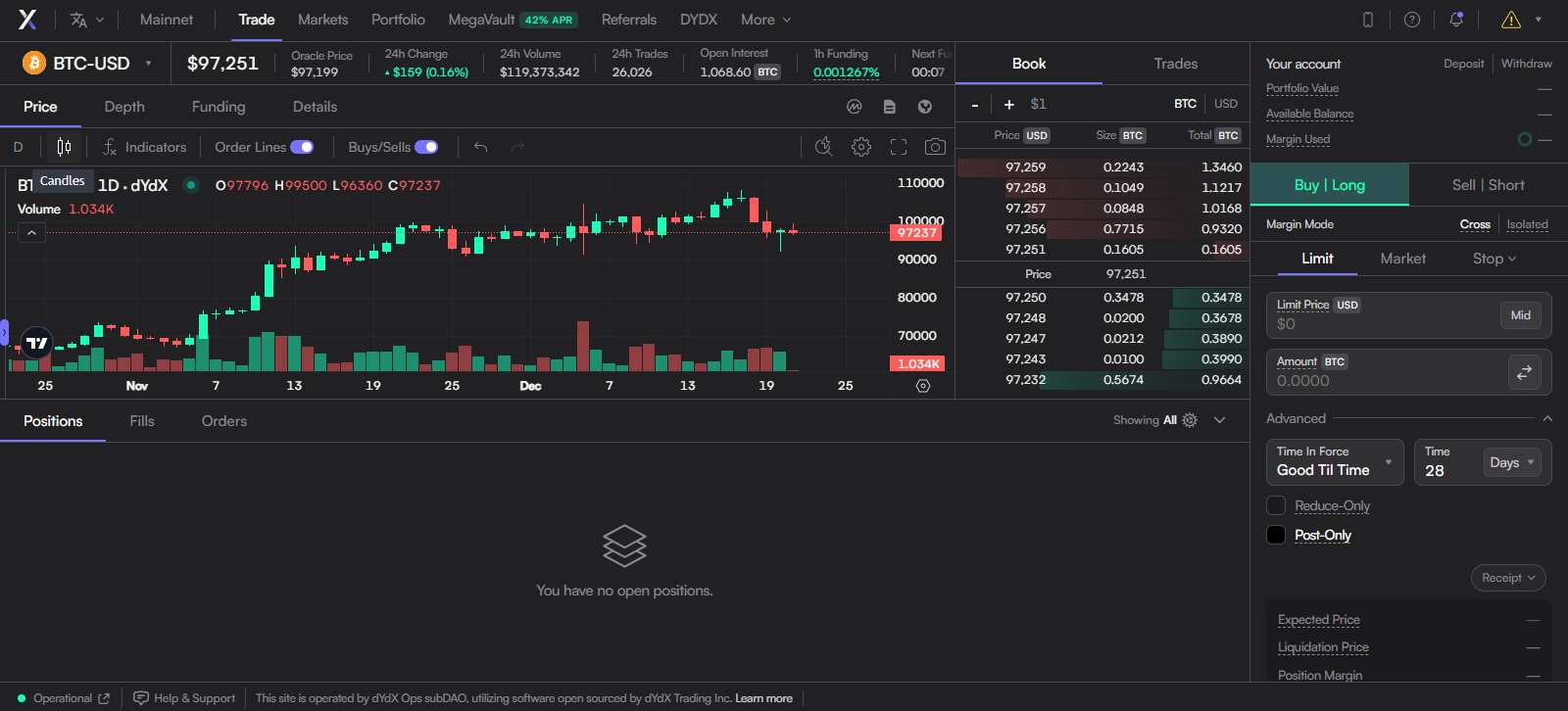
While dYdX was previously known only for futures, it now also supports 50+ spot assets through Solana on-chain tokens that can be traded directly on the platform. This gives users a small spot trading layer alongside its main derivatives market, but dYdX is still best understood as a futures-first exchange.
One of its newer features is Launchable Markets, which allows users to launch a new perpetual market by depositing $10,000 into the MegaVault. The MegaVault also remains one of dYdX’s main yield features, giving users access to automated liquidity strategies with high APR potential.
dYdX also has a long operating history, strong security infrastructure, advanced order types, and its own $DYDX token, which can be earned through trading rewards or bought on centralized exchanges like Binance. Compared to Hyperliquid, Aster, and Lighter, dYdX has fewer newer market features, but it remains a reliable choice for traders who want a proven decentralized futures platform.
For a closer look at fees and features, read our full dYdX review.
dYdX Pros and Cons
| 👍 dYdX Pros | 👎 dYdX Cons |
|---|---|
| ✅ Deep futures liquidity | ❌ Limited stock and RWA markets |
| ✅ Launchable Markets feature | ❌ Lower volume than top perp DEXs |
| ✅ Advanced order types | |
| ✅ Proven track record |
5. edgeX
edgeX is a decentralized perpetual exchange built for traders who want centralized exchange-style execution without giving up self-custody. The platform combines an order book trading experience with on-chain settlement, allowing users to access fast execution while maintaining transparency and control over their assets.
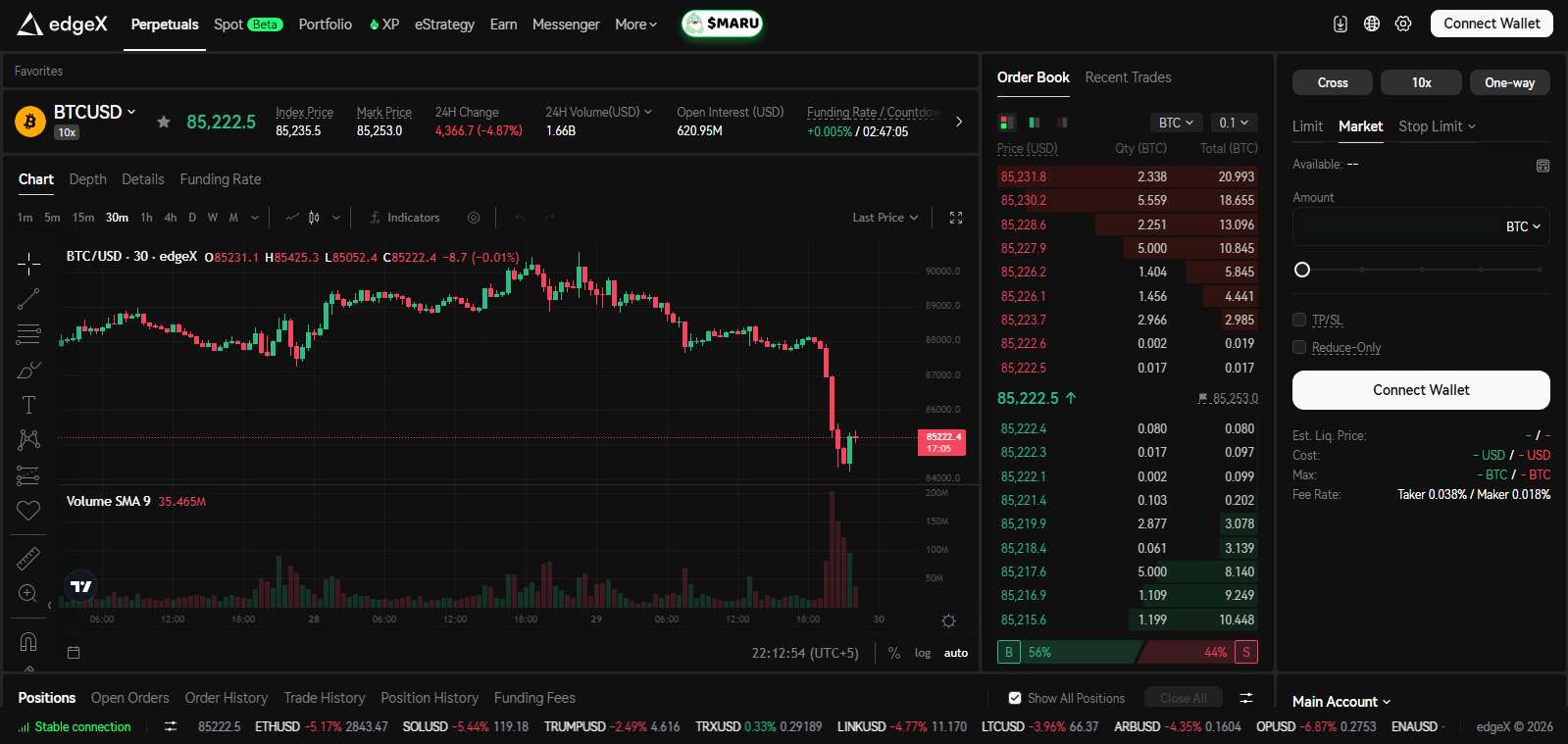
The exchange currently supports 76+ perpetual contracts with up to 100x leverage through its Perp V2 platform, which runs on the native EDGE Chain and is designed for near-instant execution and low latency trading. In addition to perpetuals, edgeX offers 4+ spot assets and has expanded into real-world asset markets, including stocks, ETFs, indices, commodities, and pre-IPO contracts.
Trading fees remain competitive, starting at 0.018% for makers and 0.038% for takers on perpetual markets. Liquidity is supported by professional market makers, including Amber Group, helping maintain tighter spreads and better execution for larger orders.
edgeX also offers yield opportunities through its vault system, where users can deposit stablecoins and earn returns generated from trading activity. The platform is available on both iOS and Android, with mobile apps that closely mirror the functionality of the desktop experience.
For traders who prioritize execution quality, high leverage, tokenized real-world asset exposure, and a professional order book environment, edgeX provides a strong alternative to larger perpetual DEXs.
Explore the full edgeX platform review.
edgeX Pros and Cons
| 👍 edgeX Pros | 👎 edgeX Cons |
|---|---|
| ✅ Stocks, ETFs, and pre-IPO markets | ❌ Smaller ecosystem than top perp DEXs |
| ✅ Native EDGE Chain execution | ❌ Limited asset selection overall |
| ✅ Vault-based yield products | |
| ✅ Mobile app for iOS and Android |
6. Extended
Extended is a decentralized perpetual exchange built on Starknet, designed for traders who prioritize speed, fee clarity, and self-custody. The platform focuses entirely on perpetual trading and avoids unnecessary complexity, keeping the experience close to what active traders expect from centralized platforms.
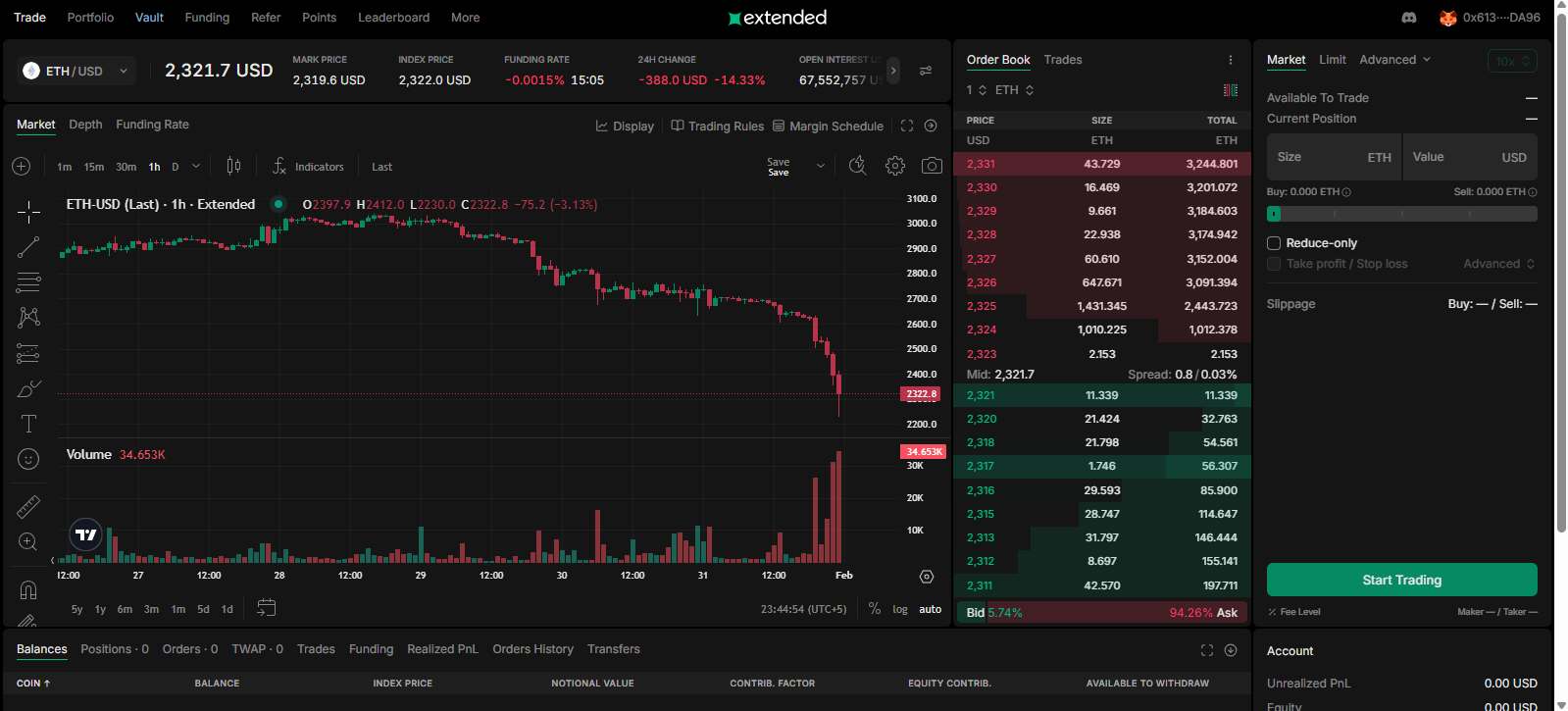
Extended offers access to more than 108+ perpetual markets across crypto assets, FX pairs, commodities, and indices with upto 100x leverage. Maker fees are set at 0.00%, while taker fees are fixed at 0.025%, which keeps costs predictable regardless of trade size or market conditions. Trading is gas-free for users, with execution handled off-chain and settlement verified on Starknet.
The interface includes TradingView charts, advanced order types, and a vault system that allows users to earn yield while using vault shares as trading margin. While there is no dedicated mobile app, the platform is optimized for desktop trading and suits users who prefer a focused perp-only setup without distractions.
Read the Extended review for key details.
Extended Pros and Cons
| 👍 Extended Pros | 👎 Extended Cons |
|---|---|
| ✅ Zero maker fees across all perpetual contracts | ❌ No spot trading |
| ✅ Gas-free trading | ❌ No dedicated mobile app |
| ✅ Stocks, FX, commodities, and indices | |
| ✅ Vault shares usable as margin |
7. Grvt
Grvt is a hybrid perpetual DEX built on zkSync that combines centralized exchange-style execution with non-custodial trading. Users can access the platform through a Web3 wallet or email-based login, making it more flexible than wallet-only DEXs while still keeping the trading setup focused on self-custody and on-chain settlement.
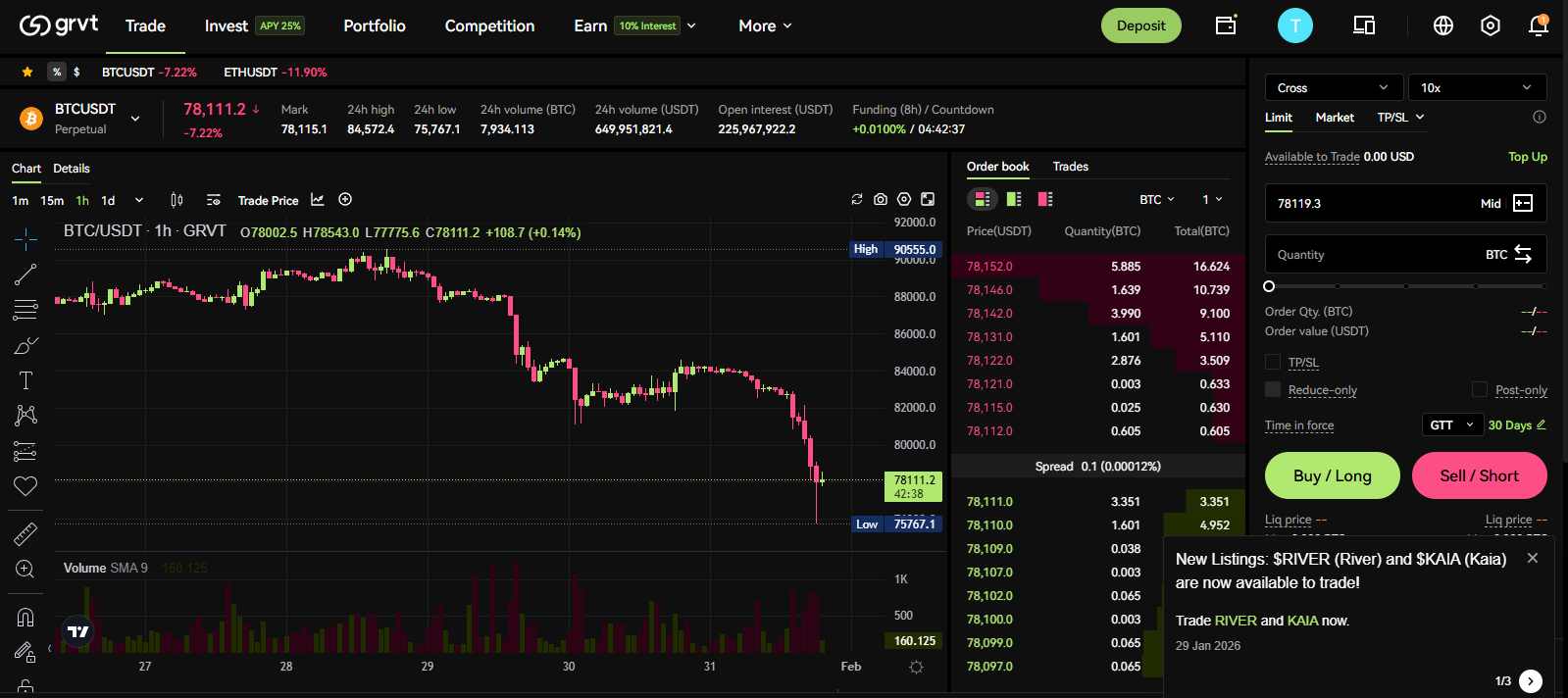
GRVT supports more than 76 perpetual contracts with leverage up to 50x. One of its defining features is negative maker fees, starting at -0.0001%, which rewards liquidity providers directly. Taker fees are set at 0.045%, placing GRVT in line with other execution-focused perp platforms. Trading runs through a central limit order book, with settlement verified on-chain using zero-knowledge proofs.
The platform has also expanded beyond crypto perps by adding perpetual exposure to stocks, forex, commodities, and selected Korean stocks. This gives traders access to both crypto and traditional market contracts from the same account while still using GRVT’s hybrid DEX setup, CLOB execution, and zk-based settlement.
Beyond trading, GRVT offers earn-on-equity features, allowing idle capital to generate yield while remaining available as margin. It also supports GRVT staking with yields of up to 11%, adding another income layer for users who want more than active trading. Native mobile apps are available for both Android and iOS, and online chat support gives users help directly inside the platform.
While GRVT does not offer spot trading, it stands out for traders who want negative maker fees, TradFi perpetual markets, Korean stock exposure, mobile access, and yield integrated directly into their trading account.
Our full Grvt review covers the details.
Grvt Pros and Cons
| 👍 Grvt Pros | 👎 Grvt Cons |
|---|---|
| ✅ Negative maker fees | ❌ Perpetual trading only |
| ✅ Earn yield on account equity | ❌ No prediction markets |
| ✅ Stocks, forex, and commodities | |
| ✅ Korean stock markets supported | |
| ✅ Zero-knowledge proof settlement | |
| ✅ Mobile apps for iOS and Android | |
| ✅ Online chat support |
8. ApeX Protocol
ApeX Protocol operates through its ApeX Omni interface, offering a broad set of trading products within a single non-custodial platform. Unlike perp-only exchanges, ApeX Omni combines perpetual futures, multichain spot swaps, prediction markets, vaults, and automation tools under one account flow.
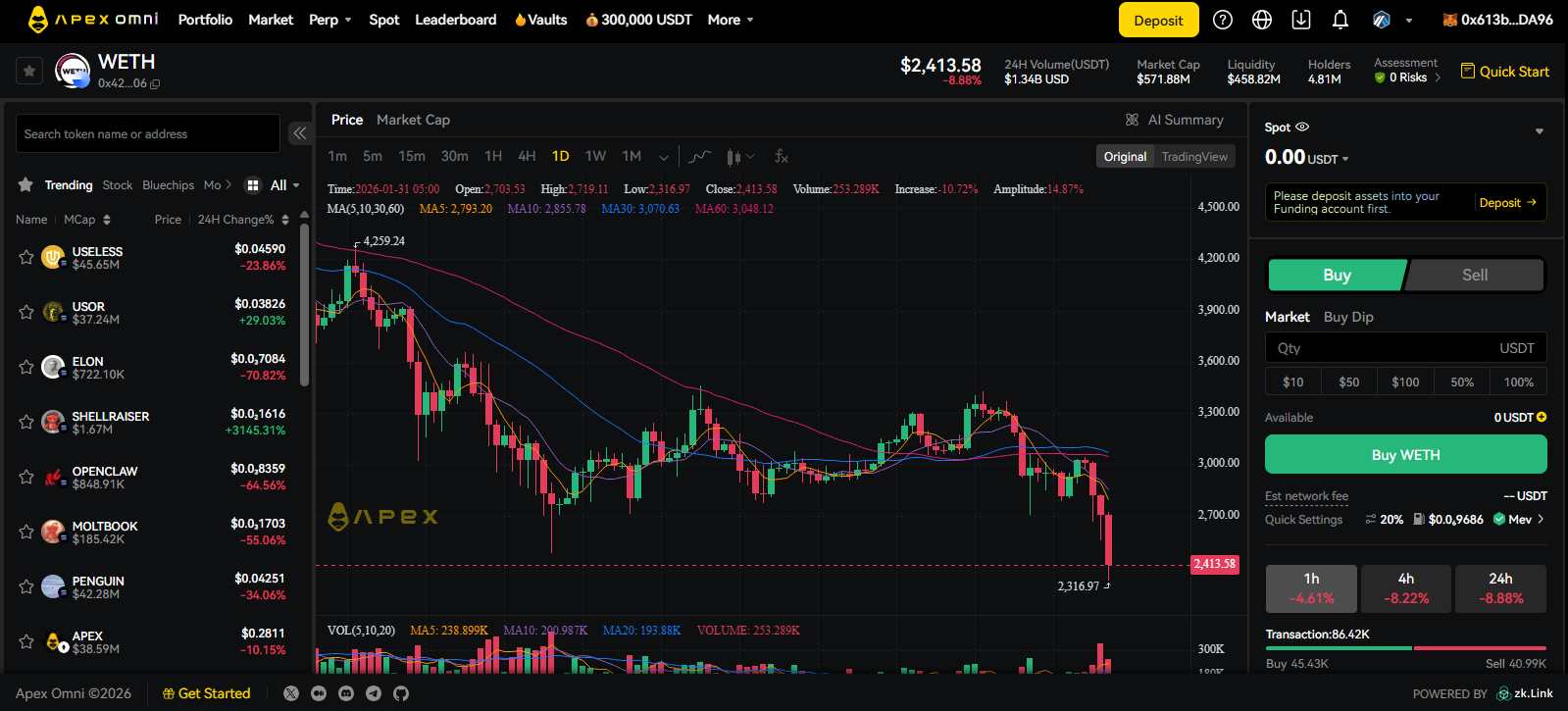
The platform supports over 100 perpetual contracts with leverage up to 100x and includes exposure to tokenized real-world assets such as stocks and metals. Perpetual trading fees start at 0.02% for makers and 0.05% for takers, while spot activity is handled through multichain swaps rather than a traditional order book. Cross-collateral support improves capital efficiency, and perpetual trades run without gas fees.
ApeX Omni also offers grid bots, copy-style vaults, staking, and prediction markets, making it one of the more feature-complete perp DEXs available. While the platform includes many moving parts, the interface remains approachable, especially for traders coming from centralized exchanges who want flexibility without giving up control of funds.
Take a closer look in our ApeX Protocol review.
ApeX Protocol Pros and Cons
| 👍 ApeX Protocol Pros | 👎 ApeX Protocol Cons |
|---|---|
| ✅ Perps, spot, and prediction markets | ❌ Feature set can feel overwhelming |
| ✅ Cross-collateral trading | ❌ No traditional spot order book |
| ✅ Multichain spot swaps | |
| ✅ Stocks and tokenized RWAs | |
| ✅ Grid bots and vault strategies | |
| ✅ Gas-free perpetual trading |
9. Ostium
Ostium is a decentralized perpetual exchange built on Arbitrum, designed for traders who want exposure to real-world assets (RWAs) like gold, forex, and stock indices, alongside crypto pairs such as BTC, ETH, and SOL. The platform supports over 78+ perpetual markets and allows users to trade with leverage of up to 200x.
Ostium uses a forex-style fee model, charging a 0.15% opening fee on crypto perpetual contracts, while closing trades are free. Fees for non-crypto markets vary by asset, so costs can differ across forex, commodities, indices, and other RWA pairs. This keeps the fee structure simple, especially for traders who want clear upfront costs before opening a position.
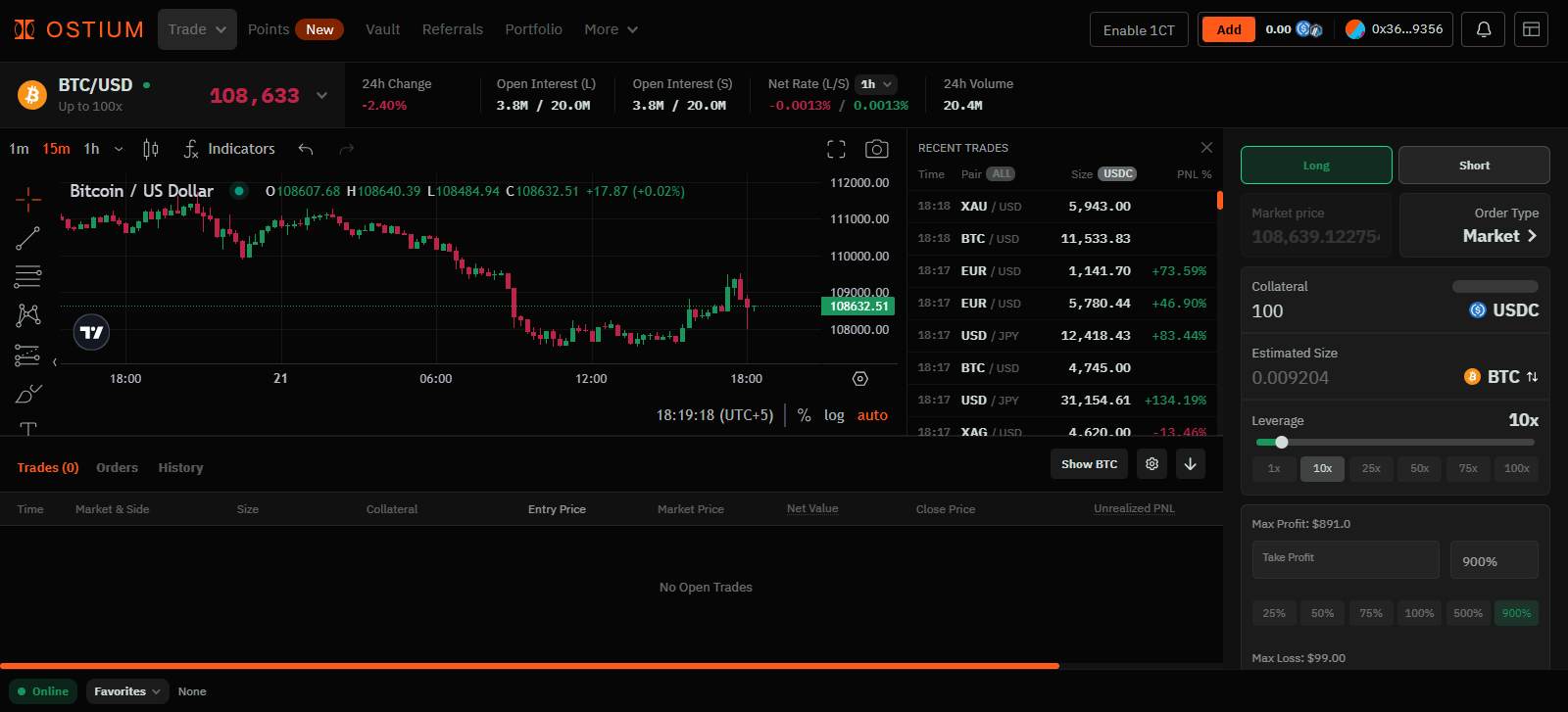
Traders can connect instantly using their Web3 wallet or email without completing KYC. The platform’s liquidity vaults offer around 13.98% APR, rewarding users who provide capital for on-chain trading. Ostium also integrates Chainlink oracles to ensure real-time, low-latency pricing for both crypto and traditional assets.
While the platform currently supports only the Arbitrum network and has limited crypto options, Ostium stands out for bringing real-world financial markets fully on-chain in a decentralized, easy-to-use setup.
Read our Ostium review for the full picture.
Ostium Pros and Cons
| 👍 Ostium Pros | 👎 Ostium Cons |
|---|---|
| ✅ Strong focus on RWA perpetuals | ❌ Only available on Arbitrum |
| ✅ Up to 200x leverage | ❌ No spot trading |
| ✅ Zero fees on closing trades | ❌ No native mobile app |
| ✅ Chainlink-powered pricing |
What Are Perpetual DEXs?
Perpetual DEXs (Decentralized Exchanges) are platforms that allow users to trade perpetual contracts directly on the blockchain, without relying on intermediaries like centralized exchanges (CEXs). These exchanges are non-custodial, meaning users retain control over their funds at all times. Perpetual contracts are unique financial instruments that allow traders to speculate on the price of assets without an expiration date.
Unlike traditional exchanges, Perpetual DEXs operate using smart contracts, which automatically execute trades based on predefined conditions. This decentralization reduces the risk of hacking and censorship but previously presented challenges like high gas fees and slippage. However, with the development of Layer 2 solutions and improved smart contract efficiency, Perpetual DEXs are becoming increasingly competitive with centralized platforms, offering low fees, better security, and enhanced privacy for traders.
Key Features of Perpetual DEXs
- Decentralization: Perpetual DEXs operate on blockchain-based smart contracts, eliminating the need for third-party intervention. Actions are autonomously executed according to pre-programmed conditions, ensuring decentralized operations.
- Non-Custodial: These platforms do not hold users’ assets. Unlike centralized exchanges (CEXs), where a central authority controls private keys, users retain full control over their funds, reducing the risk of hacks and mismanagement.
- Permissionless: Anyone with a compatible crypto wallet can access these platforms without requiring approval, KYC (Know Your Customer), or account verification. This open-access nature reinforces their decentralized ethos.
- Leveraged Trading and Never-Ending Contracts: Perpetual DEXs offer the ability to leverage positions, enter long or short trades, and hold positions indefinitely, as long as collateral is sufficient. Traders can also exit positions at any time and claim their margin.
- Order Book Trading Models: Some perpetual DEXs integrate order book models, combining the familiarity of traditional centralized exchanges with the benefits of decentralization. This model ensures greater transparency and liquidity management.
- Liquidity Pools: Automated Market Makers (AMMs) rely on liquidity pools to provide continuous market liquidity. These pools are funded by liquidity providers (LPs), who are compensated with a share of the transaction fees generated by the platform.
DEX vs. CEX
| Feature | Perp DEX | CEX |
|---|---|---|
| Control | Decentralized, user-controlled | Centralized, controlled by the exchange |
| Custody of Funds | Non-custodial (users manage their own assets) | Custodial (exchange holds users’ funds) |
| Anonymity | Offers privacy, no KYC required | KYC/AML verification required |
| Liquidity Model | Liquidity Pools or Order Book | Centralized order book |
| Fees | Generally lower, no intermediaries | Can be higher due to middlemen costs |
| Ease of Use | Requires wallet and blockchain knowledge | User-friendly, easy to onboard |
| Supported Assets | Limited compared to CEXs | Wide range of assets, including fiat |
| Speed | Depends on blockchain congestion | Faster due to centralized infrastructure |
| Transparency | Fully transparent on blockchain | Limited transparency on transactions |
Bottom Line
The right Perpetual DEX depends on how you trade. Some platforms are better for deep liquidity and fast execution, while others focus on higher leverage, RWA markets, vault yields, automation, or lower fees. Instead of choosing by rank alone, compare supported assets, leverage limits, fees, chains, liquidity, and extra tools, then pick the DEX that matches your actual trading style.
FAQs
1. What is the key difference between perpetual DEXs and traditional DEXs?
While traditional DEXs focus on spot trading, perpetual DEXs allow trading perpetual contracts without expiration dates, enabling traders to speculate on asset prices with leverage and flexible timeframes.
2. How do perpetual DEXs handle leverage trading without central authority?
Perpetual DEXs rely on smart contracts to manage collateral and liquidation automatically, ensuring that leverage is enforced transparently without the need for intermediaries.
3. Are perpetual DEXs safe for beginners?
Perpetual DEXs require some understanding of blockchain and crypto wallets. However, many platforms now offer user-friendly interfaces and demo trading features, like ApolloX, to help newcomers practice before committing funds.
4. What are the risks associated with Perp DEX?
Trading on perpetual DEXs comes with risks like smart contract exploits, oracle manipulation, and flash loan attacks, which can lead to fund losses or unfair liquidations. Other risks include low liquidity causing slippage and centralization or governance flaws impacting platform security.
5. Do perpetual DEXs support multi-chain interoperability?
Yes, many perpetual DEXs like dYdX and ApolloX support multiple blockchain networks, enabling users to trade assets across chains seamlessly.