


- •Crypto loans let borrowers access funds without selling their cryptocurrency holdings.
- •Most crypto loans require collateral worth more than the amount borrowed to reduce lender risk.
- •Approval for crypto-backed loans usually depends on the value of the collateral rather than income or credit history.
- •A rising loan-to-value (LTV) ratio increases the risk of collateral liquidation if crypto prices decline.
Crypto is now a financial market in its own right, although much of its infrastructure is still developing. Within DeFi, lending has become a major use case, with users supplying assets to liquidity pools and others borrowing against crypto collateral. Crypto loans are available through dApps such as Aave, where smart contracts manage borrowing, interest, and liquidation. They are also offered through centralized exchanges, which give users access from a familiar account dashboard. This article explains what crypto loans are, how they work and, more importantly, how they differ from traditional loans.
What Is a Crypto Loan?
Crypto loans allow you to borrow money or digital assets by using cryptocurrency as collateral. Instead of selling your Bitcoin, Ethereum, or another supported asset, you temporarily lock it with a lending platform or DeFi protocol.
Because cryptocurrency prices can change quickly, most crypto loans are overcollateralized. This means the collateral must be worth more than the amount borrowed. For example, you may need to deposit $10,000 in Bitcoin to borrow $5,000 in USDC. Depending on the provider, the loan may be issued as a stablecoin, another cryptocurrency, or fiat currency.
How Does Borrowing Against Crypto Work?
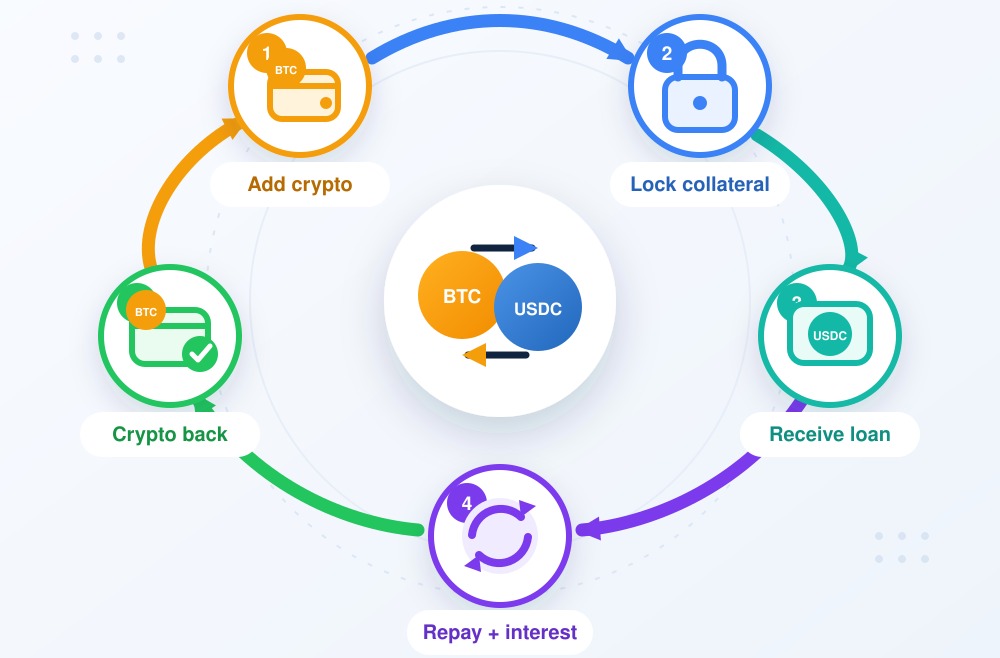
Borrowing against crypto begins with depositing an accepted asset as collateral. Depending on the platform, this could include Bitcoin, Ethereum, stablecoins, or other supported cryptocurrencies.
Unlike traditional loans, approval is generally not based on your income, employment history, or credit score. Instead, the platform determines how much you can borrow based on the current value of your collateral and its available loan-to-value ratio.
After selecting the loan amount, you receive the borrowed funds as a stablecoin, another cryptocurrency, or fiat currency. Your collateral remains locked throughout the loan and cannot normally be traded or withdrawn.
Interest begins accumulating after the funds are issued. To close the loan, you must repay the borrowed amount, accrued interest, and any applicable fees. Your collateral is then released. If its value falls while the loan remains open, you may need to deposit more collateral or repay part of the debt to prevent liquidation.
What are the Benefits of Cryptocurrency Borrowing?
Crypto loans provide several benefits for people who already own digital assets and need access to additional funds.
| Benefit | What It Means |
|---|---|
| Access Funds Without Selling | Borrow while keeping your crypto as collateral. |
| Maintain Market Exposure | Continue participating if the asset appreciates. |
| No Traditional Credit Check | Borrowing power depends mainly on collateral. |
| Faster Processing | Automated systems can issue funds quickly. |
| Flexible Repayment Options | Some loans have no fixed payment schedule. |
| Multiple Borrowing Assets | Receive stablecoins, crypto, or fiat. |
These benefits depend on the platform, collateral asset, loan structure, and availability in your region. Borrowers also remain exposed to falling crypto prices while their loan is active.
LTV and Liquidation Explained
Loan-to-value, or LTV, shows how much you have borrowed compared with the current value of your collateral.
For example, borrowing $4,000 against $10,000 in Bitcoin gives you an LTV of 40%. If the collateral falls to $6,000, your LTV increases to 66.7%, even though you have not borrowed any additional funds. Accumulating interest can also increase your LTV by raising the outstanding debt.
Every platform sets a liquidation threshold. If that threshold is 85%, the $4,000 loan would reach liquidation when the collateral falls to approximately $4,706. The platform may then sell some or all of the collateral and charge a liquidation penalty.
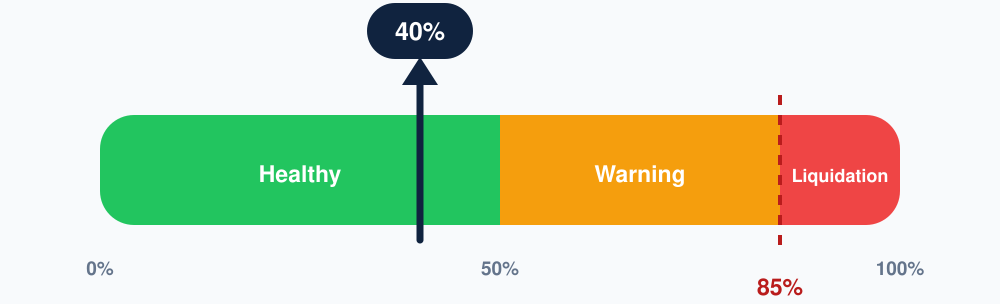
Borrowers can reduce their LTV by repaying part of the loan or adding more collateral. Starting with a lower LTV provides more room for the collateral price to fall, but no LTV completely removes liquidation risk.
Use our free LTV and liquidation calculator below to estimate your current LTV and the asset price that could trigger liquidation.
Types of Crypto Loans
Crypto loans can be categorized based on who provides the funds and manages the borrowing process. Some are managed by centralized companies, while others operate through smart contracts and onchain liquidity pools. Here are some of the main types of crypto loans available:
Centralized Crypto Loans
Centralized crypto loans are offered by exchanges and lending companies. Users deposit collateral into a platform-managed account and receive stablecoins, cryptocurrency, or fiat. Identity verification may be required.
DeFi Crypto Loans
DeFi loans operate through dApps such as Aave. Users connect a wallet, supply collateral to a liquidity pool, and borrow a supported asset. Smart contracts manage interest, repayment, and liquidation.
Exchange-DeFi Loans
Exchange-DeFi loans combine a centralized interface with onchain lending. Users manage the loan through an exchange, while a DeFi protocol provides the underlying liquidity and smart contracts. Coinbase connecting users to Morpho is one example.
Flash Loans
Flash loans allow users to borrow crypto without collateral, provided the loan is repaid within the same blockchain transaction. If repayment fails, the entire transaction is reversed. They are mainly used by developers and advanced traders for arbitrage, collateral swaps, and liquidations.
Crypto Loans vs Traditional Loans
Both crypto and traditional loans involve borrowing funds and repaying them with interest. However, they assess borrowers and manage collateral differently.
DefaultCollateral may be liquidated.
| Factor | Crypto Loans | Traditional Loans | ||
|---|---|---|---|---|
| Approval Basis | Value of crypto collateral. | Income and credit history. | ||
| Credit Check | Usually not required. | Commonly required. | ||
| Collateral | Cryptocurrency. | Property, savings, or none. | ||
| Funds Received | Crypto, stablecoins, or fiat. | Fiat currency. | ||
| Processing | Often automated. | May involve manual approval. | ||
| Interest | Fixed or variable. | Fixed or variable. | ||
| Repayment | Flexible or scheduled. | Usually scheduled payments. | ||
| Collections or asset seizure. | ||||
| Consumer Protection | Varies by jurisdiction. | More established protections. |
Crypto loans can be processed faster and require less documentation, but their collateral can be liquidated quickly. Bank loans usually take longer to approve but offer clearer repayment schedules and stronger consumer protections.
What Does a Crypto Loan Cost?
Interest is the main cost of a crypto loan, usually displayed as an annual percentage rate. The rate may be fixed or variable. Variable rates change according to market demand and the available liquidity for the borrowed asset.
Borrowers should also check for additional costs, including:
- Processing or origination fees
- Blockchain network fees
- Stablecoin conversion charges
- Fiat withdrawal fees
- Early repayment fees
- Liquidation penalties
Some platforms add processing fees to the outstanding loan amount. This means the borrower may also pay interest on those fees.
The advertised interest rate does not always represent the total borrowing cost. Before accepting a loan, calculate the interest, platform fees, network costs, and the amount required to repay the debt completely.
Coinbase Crypto Loan Example
Coinbase allows eligible users to borrow USDC against supported crypto assets. However, Coinbase does not provide the underlying loan directly. It gives users an interface to access the Morpho lending protocol on Base.
Suppose you deposit $10,000 in Bitcoin as collateral and borrow $4,000 in USDC. Your opening LTV would be 40%. The Bitcoin remains locked on Morpho while the loan is active, and interest accumulates at a variable rate.
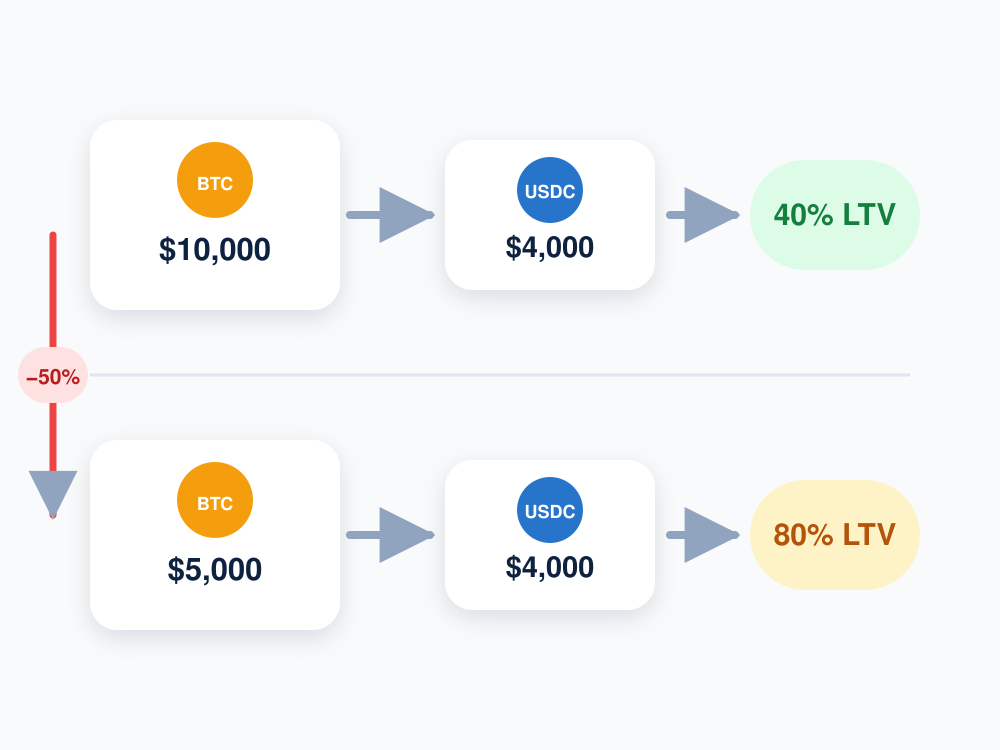
Coinbase loans have no fixed term, minimum payment, or repayment date. You can repay part or all of the outstanding amount whenever you choose. Once the loan, interest, and fees are repaid, the collateral is released.
Coinbase currently uses an 86% liquidation LTV. If the loan reaches this level because the collateral falls or interest increases the debt, the collateral can be liquidated with an additional penalty. Coinbase also charges a processing fee whenever a user borrows or increases an existing loan.
Common Uses for Crypto Loans
Crypto loans can serve personal, business, and onchain needs. Depending on the provider, borrowers may use the funds for:
- Personal expenses: Paying bills, medical costs, or other short-term expenses.
- Business needs: Managing working capital, purchasing equipment, or paying operating costs.
- Stablecoin access: Borrowing USDC or USDT for payments and onchain transactions.
- Trading and hedging: Borrowing an asset to trade, hedge an existing position, or sell it short.
- Additional investments: Using borrowed funds to purchase more crypto or other assets.
- Home down payments: Some providers now let buyers use crypto as collateral instead of selling it to raise cash.
One example is Coinbase’s partnership with Better Mortgage, which lets eligible U.S. buyers pledge Bitcoin to fund a home down payment. Borrowers must deposit BTC worth at least 250% of the down payment loan amount, while still completing Better’s usual credit and mortgage checks. Unlike standard crypto loans, routine Bitcoin price swings do not trigger margin calls or top-up requests. Coinbase One members approved through Better can also receive up to $10,000 in closing-cost credits.
Risks of Crypto Loans
Providing collateral does not make a crypto loan low risk. The collateral mainly protects the lender if the borrower cannot repay.
| Risk | How It Affects Borrowers |
|---|---|
| Liquidation Risk | Falling prices can force a collateral sale. |
| Variable Interest | Borrowing costs can increase unexpectedly. |
| Platform Risk | A company may fail or suspend withdrawals. |
| Smart Contract Risk | Code errors or exploits can affect funds. |
| Oracle Risk | Incorrect pricing can trigger liquidation. |
| Stablecoin Risk | The borrowed asset may lose its peg. |
| Network Risk | Congestion can delay repayment or collateral deposits. |
| Regulatory Risk | Loan access or terms may change. |
| Tax Risk | Liquidation may create a taxable disposal. |
When Does a Crypto Loan Make Sense?
A crypto loan can make sense when you have valuable crypto holdings, need temporary liquidity, and have a reliable way to repay the debt without depending on the collateral price.
| A Loan May Make Sense When | A Loan May Not Make Sense When |
|---|---|
| You need funds temporarily. | You need long-term financing. |
| You have a repayment source. | Repayment depends on crypto rising. |
| You can maintain a lower LTV. | You need the maximum loan amount. |
| You can monitor the position. | You cannot track collateral prices. |
| You have additional collateral. | All your savings are already locked. |
| Borrowing costs are manageable. | Fees exceed the benefit of borrowing. |
How to Get a Crypto Loan: Step by Step
The exact process depends on whether you use a centralized platform or DeFi protocol, but the main steps are similar.
Step 1: Choose a loan type
Decide whether you want to borrow through a centralized platform, DeFi protocol, or exchange-connected lending service.
Step 2: Check regional availability
Confirm that the service operates in your country and whether identity verification is required.
Step 3: Review supported assets
Check which cryptocurrencies can be used as collateral and whether the loan is issued as fiat, stablecoins, or another asset.
Step 4: Compare the loan terms
Review the interest rate, fees, maximum LTV, liquidation threshold, repayment terms, and liquidation penalty.
Step 5: Create an account or connect a wallet
Complete any required verification on a centralized platform or connect a compatible wallet to a DeFi dApp.
Step 6: Deposit collateral
Transfer the supported crypto and confirm how much you can borrow against it.
Step 7: Select the loan amount
Choose an amount that leaves sufficient room between your opening LTV and the liquidation threshold.
Step 8: Review and receive the loan
Confirm the total debt, interest rate, fees, and liquidation price before accepting the loan.
Step 9: Monitor and repay
Track the collateral value and accumulated interest. Repay the debt or add collateral if the LTV begins approaching liquidation.
Tips for Borrowing Against Crypto
A crypto loan requires active management because collateral values, interest rates, and liquidation risk can change while the loan remains open.
- Avoid the maximum LTV: Borrowing the full available amount leaves little room for a market decline.
- Calculate the liquidation price: Know how far your collateral can fall before the platform begins selling it.
- Plan your repayment: Repayment should come from income or available funds, not only from the expectation that crypto prices will rise.
- Keep additional collateral available: Extra collateral can help reduce LTV during a sudden decline.
- Set price and LTV alerts: Notifications can give you time to repay part of the debt or add collateral.
- Check variable interest rates: A low starting rate can increase as borrowing demand changes.
- Compare every fee: Include processing, network, conversion, withdrawal, and liquidation charges.
- Understand collateral custody: Check where the assets are held and whether the provider can reuse them.
- Avoid unnecessary leverage: Using loan proceeds to buy more volatile crypto can increase losses quickly.
- Review the loan regularly: Monitor collateral value, accumulated interest, and distance from liquidation.
Bottom Line
Crypto loans are no longer limited to DeFi users who are comfortable with smart contracts. They now appear inside familiar exchange dashboards, making borrowing against Bitcoin, Ethereum, and other assets easier to access. Still, the experience can look very different depending on whether the loan comes from an exchange, lender, or onchain protocol. If learning about crypto loans has made you curious about which platforms handle user assets responsibly, our list of the safest crypto exchanges looks at security systems, regulation, proof of reserves, insurance arrangements, and how exchanges have responded when something went wrong.
FAQs
1. Can I Borrow Cash Against Bitcoin?
Yes. Some crypto lenders allow users to deposit Bitcoin as collateral and receive fiat currency or stablecoins. Available currencies and withdrawal methods depend on the provider.
2. How Much Can I Borrow Against Crypto?
The amount depends on the collateral value and the platform’s maximum LTV. If your collateral is worth $10,000 and the maximum LTV is 50%, you could borrow up to $5,000.
3. Do Crypto Loans Require Credit Checks?
Most collateralized crypto loans do not require traditional credit checks. However, centralized platforms may still require identity verification before providing access.
4. Can I Get a Crypto Loan Without Collateral?
Standard crypto loans usually require collateral. Flash loans do not, but they must be borrowed and repaid within the same blockchain transaction.
5. What Happens if My Collateral Increases?
An increase in collateral value lowers your LTV and moves the loan further from liquidation. Some platforms may then allow you to withdraw collateral or borrow additional funds.
6. What Happens if I Cannot Repay?
Interest may continue accumulating, and the collateral can eventually be liquidated according to the platform’s terms. Fixed-term lenders may also charge late or default fees.