



- •An estimated 109 million to 383 million people own Bitcoin, but no exact global count exists.
- •Bitcoin addresses do not equal individual owners because people can use multiple wallets, while custodians may hold funds for millions of customers.
- •Strategy holds 843,775 BTC, accounting for approximately 66.8% of tracked Bitcoin held by public companies.
- •Approximately 16.7 million BTC qualifies as long-term-holder supply, with 34% remaining unmoved for five years.
- •About 988,000 addresses hold at least 1 BTC, but the number of individual Bitcoin owners remains unknown.
Bitcoin ownership now extends from individual wallets to public companies, governments, ETFs, and DeFi protocols. Yet the simplest question, how many people own Bitcoin, still has no exact answer.
Approximately 365 million people owned Bitcoin, up from 337 million in 2024. However, this remains an estimate because one person may control several addresses, while a single exchange or ETF wallet can represent millions of investors. To understand Bitcoin ownership properly, people, addresses, custodians, and on-chain holdings must be considered separately.
And in this article, we will trace how Bitcoin ownership has changed, where the supply sits today, and what on-chain data reveal about holder behavior.
How Many People Own Bitcoin?
An estimated 109 million to 383 million people may own Bitcoin worldwide in 2026. The range is large because each study uses a different method to define and count a Bitcoin owner.
MEXC and Bitbo place the figure closer to 106 to 109 million. Their estimates focus more heavily on active wallet addresses and exchange users.
Crypto.com’s 2025 Market Sizing Report gives us a much higher estimate. It calculated that Bitcoin ownership increased by 8.3%, from 337 million people in 2024 to 365 million in 2025.
Bitcoin has attracted less public interest during 2026, so carrying forward the same 8.3% growth rate could push the estimate too high. Applying a more cautious 5% increase gives us 383.25 million.
This places the estimated upper figure at around 383 million Bitcoin holders. You can think of 109 million as the conservative count of identifiable users and 383 million as an estimate that includes people holding Bitcoin through exchanges and other custodial services.
Why the Exact Number of Bitcoin Holders Is Unknown
The Bitcoin blockchain can show how much BTC is stored at a particular address, but it cannot tell us who owns that address. There is no name, account number, or verified identity attached to it.
One person can control several wallets, and every wallet can generate multiple addresses. Bitcoin.org even recommends using a new address for each payment, which helps protect privacy but makes holder estimates less precise. Wallets may also create separate change addresses whenever Bitcoin is sent.
The same problem works in reverse with custodial services. An exchange may keep customer funds in a few large cold wallets, meaning one address can represent millions of users. ETF investors also gain exposure through fund shares without receiving their own Bitcoin address.
Dormant addresses create another complication. Some belong to long-term holders, while others may contain Bitcoin that has been permanently lost. Looking at inactivity alone cannot tell us which is which.
This is why addresses, wallets, exchange accounts, and individual holders cannot be counted as the same thing. Every ownership estimate depends on assumptions about how these groups overlap.
How Bitcoin Ownership Changed
Bitcoin ownership has expanded through several different waves. Early miners and developers never disappeared, but retail investors, companies, governments, ETFs, and DeFi users gradually joined them.

2009 to 2012: Early Bitcoin users
Bitcoin started within a relatively small community of cypherpunks, developers, and miners. The first Bitcoin specification and proof of concept were released in 2009, according to Bitcoin.org. Acquiring BTC generally required mining it or arranging a direct transfer with another user.
2013 to 2016: Exchanges bring retail access
Crypto exchanges made it easier to buy Bitcoin using traditional currencies. This reduced the technical knowledge required to get started and brought the first major retail ownership wave. By early 2017, a University of Cambridge study estimated that 2.9 million to 5.8 million people were actively using cryptocurrency wallets.
2017: The retail boom
Bitcoin’s price rally and the ICO market attracted a much larger retail audience. Exchange registrations increased rapidly, and Bitcoin became a regular topic across mainstream financial media. However, account growth still could not show how many users held Bitcoin rather than another cryptocurrency.
2020 to 2021: Companies enter the market
Corporate ownership became more visible when MicroStrategy, now Strategy, purchased 21,454 BTC in August 2020. Its official purchase records show how the company continued building its position. Tesla followed in early 2021 with a $1.5 billion Bitcoin investment.
These purchases gave shareholders indirect exposure to Bitcoin through companies holding it on their balance sheets.
2024: Spot Bitcoin ETFs arrive
The SEC approved several spot Bitcoin exchange-traded products in January 2024. Investors could purchase Bitcoin exposure through brokerage and retirement accounts without managing a wallet or private keys.
2025 to 2026: Ownership growth slows
Crypto.com estimated that Bitcoin ownership increased from 337 million people in 2024 to 365 million in 2025. Applying a slower 5% growth assumption places the upper 2026 estimate near 383 million.
Individuals With the Largest Estimated Bitcoin Holdings
Personal Bitcoin holdings are much harder to verify than company or government balances. Individuals are not required to publish their wallets, and they can divide their Bitcoin across exchanges, custodians, trusts, and multiple addresses.
The figures below are therefore based on blockchain estimates, historical purchases, and public disclosures.
1. Satoshi Nakamoto: Approximately 1.1 Million BTC
Satoshi Nakamoto, the anonymous person or group that created Bitcoin, is believed to control approximately 1.1 million BTC.
Satoshi accumulated these coins by mining Bitcoin during its earliest years, when there were very few other miners on the network. The addresses connected to this early mining activity have remained largely inactive, although nobody can confirm whether Satoshi still has access to their private keys.
2. Cameron and Tyler Winklevoss: Approximately 70,000 BTC
Cameron and Tyler Winklevoss are estimated to hold approximately 70,000 BTC collectively.
The twins began buying Bitcoin in 2012, reportedly investing part of the money they received from their Facebook settlement. They later founded the Gemini cryptocurrency exchange. Their exact wallet balances are not public, so the 70,000 BTC figure remains an estimate rather than a confirmed on-chain balance.
3. Tim Draper: More Than 31,000 BTC Purchased
Venture capitalist Tim Draper acquired most of his Bitcoin through auctions conducted by the U.S. Marshals Service.
In 2014, Draper purchased approximately 29,656 BTC seized from the Silk Road case. He later purchased another 2,000 BTC in a second government auction, taking his total auction purchases above 31,000 BTC.
Draper has remained a public supporter of Bitcoin, but he has not disclosed his complete current balance. His original purchases should therefore not be treated as proof that he still holds every coin.
4. Michael Saylor: At Least 17,732 BTC
Michael Saylor publicly disclosed that he personally owned 17,732 BTC, purchased at an average price of $9,882 per Bitcoin.
In 2024, Saylor said that he had not sold any of his personal Bitcoin and that he continued buying. This suggests his current balance may be higher, although he has not provided an updated figure.
Saylor’s personal Bitcoin is separate from the 843,775 BTC held by Strategy. He benefits from Strategy’s Bitcoin holdings as a major shareholder, but the company’s BTC should not be counted as part of his personal wallet balance.
These estimates show why ranking individual Bitcoin owners is difficult. Someone may own Bitcoin directly, through a company, inside an ETF, or through an exchange account without any public address being connected to their identity.
Who Holds Bitcoin Today?
Most Bitcoin still sits outside wallets linked to named companies, governments, funds, or protocols. However, BitcoinTreasuries currently tracks approximately 4.19 million BTC across five identifiable categories.
| Tracked Category | Bitcoin Held | Share of 21M |
|---|---|---|
| Public Companies | 1,263,286 BTC | 6.02% |
| Private Companies | 281,752 BTC | 1.34% |
| Governments | 649,961 BTC | 3.10% |
| ETFs and Exchanges | 1,622,533 BTC | 7.73% |
| DeFi and Other Entities | 369,490 BTC | 1.76% |
| Total Tracked | 4,187,022 BTC | 19.94% |
These categories tell us where some of the supply sits, but not necessarily who benefits from it. An ETF holds Bitcoin for shareholders, while an exchange wallet may contain deposits belonging to millions of customers.
Add an original pie or donut chart after this table showing the five tracked categories and Bitcoin outside tracked entities.
Public Companies
BitcoinTreasuries currently tracks 209 publicly traded companies with non-zero Bitcoin holdings. Together, they hold approximately 1.26 million BTC.
Strategy accounts for most of that total, holding 843,775 BTC. That gives one company approximately 66.8% of all Bitcoin tracked across public companies. At the opposite end, ATIF Holdings is listed with just 0.2 BTC.
The large difference between these holdings shows why the number of companies alone can be misleading. Hundreds of companies may hold Bitcoin, but a large part of the public-company supply remains concentrated with Strategy.
Private Companies
Private companies hold approximately 281,752 BTC, according to the data from BitcoinTreasuries. Block.one leads this category with 164,000 BTC, representing about 58% of the tracked private-company total.
Unlike public companies, private businesses are not always required to publish detailed financial reports. Their Bitcoin holdings can therefore be harder to confirm and may only become known through company announcements or identified wallets.
Governments
Government entities are estimated to hold 649,961 BTC. The 3 largest listed holdings belong to:
- United States: 328,372 BTC
- China: 190,000 BTC
- United Kingdom: 61,245 BTC
These figures should not be interpreted as Bitcoin purchased as an investment. Much of the Bitcoin associated with governments came from criminal investigations, seizures, and asset forfeitures.
The United States, for example, accumulated Bitcoin through cases involving Silk Road, Bitfinex, and other enforcement actions. In 2025, the government established a Strategic Bitcoin Reserve for finally forfeited BTC.
China’s estimated holdings are commonly linked to the PlusToken case, while the United Kingdom’s holdings largely came from major fraud and money-laundering seizures. Because governments can transfer, return, or dispose of confiscated assets, these figures should be treated as tracked estimates rather than permanently committed reserves.
By contrast, El Salvador deliberately purchased Bitcoin to hold as a national reserve and currently holds approximately 7,713 BTC. It remains one of the clearest examples of a government treating Bitcoin as a long-term treasury asset.
Bitcoin ETFs
Bitcoin ETFs have become one of the largest identifiable holding groups. BitcoinTreasuries combines ETFs and exchanges into a category containing approximately 1.62 million BTC, but these two groups represent very different types of ownership.
Among the largest funds listed are the iShares Bitcoin Trust with 811,291 BTC, Fidelity’s Wise Origin Bitcoin Fund with 185,798 BTC, and the Grayscale Bitcoin Trust with 150,744 BTC.
This Bitcoin does not belong to BlackRock, Fidelity, or Grayscale in the same way Strategy owns Bitcoin on its balance sheet. The funds hold BTC to back ETF shares purchased by investors. The ETF may control the custodial wallet, but its shareholders receive the economic exposure.
Exchanges & Custodians
Exchange wallets tell a similar story. They may appear among the largest Bitcoin wallets, but much of the balance belongs to customers rather than the exchange itself.
The Arkham data you captured shows two Binance cold wallets holding approximately 248,598 BTC and 181,321 BTC. Together, those two wallets contain almost 430,000 BTC. Robinhood and Bitfinex wallets are also shown with approximately 140,850 BTC and 130,010 BTC respectively.
That does not mean Binance has one owner holding 430,000 BTC. These wallets pool deposits from many customers, making one on-chain entity look like a single very large Bitcoin holder.
DeFi and Wrapped Bitcoin
Bitcoin can also be used across blockchains that do not support native BTC. This is done by keeping Bitcoin with a custodian and issuing a corresponding token on another network.
Wrapped Bitcoin holds 116,152 BTC, while cbBTC holds 87,668 BTC. Combined, these two products represent 203,820 BTC.
These tokens do not increase Bitcoin’s supply. When one WBTC or cbBTC is issued, an equivalent amount of BTC is expected to remain in custody. The token holder can use that representation for trading, lending, borrowing, or liquidity provision, while the underlying Bitcoin remains on the Bitcoin blockchain.
Bitcoin Outside Tracked Entities
Subtracting the 4,187,022 BTC tracked across these categories from Bitcoin’s 21 million maximum supply leaves approximately 16,812,978 BTC outside them.
This does not mean 16.8 million BTC is missing or unaccounted for. The figure includes Bitcoin held by individuals, unidentified wallets, smaller businesses, miners, early holders, and entities that have not disclosed their holdings. It also includes Bitcoin that has not yet been mined because the calculation starts with the full 21 million maximum supply.
Some of the mined Bitcoin within this group may be inaccessible or permanently lost, but inactivity alone cannot confirm that. The safest description is that this Bitcoin sits outside the ownership categories covered by the tracker.
Largest Tracked Bitcoin Wallets
The largest Bitcoin wallets should not be confused with the largest individual Bitcoin owners. Arkham’s Bitcoin explorer tracks addresses and groups many of them using entity labels.
In the current snapshot, two Binance cold wallets contain approximately 248,598 BTC and 181,321 BTC. Combined, that is close to 430,000 BTC. Other large addresses are associated with Robinhood, Bitfinex, Tether, the U.S. government, and an unidentified holder.
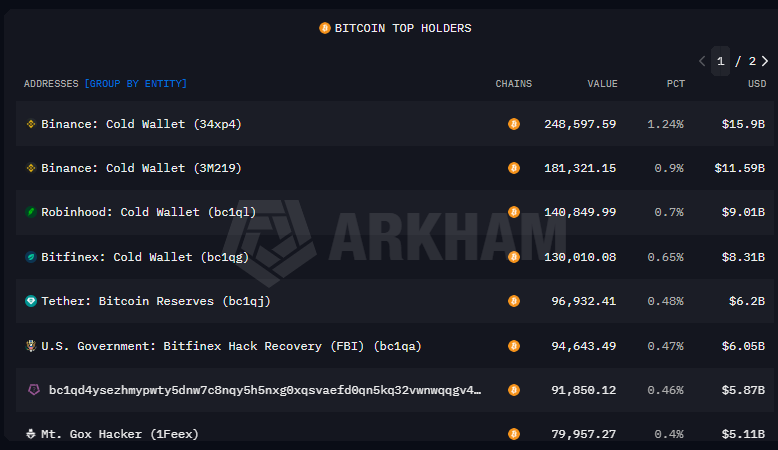
Most of the Bitcoin in Binance’s wallets does not economically belong to Binance. These cold wallets mainly hold customer deposits, meaning one address can represent millions of account holders. The same applies to other exchanges and custodians appearing near the top of the list.
What On-Chain Data Shows
The blockchain cannot tell us the name of every Bitcoin owner, but it can show how much BTC sits in an address, how long those coins have remained there, and whether their estimated cost basis is above or below the market price.
These metrics give us a statistical picture of holder behaviour, but they still measure addresses and coins rather than unique people.
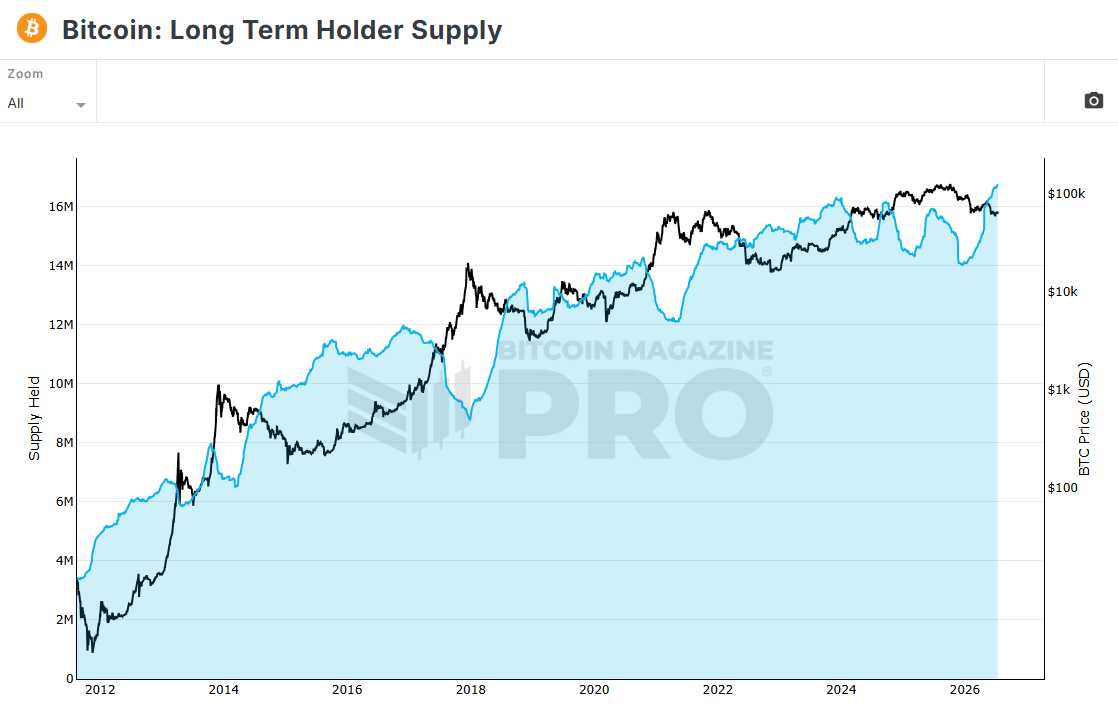
Long-Term Holder Supply
Long-term holder supply measures Bitcoin that has remained unmoved for at least 155 days. Current data places this supply at approximately 16.7 million BTC, close to its highest recorded level.
This means a large percentage of the circulating Bitcoin supply is not moving frequently. It does not mean there are 16.7 million long-term holders. One person may control several addresses, while custodial wallets, dormant balances, and potentially lost Bitcoin may also be included.
Five-Year HODL Wave
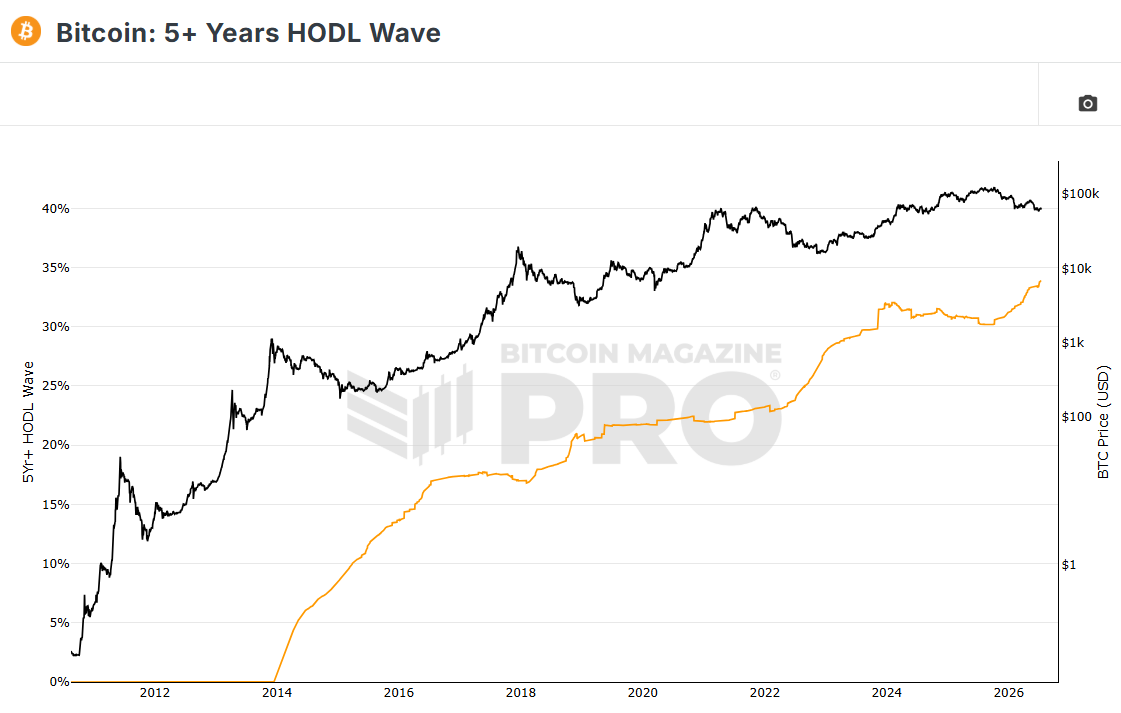
The five-year HODL wave measures the percentage of Bitcoin that has not moved on-chain for at least five years.
Current data places this figure at approximately 34%. In other words, about one-third of Bitcoin’s circulating supply has remained unmoved for five years or longer.
Some of these coins likely belong to committed long-term investors. Others may be stored in institutional custody or held in wallets whose keys have been lost. The data cannot explain why the coins have not moved, but it shows that a considerable part of the supply has remained inactive for years.
Bitcoin Address Balances
Bitcoin address-balance data shows how many addresses hold more than a specified amount of BTC:
- Approximately 12.8 million addresses hold more than 0.01 BTC.
- Around 4.5 million addresses hold more than 0.1 BTC.
- Just under 1 million addresses hold more than 1 BTC.
- Approximately 151,000 addresses hold more than 10 BTC.
Addresses holding at least 0.01 BTC and 0.1 BTC remain close to record levels. The number of addresses holding at least 1 BTC is also relatively stable, although it has slipped slightly below its previous peak. Addresses holding more than 10 BTC have declined from approximately 157,000 to around 151,000.
These groups overlap and should not be added together. An address containing 1 BTC is also included in the 0.1 BTC and 0.01 BTC groups.
Changes in large-address counts do not always mean whales are buying or selling. Exchanges and custodians regularly combine funds, divide balances, or move Bitcoin between addresses. ETF custody may also concentrate Bitcoin into a small number of large addresses.
Addresses in Profit and Loss
Addresses in profit measures the percentage of Bitcoin addresses whose estimated cost basis is below the current Bitcoin price. Addresses in loss measures the opposite.
Current data places roughly 70% of Bitcoin addresses in profit and around 30% in loss. Put simply, about seven out of every ten addresses are holding Bitcoin above their estimated on-chain cost basis.
This does not mean exactly 70% of Bitcoin investors are profitable. The calculation counts addresses rather than people, and the cost basis is estimated using Bitcoin’s price when coins entered an address. Moving Bitcoin between two wallets owned by the same person can therefore affect the data even when no purchase or sale occurred.
Bottom Line
Regardless of whether Bitcoin has 100 million holders or 400 million, its reach is clear. What began with cypherpunks and early miners now attracts wealthy individuals, governments, public companies, ETFs, and BlackRock, the world’s largest asset manager. Many buyers who stayed patient through complete market cycles have ended in profit, although returns were never guaranteed. If you own Bitcoin today, you are participating in an asset that has moved from small internet communities to the centre of global finance.
FAQs
1. How Many People Own Bitcoin Worldwide?
Estimates range from approximately 109 million to 383 million people. The range is large because Bitcoin ownership cannot be connected perfectly to individual identities.
2. How Many People Own at Least 1 Bitcoin?
No exact figure is available. Approximately 988,000 Bitcoin addresses hold at least 1 BTC, but addresses are not people. One person can control several addresses, while one exchange address can hold Bitcoin for thousands of customers.
3. Who Owns The Most Bitcoin?
Satoshi Nakamoto is believed to control approximately 1.1 million BTC accumulated through early Bitcoin mining. Among public companies, Strategy is the largest holder with 843,775 BTC.
4. How Many Bitcoin Wallets Exist?
The exact number of Bitcoin wallets is unknown because wallets can be created privately and may contain multiple addresses. Approximately 56.8 million Bitcoin addresses currently hold a non-zero balance, but this is not the same as the number of wallets or owners.
5. How Much Bitcoin is Permanently Lost?
An estimated 2.3 million to 3.7 million BTC may be permanently lost because of forgotten passwords, missing private keys, discarded devices, and inaccessible wallets. The precise amount cannot be confirmed because a dormant wallet may still belong to someone who intends to hold.
6. Do Bitcoin Etfs Own Their Bitcoin?
Spot Bitcoin ETFs hold real Bitcoin through regulated custodians to support their fund shares. ETF investors own shares in the fund rather than controlling the underlying Bitcoin directly.
7. Do WBTC and cbBTC Create Additional Bitcoin?
No. WBTC and cbBTC are tokenized representations of Bitcoin used on other blockchain networks. They are designed to be backed by BTC held with custodians and do not increase Bitcoin’s 21 million supply limit.