

- •Algorand focuses more on settlement finality, uptime, lower hardware needs, and long-term security.
- •Solana has stronger current adoption, more active apps, and higher ecosystem activity across DeFi, NFTs, and Web3.
- •Algorand has a stronger institutional security angle because of its uptime record and Falcon-based post-quantum work.
- •Solana fits high-volume application use better, while Algorand fits reliable settlement and security-sensitive use cases.
As crypto moves closer to real institutional use, Layer 1 blockchains are being judged on more than speed and low fees. Banks, asset managers, payment firms, and tokenization platforms need networks that can settle transactions quickly, stay online, keep costs predictable, and remain secure for the long term. That is where Algorand vs Solana becomes an interesting comparison. Solana has stronger adoption, higher app activity, and a larger user ecosystem. Algorand has a cleaner uptime record, lower hardware needs, fast finality, and stronger post-quantum security work. So the real question is not which chain gets more attention today, but which design lines up better with what institutions may need tomorrow.
Quick Overview
Algorand launched in 2019 and was founded by Silvio Micali, a well-known cryptographer. It uses Pure Proof-of-Stake, where users can support consensus without mining or heavy hardware. Its design also uses Verifiable Random Function selection, which randomly chooses participants for block proposal and voting. You can read our guide on Algorand to understand how Pure Proof-of-Stake, VRF selection, and fast finality work together. The goal is simple: low fees, reliable settlement, and a base layer that can support payments, tokenized assets, NFTs, and smart contracts without making the network too expensive to use.
Solana launched in 2020 and takes a different route. It uses Proof of Stake with Proof of History, a system that timestamps transactions before consensus. That makes ordering transactions faster and reduces the amount of coordination validators need.
Solana also uses parallel execution through Sea Level, which allows multiple transactions and smart contracts to run at the same time. You can read our guide on Solana to understand how its Proof of History system, consensus model, and parallel execution work together. This is why Solana vs Algorand often becomes a discussion about consistency on one side and raw performance on the other.
| Feature | Algorand | Solana |
|---|---|---|
| Launch Year | 2019 | 2020 |
| Consensus | Pure Proof-of-Stake | Proof of Stake + Proof of History |
| Main Focus | Settlement, uptime, security | Speed, apps, ecosystem activity |
| Finality | Around 3 seconds | Around 1 to 2 seconds |
| Fees | Very low | Very low |
| Smart Contracts | Algorand Virtual Machine | Rust-based programs |
| Hardware Needs | Lower | Higher |
| Ecosystem Size | Smaller | Larger and more active |
| Downtime Record | No major downtime reported | Seven major outages reported |
| Quantum Readiness | Falcon-based post-quantum work | No native post-quantum feature noted |
| Institutional Angle | Reliable settlement infrastructure | High-volume application network |
For institutions, these differences matter because adoption does not depend only on which network has more users today. Banks, asset managers, and tokenization platforms also look at uptime, settlement finality, security, decentralization, operating requirements, and long-term reliability. That is where Algorand and Solana start to show very different strengths.
Speed, Fees, and Settlement
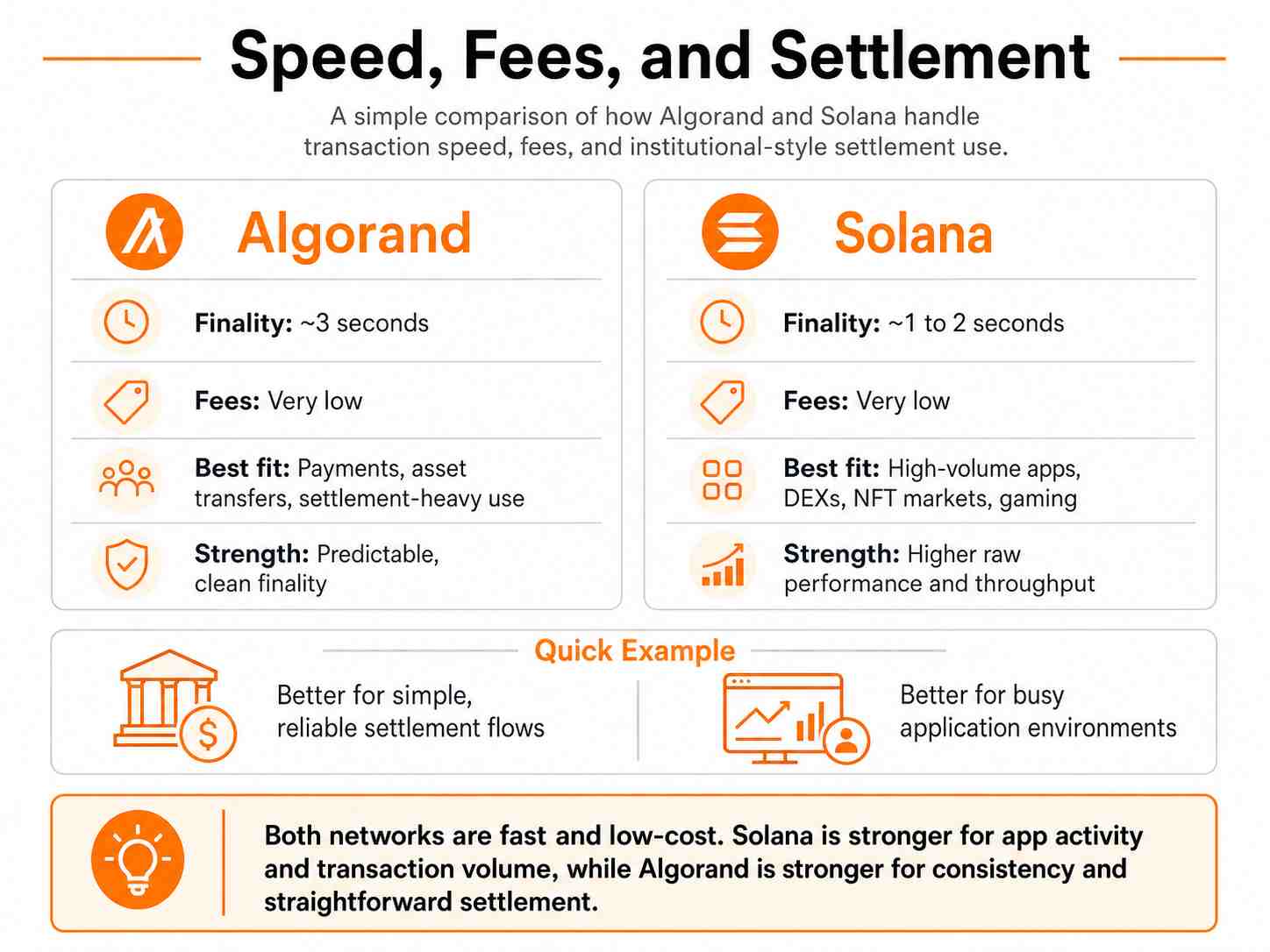
Speed matters because institutions do not want slow settlement windows. Payment firms, trading desks, and tokenized asset platforms need finality that is fast and predictable. In this area, both chains perform well.
Algorand reaches practical finality in around 3 seconds. Once a transaction is confirmed, it is final. There is no need to wait through several confirmation rounds. Fees are also very low, which makes it useful for payments, asset transfers, and settlement-heavy use cases.
Solana is faster in raw performance terms. It often reaches finality in around 1 to 2 seconds and is built for high transaction volume. Its parallel execution model makes it strong for apps where many actions are happening at once, such as DEX trading, NFT markets, games, and consumer-facing Web3 platforms.
This is where Algorand vs Solana needs nuance. Solana has the stronger performance story for app activity and transaction volume. Algorand has the stronger settlement story for users who care more about clean finality, low complexity, and consistency. Both are fast and cheap, but they are not optimized for the same type of adoption.
Uptime and Reliability
For institutions, uptime is not a small detail. A blockchain used for settlement, payments, or tokenized assets cannot go offline at the wrong time. If the chain stops, users cannot move value, execute trades, or complete settlement. That creates trust issues, even if the technology is fast when it works.
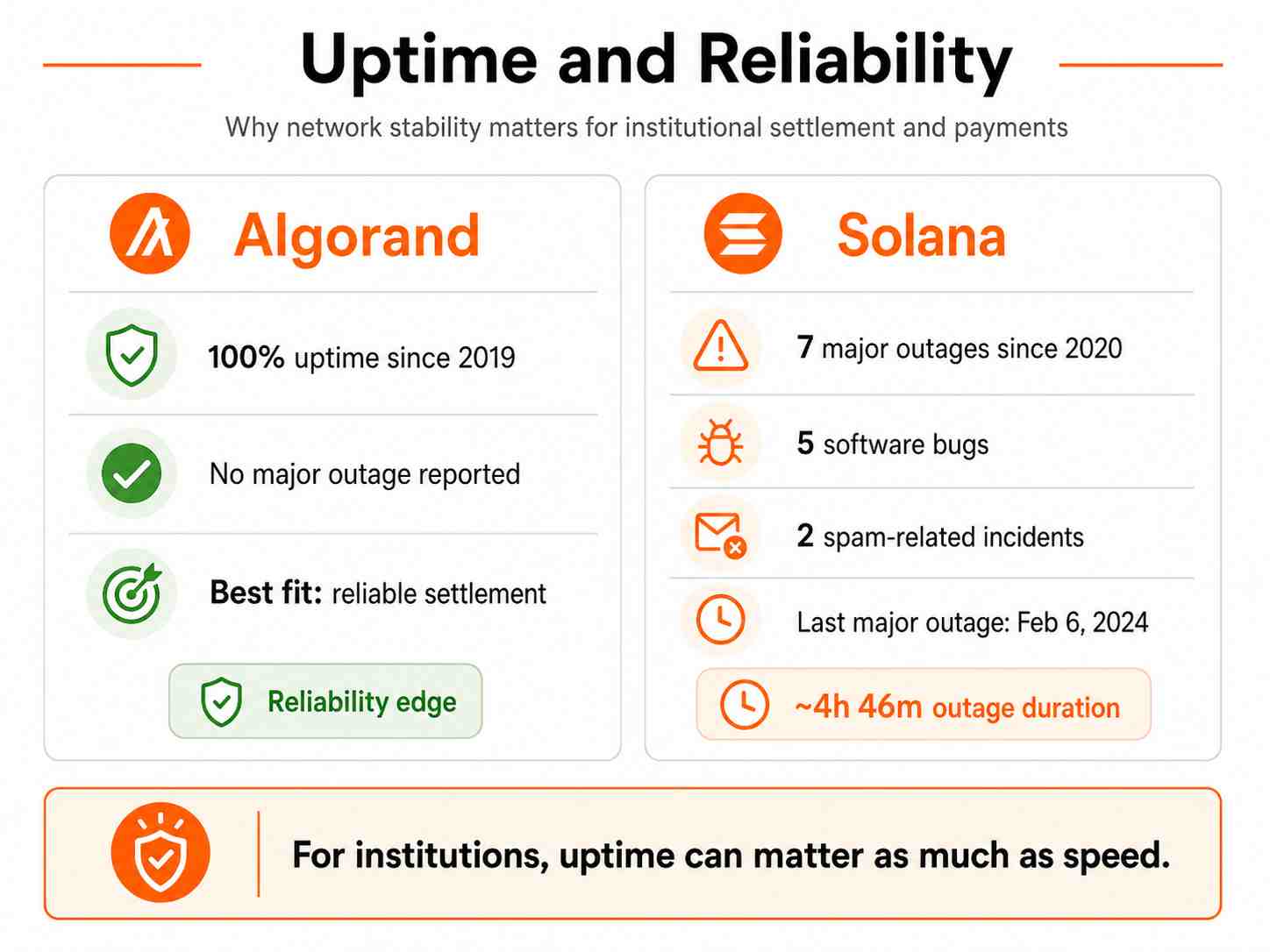
This is one of the clearest differences in Algorand vs Solana. Algorand says it has maintained 100% network uptime since launch in 2019. Its DeFi page also highlights 100% uptime since launch, along with instant finality and low transaction costs.
Solana has had a more difficult reliability history. Since its launch in 2020, Solana has experienced 7 major outage incidents, with 5 linked to client bugs and 2 linked to transaction spam, according to Helius. The last officially confirmed major outage happened on February 6, 2024, when Solana Mainnet Beta block finalization halted. Solana’s own outage report said engineers traced the problem to a bug and prepared a patched validator release for the restart. Decrypt reported that the outage lasted four hours and 46 minutes before resolution.
This does not erase Solana’s adoption or technical progress. It does, however, matter for institutional review. In a serious ALGO vs SOL comparison, Solana has better ecosystem activity, but Algorand has the stronger reliability record.
Security, Quantum Readiness, and Decentralization
Security is not only about today’s hacks or bugs. For institutions, long-term risk matters too. Financial infrastructure can stay in use for years, sometimes decades. That is why post-quantum planning is becoming more relevant.
This is where Algorand has a strong technical angle. Algorand introduced state proofs in 2022, signed using Falcon, a post-quantum secure digital signature scheme. In 2025, Algorand said it executed the first post-quantum transaction on a live public mainnet using Falcon signatures. Its main site also says Falcon signatures help protect the history of the chain against future quantum-computing threats.
That does not mean quantum computers are already breaking blockchains today. But it does mean Algorand is preparing earlier than most networks. For asset managers, public-sector systems, and tokenized finance platforms, that kind of planning can matter.
Decentralization is another part of the same discussion. Algorand has lower hardware needs, which can make participation easier. Solana has a large validator count, but its performance model needs stronger infrastructure. That is the tradeoff. Solana pushes for higher throughput. Algorand keeps the participation model lighter.
In a SOL vs ALGO view, Solana looks stronger for scale and user activity. Algorand looks stronger for lower operational complexity, uptime, and long-term security design.
Ecosystem and Adoption
Adoption is where Solana clearly has the stronger position today. It has more visible user activity, more apps, and more market attention. The numbers from your Solana brief show 9.2 million monthly active wallets, 83,000 daily active accounts, 2,132 validators, and more than 32 million NFTs minted. Projects like Helium, Marinade, Tensor, and Jito also show how Solana has built traction across infrastructure, staking, NFTs, and DeFi.
Algorand’s ecosystem is smaller. DeFiLlama figures from your Algorand brief showed around $41 million in TVL and about $72.7 million in stablecoin market cap. That shows there is still DeFi and payment activity, but it is not at Solana’s level.
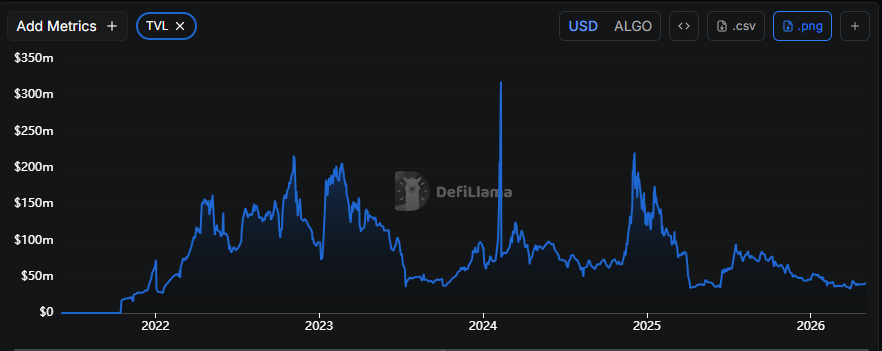
Still, the differences between Algorand and Solana are not only about which network has more users today. The institutional adoption question is deeper. Solana has the larger live ecosystem. Algorand has the stronger case around uptime, settlement finality, lower hardware needs, and post-quantum security. If future adoption is driven by institutions, both sides matter.
What Each Network Is Better Suited For
The practical Algorand vs Solana comparison comes down to the type of adoption being discussed.
Solana fits high-activity consumer and developer markets better right now. DeFi trading, NFTs, staking apps, gaming, and high-volume Web3 platforms benefit from its speed and parallel execution. Its ecosystem already has more users and more visible projects, which gives developers a stronger reason to build there.
Algorand fits settlement-focused and security-sensitive use cases better. Payments, tokenized assets, financial settlement, low-cost transfers, and systems that need high uptime may find Algorand’s design easier to trust. Its post-quantum work also gives it a stronger future-security angle than most Layer 1 networks.
That is why the comparison should not be framed as one chain replacing the other. Algorand and Solana are both fast Layer 1 networks, but their adoption paths are different. Solana is already stronger in application activity. Algorand may be better aligned with institutions that care more about reliability, security, and clean settlement.
Bottom Line
The Algorand vs Solana debate makes more sense when viewed through institutional adoption, not just retail hype. Solana has stronger current adoption, more active apps, and better ecosystem momentum. Algorand has a cleaner uptime record, fast finality, low fees, lower hardware needs, and a stronger post-quantum security story. If future adoption is led by apps, communities, NFTs, and high-volume Web3 products, Solana has a clear lead. If future adoption is led by institutions looking for reliable settlement, long-term security, and predictable network performance, Algorand has a stronger case than its current ecosystem size suggests.