


-
- •Aave V4 went live on Ethereum mainnet in March 2026, improving how liquidity moves across markets and making the protocol more efficient.
- •The SEC closed its four-year investigation into Aave in December 2025, removing a major regulatory overhang.
- •Aave now runs a $50 million annual token buyback funded by protocol revenue, which adds steady support for AAVE.
A crypto lending protocol competing with traditional banks would have sounded unrealistic a few years ago. But with the right products, steady execution, and a lending model people actually use, that gap has started to narrow. Aave is one of the clearest examples of that shift. It has already reached deposit levels that put it in the same conversation as mid-sized U.S. commercial banks, which says a lot about how far decentralized finance has come. That is what makes AAVE price prediction worth paying attention to now.
Historical Pattern: Volatility, Cycles, and Survival
AAVE has already lived through the full crypto cycle most tokens never make it past. It surged during the 2020 to 2021 DeFi boom, when cheap liquidity and fast-moving capital pushed lending protocols into the spotlight. At its peak, AAVE traded above $600 as traders priced in aggressive growth across borrowing, yield, and governance.
That phase did not last. Once liquidity tightened in 2022 and risk appetite fell, DeFi was hit hard. Lending activity slowed, token prices dropped, and weaker projects struggled to recover. AAVE was no exception. The token lost most of its peak value and spent long periods trading well below earlier highs.
What kept Aave relevant was not hype. It was product durability. While many protocols stalled or faded, Aave kept operating across chains, kept attracting deposits, and kept improving its risk systems. That history matters because it tells you something simple: AAVE has already been stress-tested in conditions that broke others.
Aave (AAVE)
New TokenToken Symbol
AAVE
Current Price
Loading...
Daily Change
Loading...
All-Time High
Loading...
Daily Low
Loading...
Daily High
Loading...
24h Volume
Loading...
Market Cap
Loading...
FDV
Loading...
Total Supply
Loading...
Max Supply
Loading...
What’s Really Moving AAVE: The Fundamental Drivers
AAVE is no longer just a token traders rotate into when DeFi starts running. Its price now reflects whether Aave can keep expanding its role as core credit infrastructure for onchain finance.
Bullish Catalysts
Aave remains the largest DeFi lending protocol by a clear margin. The protocol currently holds more than $25.98 billion in TVL, which shows users still trust it to park large amounts of capital. On top of that, Aave is generating over $545 million in annual fees, which puts it in a different class from DeFi projects that still rely mainly on narratives.
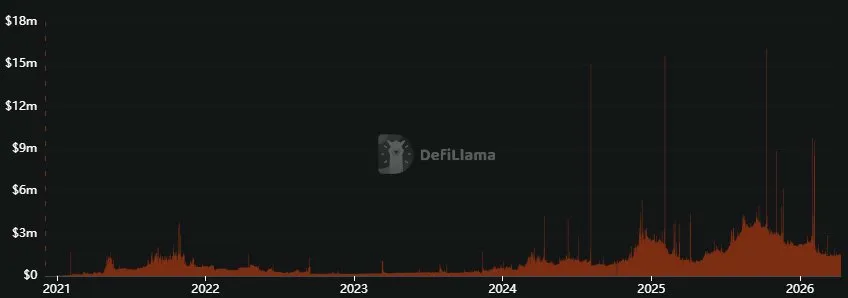
The fee trend also matters. Based on protocol data, daily fees were closer to roughly $550,000 in 2022, while recent averages are now around $1.5 million. DeFiLlama’s fee chart also points to a broader uptrend in daily revenue, with several spikes above $15 million during late 2025 when borrowing activity and protocol usage picked up sharply. That kind of improvement matters more than short-term price spikes because it shows the platform is handling more real activity, not just attracting temporary traders.
A major recent catalyst was Aave V4’s Ethereum mainnet launch in March 2026. The new hub-and-spoke design is built to improve capital efficiency and let Aave support more tailored lending markets without splitting liquidity too aggressively. If V4 performs well, it can make Aave harder to compete with over time.
Another important development is the protocol’s $50 million annual buyback program, funded through revenue. Buybacks do not guarantee higher prices, but they do create steady structural demand and reduce available supply over time. In a market where token inflation often hurts holders, this is one of the cleaner support mechanisms you can ask for.
Beyond DeFi-native users, Aave is also pushing toward broader financial use cases. Its Horizon RWA market has already crossed $550 million in deposits, with plans to grow further through institutional partnerships. At the same time, the GHO stablecoin crossed $500 million in supply, which helps keep more value inside Aave’s own ecosystem.
There is also the retail angle. The new Aave App, which offers savings products with up to 9% APY, could bring in users who care less about DeFi mechanics and more about simple yield access. That matters because if Aave can become easier for regular users to access, it changes how people think about its growth ceiling.
Bearish Pressures
Strong protocol growth does not remove risk. AAVE still trades inside a market where sentiment can change quickly, and DeFi remains exposed to issues that traditional investors are often not comfortable ignoring.
The first issue is regulation. Even though the SEC closed its 4-year investigation into Aave in late 2025, DeFi is still under pressure in major markets. New stablecoin rules, lending restrictions, or compliance burdens could affect usage.
Second, token holders do not directly receive protocol revenue in the same way equity holders receive company cash flow. That means price support depends partly on governance demand, staking demand, and market expectations rather than a simple earnings multiple.
Competition is also getting sharper. Aave is still ahead, but platforms like Morpho and other lending protocols are becoming more efficient in certain areas. If Aave slows down on product execution, that gap can narrow faster than many expect.
You should also watch governance and contributor shifts. Aave Labs is still pushing major upgrades, but recent changes in contributor relationships show that execution at this scale can get messy, especially when revenue and control become bigger issues.
Technical Analysis: AAVE’s Current Market Setup
AAVE is now trading in a market that looks very different from the one that drove its last major rally. Price is no longer moving on narrative alone. Traders are watching whether Aave’s improving fundamentals can keep attracting fresh demand while the broader market decides where risk assets go next.
Current Price and Market Position
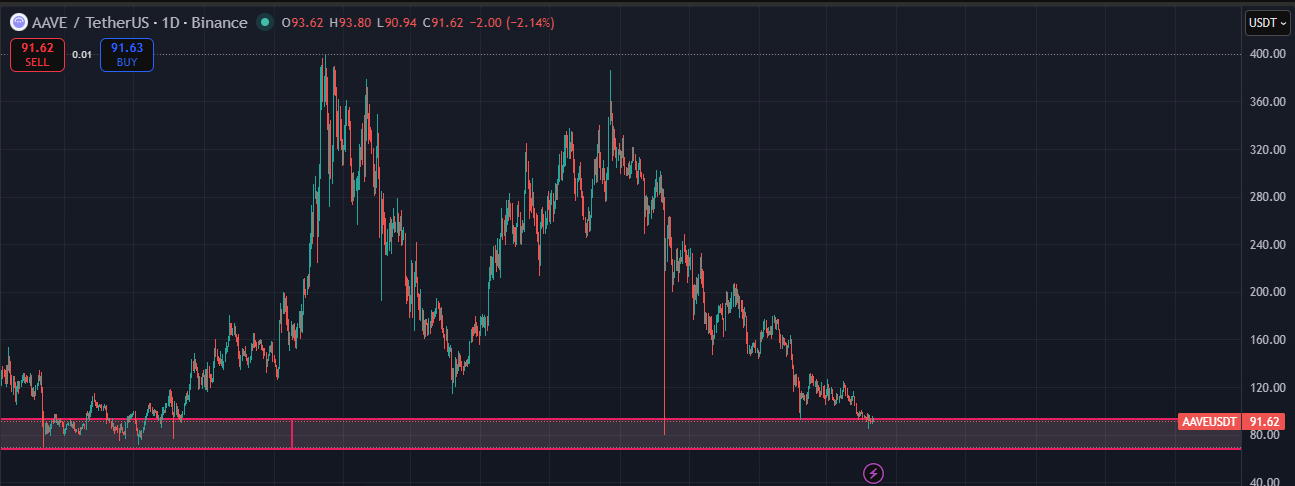
AAVE has recovered well from its post-2021 lows, but it is still trading far below its all-time high. That gap matters. It tells you two things at once: the token has already survived its hardest reset, and there is still room for re-rating if fundamentals keep improving.
What makes this setup more interesting than a normal rebound is that Aave is now in a stronger business position than it was during its last cycle peak. Back then, valuation ran ahead of actual protocol maturity. Today, you have larger TVL, deeper cross-chain usage, stronger stablecoin traction, and a clearer path toward institutional products.
If you are looking at AAVE now, the token sits in a phase where market participants are trying to decide whether recent protocol progress deserves a fresh premium, or whether much of that is already priced in.

Technical Setup
From a technical point of view, AAVE is trading in a constructive but still cautious structure. The broader recovery trend remains intact, but upside follow-through will depend on whether buyers can defend higher lows and push through recent resistance zones.
Right now, what matters most is market behavior around support during pullbacks. When a token starts holding dips better while fundamentals improve, that usually tells you longer-term buyers are stepping in rather than waiting for a deeper flush.
That said, crypto rarely moves in clean lines. Even strong assets can see sharp corrections when Bitcoin weakens or macro conditions tighten, and AAVE is still sensitive to broader DeFi sentiment.
Sentiment and Participation Trends
Aave’s current market tone looks stronger than many DeFi peers because participation is no longer driven only by short-term traders looking for quick upside.
Institutional interest is becoming more visible through Aave’s RWA push, while retail-facing products like the Aave App can help expand its user base over time. There is also a practical accessibility angle here. Since Aave runs primarily on Ethereum, many users access the protocol through a MetaMask wallet setup, which keeps onboarding relatively simple for anyone already active in DeFi.
Another factor supporting sentiment is scale. Aave is no longer viewed only as a crypto-native lending app. At peak deposit levels in 2025, the protocol held enough user capital to be discussed alongside mid-sized U.S. commercial banks by deposit scale. That comparison matters because it changes how investors look at Aave. Instead of treating it as another speculative DeFi token, more market participants now see it as proof that onchain credit can compete with parts of traditional finance in real terms.
More importantly, Aave is still one of the few DeFi protocols people recognize outside niche crypto circles. That brand trust matters. In crypto, users often return to what they already know works, especially after going through difficult market phases.
Price Outlook Based on Current Conditions
AAVE price prediction in the near term depends on how well the protocol converts strong fundamentals into fresh token demand, while also staying supported by broader crypto sentiment.
Short-Term Outlook for 2026
- Bear case: If broader crypto sentiment weakens, DeFi activity slows, or V4 adoption takes longer than expected, AAVE could lose momentum and revisit lower support zones. In that case, price may trade in the $180 to $220 range.
- Base case: If protocol revenue stays healthy, buybacks continue, and V4 rolls out steadily without major issues, AAVE could keep building gradually. This is the most balanced setup right now, with a realistic range of $240 to $320.
- Bull case: If Aave V4 scales well, Horizon expands faster, and the Aave App brings in meaningful retail traction, the token can move into a stronger repricing phase. In that case, AAVE may test $350 to $450 during 2026.
Future Outlook and AAVE Price Predictions
Aave’s long-term case is stronger than most DeFi projects because it is already operating at scale. The question is less about whether Aave survives and more about how much of onchain lending, RWA credit, and retail savings it can capture over time.
| Year | Bear Case | Base Case | Bull Case |
|---|---|---|---|
| 2026 | $180 | $280 | $420 |
| 2027 | $220 | $340 | $500 |
| 2028 | $260 | $400 | $600 |
| 2029 | $300 | $470 | $700 |
| 2030 | $350 | $550 | $850 |
Bottom Line
AAVE price prediction looks more grounded now than it did in earlier cycles because the protocol has real scale behind it. You are looking at a DeFi project with strong revenue, large deposits, product expansion, and clearer long-term direction than most of its peers. That does not remove risk, and short-term swings will still be part of the ride. But if you are planning to buy AAVE, it helps to focus less on short-term noise and more on whether DeFi lending keeps maturing and Aave continues executing, because that is where its stronger long-term case stands compared with many large-cap altcoins.
FAQs
1. What affects AAVE price the most?
AAVE’s price is mainly influenced by Aave’s TVL, protocol revenue, user growth, DeFi market sentiment, major upgrades like V4, and broader crypto conditions led by Bitcoin.
2. Is AAVE still a good long-term project?
Aave remains one of the strongest DeFi projects because it has survived multiple market cycles, kept growing its user base, and continues launching new products. That gives it stronger long-term fundamentals than many altcoins.
3. Can AAVE reach $1,000?
AAVE reaching $1,000 is possible, but it would require a much larger market re-rating. With a current market cap of around $1.4 billion, a $1,000 price would push Aave’s valuation to roughly $16 billion based on current circulating supply. That is not impossible in a strong cycle, but it would likely need sustained DeFi growth, higher protocol revenue, and stronger institutional demand.
4. How does Aave make money?
Aave earns fees from lending and borrowing activity across its markets. Protocol revenue has grown steadily, with annual fees now above $545 million, which supports buybacks and ecosystem expansion.