


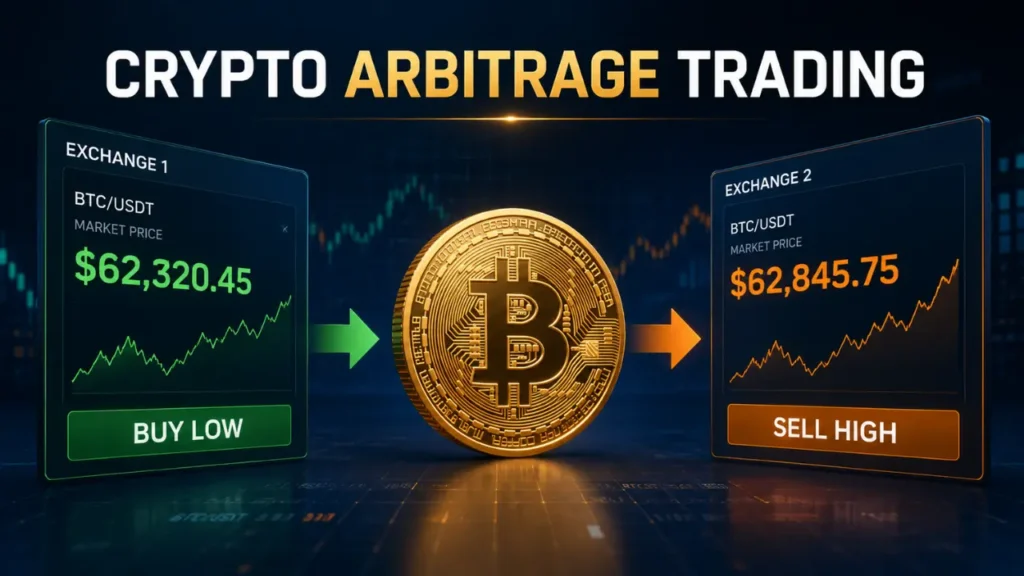
- •Crypto arbitrage trading involves profiting from price differences for the same asset across different markets.
- •Arbitrage can reduce exposure to market direction, but fees, slippage, delays, and liquidity still create risks.
Arbitrage is not a new trading strategy. It has been practised for generations across traditional markets and has also found its place in cryptocurrencies. Crypto arbitrage involves taking advantage of market inefficiencies by profiting from price differences across exchanges. What makes it particularly attractive is that crypto markets operate around the clock and are entirely digital. Traders can monitor multiple exchanges remotely or automate parts of the process using dedicated software. In this article, we explain how crypto arbitrage trading works, its different types, available tools, and the risks involved.
What is Arbitrage Trading in Crypto?
Crypto prices can vary across exchanges, and taking advantage of these price differences is known as crypto arbitrage trading. A trader buys a crypto asset at a lower price on one exchange and sells it at a higher price on another. The difference between both prices, after deducting trading fees, withdrawal charges, network fees, and other costs, becomes the trader’s profit.
These opportunities appear because every exchange operates as a separate marketplace with its own buyers, sellers, liquidity, and trading activity. When demand for an asset is higher on one exchange, its price may temporarily rise above the price available elsewhere. However, these gaps can disappear within seconds as traders place orders and bring prices closer together. Speed is therefore important in crypto arbitrage, which is why many traders use software to monitor exchanges or automate their trades. Still, a visible price difference does not necessarily guarantee a profitable trade.
For example, CoinMarketCap shows that Bitcoin can have slightly different prices across exchanges. These are all top-tier exchanges, yet Bitcoin is not priced exactly the same on each one.
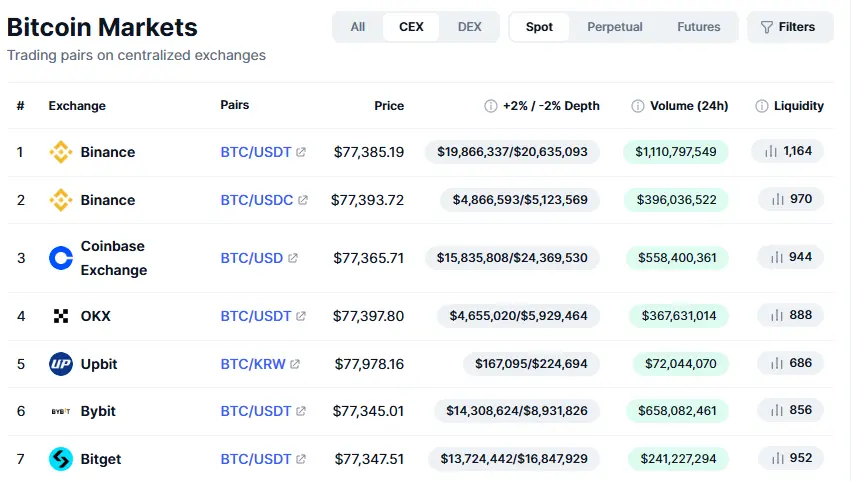
Crypto arbitrage involves taking advantage of these price differences by buying Bitcoin at a lower price on one exchange and selling it at a higher price on another. Traders need to act quickly, as these differences usually last only briefly.
Types of Crypto Arbitrage
Crypto arbitrage can take several forms depending on where the price difference occurs and how traders structure the trade to capture it.
Cross-Exchange Arbitrage
Cross-exchange arbitrage involves buying a cryptocurrency on one exchange where its price is lower and selling it on another where it trades higher. Traders may transfer the asset between exchanges or keep funds on both platforms to execute both trades quickly before the price difference disappears.
Triangular Arbitrage
Triangular arbitrage takes place within a single exchange and involves trading between three cryptocurrency pairs. For example, a trader may exchange USDT for BTC, BTC for ETH, and ETH back into USDT. If pricing differences exist between these pairs, the final USDT balance may exceed the starting amount.
CEX-DEX Arbitrage
CEX-DEX arbitrage occurs when a cryptocurrency has different prices on a centralized exchange and a decentralized exchange. Traders buy the asset from the cheaper market and sell it on the more expensive one. The calculation must account for trading fees, blockchain fees, slippage, and transaction confirmation times.
Funding Rate Arbitrage
Funding rate arbitrage targets the periodic payments exchanged between long and short traders in perpetual futures markets. A trader may buy an asset in the spot market and open an equivalent short perpetual position. This reduces exposure to price movements while allowing the trader to collect positive funding payments.
Cross-Border Arbitrage
Cross-border arbitrage involves price differences between cryptocurrency markets operating in different countries. These opportunities often result from local demand, currency restrictions, or limited market access. Traders buy crypto in the lower-priced market and sell it in the higher-priced country, although capital controls and currency conversion can complicate the process.
Costs of Crypto Arbitrage Trading
A visible price difference does not represent the final profit. Traders may incur several costs while buying, transferring, and selling crypto:
- Trading fees: Charged when buying and selling assets on exchanges.
- Withdrawal fees: Applied when moving crypto away from an exchange.
- Network fees: Paid for processing transactions on the blockchain.
- Deposit fees: Some platforms charge for certain deposit methods.
- Slippage: The executed price may differ from the displayed price.
- Currency conversion fees: Incurred when converting between fiat currencies.
- Funding payments: Applicable when holding perpetual futures positions.
- Borrowing costs: Charged when borrowed funds or assets are used.
- DEX fees: Liquidity provider fees charged on decentralized exchanges.
- Gas fees: Required for executing transactions through smart contracts.
- Bridge fees: Charged when moving assets between blockchain networks.
- Tax liabilities: Arbitrage profits may be taxable depending on local laws.
How to Find Crypto Arbitrage Opportunities
Finding workable opportunities requires more than comparing the last traded prices shown across exchanges.
Compare Bid and Ask Prices
Compare the lowest ask price where the asset will be purchased with the highest bid price where it will be sold. Last traded prices may no longer be available.
Use Arbitrage Scanners
Arbitrage scanners compare prices across multiple exchanges and highlight possible opportunities. Some also filter results according to fees, liquidity, supported networks, and expected returns.
Monitor Liquidity and Volume
Order-book depth shows how much BTC or ETH is available at each price. Trading volume also helps determine whether an opportunity can be executed without significant slippage.
Watch Market Inefficiencies
Price differences can appear during sudden market movements, listing announcements, regional demand changes, or exchange-specific activity. Price alerts help traders respond when spreads reach a selected level.
Confirm Deposits and Withdrawals
Confirm that both exchanges support deposits and withdrawals through the same network. Some price differences exist because withdrawals are suspended, making the trade impossible to complete.
Risks Involved in Crypto Arbitrage
Crypto arbitrage is generally considered less exposed to market direction, but it is not without risk. Speed is one of the biggest challenges, as price differences can disappear before both sides of the trade are completed. Transfer delays, network congestion, or failed orders may also affect execution.
Trading, withdrawal, network, and currency-conversion fees can further reduce the expected return. Slippage and limited liquidity may cause orders to fill at prices different from those initially displayed. As a result, a visible price difference does not always translate into an actual profit.
Tips to Maximize Profit on Crypto Arbitrage Trading
Because arbitrage margins are often small, faster execution and lower costs can improve the final result.
Use Automated Bots
Arbitrage bots monitor several exchanges and execute trades faster than manual traders. However, they require monitoring because incorrect settings or delayed data can lead to unintended trades.
Choose Low-Fee Exchanges
Lower trading and withdrawal fees leave more of the price difference available as profit. Traders can compare our list of no-fee crypto exchanges offering zero-fee trading on selected markets.
Keep Exchanges Pre-Funded
Keeping funds on multiple exchanges allows traders to buy and sell at nearly the same time. This removes the need to wait for a transfer after finding an opportunity.
Check Liquidity Before Trading
Order-book depth shows whether the complete trade can be filled near the displayed price. Limited liquidity can cause slippage, particularly when placing larger orders.
Set a Minimum Spread
The price difference should be large enough to account for all expected costs. A minimum spread prevents trades where fees and slippage could consume most of the return.
Bottom Line
Crypto arbitrage trading turns small price differences between markets into trading opportunities. Its appeal comes from the always-open nature of crypto markets, although fees, speed, liquidity, and execution determine whether a visible spread produces a return. For readers more interested in following established traders than tracking exchange prices, our list of the best crypto copy trading platforms presents another approach.
FAQs
1. Is Crypto Arbitrage Trading Legal?
Crypto arbitrage is generally legal where cryptocurrency trading is permitted, but local laws and tax rules still apply.
2. Is Crypto Arbitrage Profitable?
It can be profitable when the price difference exceeds fees, slippage, and other trading costs.
3. How Much Money Is Needed for Crypto Arbitrage?
There is no fixed minimum. The required amount depends on exchange limits, fees, and the available price difference.
4. Which Cryptocurrencies Are Best for Arbitrage?
BTC and ETH are commonly used because they have high liquidity and trade across many exchanges.
5. Can Crypto Arbitrage Be Automated?
Yes, arbitrage bots can monitor multiple exchanges and automatically execute trades when selected conditions are met.