




- •A crypto bear market is a prolonged decline characterized by lower highs, lower lows, and weakening investor demand.
- •The traditional 20% decline threshold is less reliable in crypto because sharp corrections can occur even during bull markets.
- •Extreme fear and capitulation can appear near market bottoms, but they do not confirm that a recovery has begun.
- •Some cryptocurrencies never recover after a bear market, making project development, funding, tokenomics, and liquidity essential factors to evaluate.
Bear markets can be harsh, especially if you entered the market near the top. Hearing some people on Crypto Twitter call a decline “just a correction” while others warn that another bear market has begun can leave new investors confused. Bear markets are not unique to crypto. They occur across asset classes, including gold and US stocks, and are something every investor should understand. In this article, we explain what a crypto bear market is, how it begins, which signs investors follow, and how to navigate a prolonged market decline.
What Is a Bear Market?
A bear market in crypto is a prolonged period during which the prices of Bitcoin and other cryptocurrencies are generally falling or expected to continue falling. It is not defined by one bad day or a sudden crash. The decline usually continues for months and is accompanied by weaker demand, negative investor sentiment, reduced liquidity, and lower market participation.
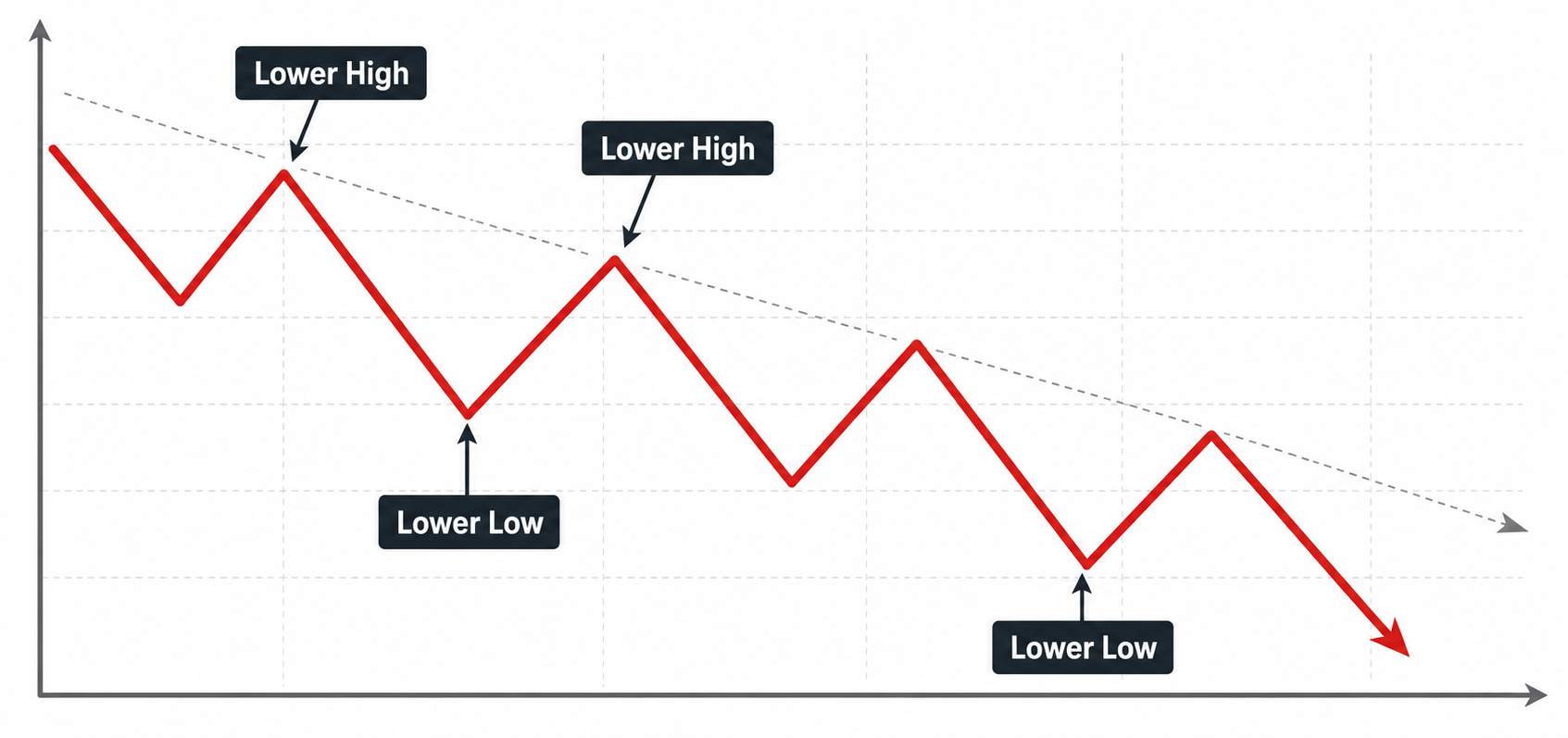
On price charts, bear markets commonly form lower highs and lower lows. Prices may recover temporarily, but each rally fails to reach the previous high before selling resumes. These temporary recoveries are often called bear-market rallies.
However, one cryptocurrency falling sharply does not mean the entire crypto market is bearish. Its decline could result from problems specific to that project.
How a Bear Market Begins
A bear market can begin while investor sentiment is still positive. Prices stop making convincing new highs, rallies attract fewer buyers, and important support levels eventually break. If buying demand remains weak, former support can become resistance, leading to further declines.
The change can be triggered by tighter financial conditions, regulatory uncertainty, major hacks, exchange failures, or problems within large crypto projects. High leverage can make the decline worse, as falling prices liquidate positions and force more selling.
There is no announcement confirming when a bear market has started. It usually becomes clear only after weakness continues and a downward market structure has formed.
Phases of a Bear Market
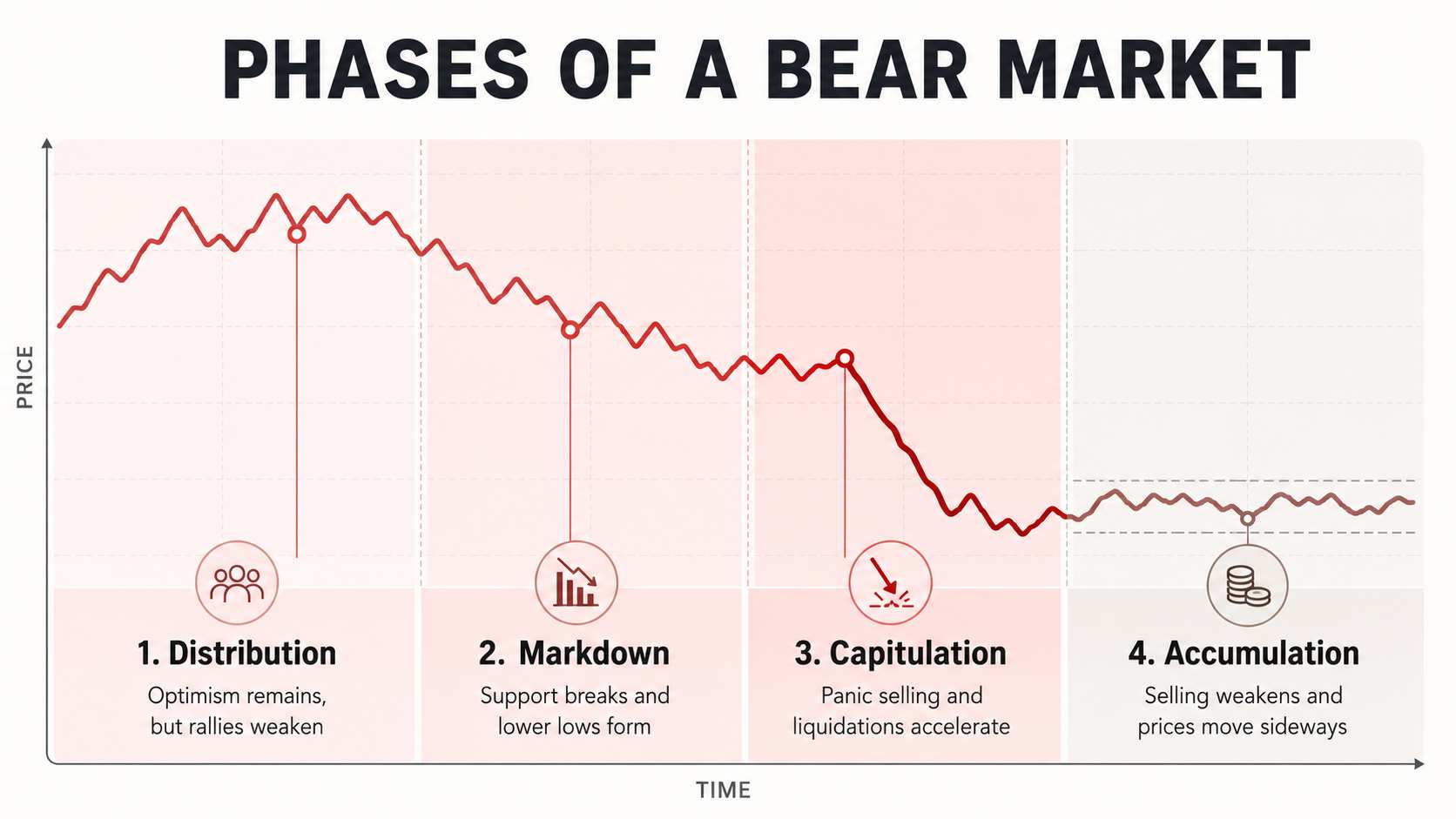
Bear markets do not always follow the same path, but they can generally move through 4 stages:
- Distribution: Sentiment remains positive, but early investors begin taking profits and rallies gradually lose strength.
- Markdown: Support levels break, lower highs and lower lows form, and declining prices become more noticeable across the market.
- Capitulation: Panic selling and forced liquidations can cause a sharp decline accompanied by unusually high trading volume.
- Accumulation: Selling pressure weakens, prices begin moving sideways, and long-term buyers gradually return. However, accumulation does not immediately confirm a new bull market.
Characteristics of a Crypto Bear Market
A crypto bear market is marked by sustained weakness across the wider market rather than a decline in one cryptocurrency. Bitcoin and altcoins generally form lower highs and lower lows, recovery attempts fail, and former support levels become resistance. Sentiment also turns negative as investors move towards cash, stablecoins, or less speculative assets.
Liquidity and market participation often decline as interest fades. Volatility can remain high, particularly during liquidations and panic selling. Trading volume does not always increase throughout a bear market. It may remain low during quiet periods before rising sharply during major sell-offs.
Bear Market vs. Market Correction
A market correction is a temporary decline within a wider upward trend, while a bear market is a longer period of sustained price weakness.
| Factor | Market Correction | Bear Market |
|---|---|---|
| Price Decline | Traditionally 10% or more | Traditionally 20% or more |
| Duration | Usually days or weeks | Can continue for months |
| Market Structure | Wider upward trend remains | Lower highs and lower lows form |
| Recovery | Prices reclaim previous levels | Rallies repeatedly fail |
The traditional 20% rule is less reliable in crypto because declines of 20% or more can occur during an ongoing bull market. The duration, wider market structure, and strength of the recovery provide more context than the percentage decline alone.
How to Identify a Crypto Bear Market
Bear markets are easier to identify in hindsight. While the market is falling, investors usually look for several signals pointing in the same direction rather than relying on one indicator.
| Indicator | What to Look For | Important Context |
|---|---|---|
| Bitcoin Market Structure | Lower highs, lower lows, failed breakouts, and broken support. | Continued weakness matters more than one decline. |
| Moving Averages | Price below the 200-day average and a death cross. | Moving averages confirm trends after they begin. |
| Monthly MACD | MACD crossing below its signal line. | The crossover often appears after prices have fallen. |
| Fear and Greed Index | Prolonged fear and weak investor confidence. | Extreme fear does not confirm the bottom. |
| Volume and Liquidity | Lower spot volume, stablecoin inflows, and participation. | Volume can spike temporarily during panic selling. |
| Bitcoin Dominance | Rising dominance as altcoins underperform. | It does not show whether Bitcoin has bottomed. |
| On-Chain Indicators | Realized price, MVRV, realized losses, exchange flows, and holder activity. | These indicators should be assessed together. |
Is the Market Bottoming?
A capitulation event involving forced liquidations, panic selling, or unusually high volume can occur near the final stages of a bear market. However, one sharp crash does not confirm the bottom.
A bottom becomes more credible when prices stop making lower lows, remain within a stable range, reclaim important levels, and begin forming higher lows. Long-term holder accumulation and improving spot demand can provide further context.
How Long Does a Crypto Bear Market Last?
There is no fixed duration for a crypto bear market. After Bitcoin reached nearly $20,000 in December 2017, it fell to around $3,200 by December 2018. The next major cycle took Bitcoin from approximately $69,000 in November 2021 to around $15,500 one year later.
Both declines took roughly a year to reach their cycle lows, but this does not create a one-year rule. Prices can also move sideways for months after the lowest point before confidence and participation return.
How to Navigate a Bear Market
Bear markets can continue longer than investors expect, so buying every dip or investing everything at once can leave little room if prices keep falling. Navigating one begins with protecting capital, maintaining liquidity, and carefully reviewing both existing and new investments.
Protect Capital and Liquidity
Avoid unnecessary leverage and keep some funds available instead of investing everything at once. Money needed for upcoming expenses should not be exposed to a prolonged market decline.
Research Before Buying Dips
A falling price does not automatically make a cryptocurrency undervalued. Check whether the project still has active development, genuine usage, sufficient liquidity, manageable token unlocks, reliable leadership, and enough funding to continue operating. Some cryptocurrencies never recover.
Use DCA Without Assuming the Bottom
Dollar-cost averaging spreads purchases across several dates, reducing dependence on one entry price. However, it cannot prevent losses if the market or selected asset continues falling.
Investors who do not want to select and rebalance several coins manually can also consider crypto index products. Bitpanda offers several Crypto Indices covering different basket sizes and market segments. The BCI10, for example, provides exposure to 10 cryptocurrencies selected using market capitalisation and liquidity, with monthly rebalancing. Another option is CMC20, an index token tracking 20 major crypto projects, available through MEXC and Aster. These products reduce manual portfolio management but do not protect against market-wide losses.
Reduce Counterparty Risk
Bear markets can expose financial problems within exchanges, lenders, and other crypto platforms. Funds being held for the long term can be moved to secure storage, while only the amount required for trading remains on an exchange.
Bear Market Mistakes to Avoid
Falling prices are not the only source of bear-market losses. Decisions made in response to those prices can increase the damage, especially when investors act without research or try to recover losses quickly.
| Mistake | Why It Is Risky |
|---|---|
| Trying to Catch the Exact Bottom | The bottom is only clear afterwards. |
| Buying Every Dip | Some projects continue falling or fail. |
| Averaging Down Without Research | The original investment case may have changed. |
| Using Excessive Leverage | Volatility can quickly liquidate positions. |
| Holding Failed Projects Indefinitely | Previous highs do not guarantee recovery. |
| Investing Money Needed Soon | Investors may be forced to sell at a loss. |
| Ignoring Exchange Solvency | Withdrawals can be restricted if a platform fails. |
Tips for Navigating a Bear Market
Bear markets can be slow and uncertain, making it important to follow a plan instead of reacting to every price movement.
- Prepare for several outcomes: Prices may decline further, move sideways, or begin recovering.
- Build a watchlist: Research promising projects without feeling pressured to buy immediately.
- Review your investment case: Reconsider a position if its development, funding, usage, or liquidity weakens.
- Define risk before trading: Set the entry, stop-loss, target, and position size before opening a trade.
- Ignore influencer price targets: Base decisions on market conditions and project data.
- Track continued development: Bear markets reveal which projects can keep building without rising token prices.
What Comes After a Bear Market?
A bear market can end in different ways. Prices may recover quickly after heavy selling, or the market may spend months moving sideways while buyers and sellers reach a new balance. The change usually becomes visible through improving price structure, liquidity, and participation rather than one clear event. Our bull vs. bear markets comparison explains how the two phases differ and what changes as the market moves from one to the other.
FAQs
1. What Qualifies as a Crypto Bear Market?
A crypto bear market is a prolonged period of declining prices, weak demand, and negative sentiment. The traditional 20% threshold provides context, but market structure and duration matter more in crypto.
2. Is a Crypto Winter a Bear Market?
A crypto winter generally refers to a particularly long and severe bear market. It is often accompanied by weak trading activity, declining funding, project failures, and reduced public interest.
3. Do All Cryptocurrencies Recover After a Bear Market?
Many cryptocurrencies never return to their previous highs. Projects can lose users, funding, liquidity, or developer support, while increasing token supply can make previous prices more difficult to reclaim.