


- •Resting limit orders add liquidity and usually receive maker fees.
- •Limit orders may become taker orders if they execute immediately.
- •Post-only helps preserve maker status and avoid taker fees.
- •0% maker fees may apply to spot, futures, or both.
- •Liquidity and spreads directly affect fill quality.
- •Advanced order types provide greater execution control.
The maker-and-taker concept is not new. It has been adopted from traditional markets, though not exactly in its original form, as crypto exchanges have adjusted it slightly. Even then, maker fees are generally more beneficial for active traders because markets tend to reward liquidity providers, and crypto markets are no different. As a trader, finding crypto exchanges for limit orders with 0% maker fees can lower your trading costs, and in this article, we will identify the exchanges that offer them.
Difference Between Limit and Market Orders
First, let’s clear up what the difference between limit orders and market orders is.
Limit orders that rest in the order book are so-called “passive market participants” or maker orders and don’t immediately move the price of an asset. If you place a limit order, you are placing an order into the order book at a specific price. This order will only be executed when the market reaches your price and sufficient liquidity is available. The average limit order fees are 0.02%. When you look at an order book, the prices and quantities shown are resting limit orders.
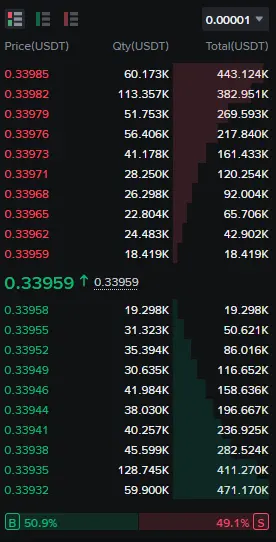
These resting limit orders add liquidity to the order book. For example, if BTC is trading at $65,000 and you place a limit buy for 1 BTC at $60,000, the exchange reserves your $60,000 until the order is filled or cancelled. You have now added buy-side liquidity to the order book.
The same applies when selling. If BTC is trading at $65,000 and you place a limit sell for 1 BTC at $70,000, the exchange reserves that 1 BTC while your order remains open. This time, you are adding sell-side liquidity.
However, not every limit order is a maker order. If your limit order can execute immediately against an existing order, it becomes a taker order. This is why traders use post-only orders when they want to ensure their orders add liquidity.
Market orders are so-called “active market participants” or taker orders. They execute immediately at the best available price. They “take” the orders from the order book, so to speak. Market orders fill the limit orders that rest in the order book, and by doing so, they remove liquidity and can move the price through different levels of the order book. That’s why they are referred to as active or aggressive. The average market order fees are 0.06%.
For example, suppose the lowest sell order contains only 0.5 BTC at $65,000. If you place a market buy for 1 BTC, your order takes that 0.5 BTC and then continues filling against the next available sell orders. Unlike a resting limit order, it does not add anything to the order book.
As you can see, limit orders are usually cheaper than market orders. While a difference of 0.04% might seem small, it can add up to a lot of money. Especially when you are using leverage, your fees relative to your margin increase a lot. Also, some crypto exchanges have slow order processing or low trading volume and liquidity, which can lead to poor order execution. That’s why choosing the best exchange for limit orders is so important.
What Makes a Crypto Exchange Good for Limit Orders
Choosing an exchange merely because it offers low maker fees is not the right way to approach it. A few other factors affect how easily your limit orders are filled:
- Deep liquidity: Enough orders should be available when the market reaches your limit price.
- Tight spreads: The highest bid and lowest ask should remain close together.
- Fast order matching: Resting limit orders should be matched quickly when the market reaches their prices.
- Advanced order controls: Look for post-only, stop-limit, OCO, and reduce-only orders.
- Simple order management: Placing, editing, and cancelling resting orders should be easy.
- Risk controls: The exchange should help you manage a position after your limit order fills.
Limit orders give you control over the execution price, but they do not guarantee a fill if the market never reaches your chosen price.
Top Crypto Exchanges With 0% Maker Fees Compared
While choosing the best crypto exchanges with 0% maker fees, we kept things quite straightforward because the available choices are limited. We included only exchanges that actually offer 0% maker fees without any hidden caveats and removed those with questionable liquidity. After these checks, here is what our finalized list of crypto exchanges with the lowest limit order fees looks like.
- Bitfinex – Best for Zero-Fee Trading
- KCEX – Best for Altcoin Limit Orders
- Ourbit – Best for Zero-Fee Spot Orders
- Aster – Best for Futures Limit Orders
1. Bitfinex
Bitfinex takes the most direct approach to trading fees: it charges 0% for both maker and taker orders across spot, margin, derivatives, and OTC trading. Among crypto exchanges with lowest limit order fees, it is the only option on our list where the zero-fee structure is not restricted to a particular order type or market.
For active traders, this removes one of the main costs involved in placing and adjusting orders frequently. You can layer limit orders, scale into a position, or close part of it without paying a trading fee every time an order is filled. Market orders are also free, so switching from a planned limit entry to an immediate execution does not introduce an additional fee.
Bitfinex also has a limit-order setup. Scaled Order distributes one order across several price levels, while Stop Limit controls when it enters the book. The Interactive Book lets you place and manage orders from the order book itself. Its modifiers include FOK, IOC, Hidden, and Post Only, covering execution timing, visibility, and maker status.
Liquidity is moderate across the exchange, although BTC and ETH markets generally have stronger order-book depth than smaller pairs. Zero trading fees also do not remove every possible cost. Margin funding interest, perpetual funding payments, spreads, and slippage can still affect the final result of a trade.
| 👍 Bitfinex Pros | 👎 Bitfinex Cons |
|---|---|
| ✅ Zero trading fees | ❌ Moderate overall liquidity |
| ✅ Advanced order controls | ❌ KYC is required |
| ✅ Interactive order book | |
| ✅ Free market executions |
2. KCEX
KCEX combines zero spot trading fees with 0% futures maker fees, making it the cheapest crypto exchange for limit orders. Spot maker and taker orders cost nothing, while futures traders pay 0% when adding liquidity and 0.01% when taking it.
This works well for traders who build positions through several resting orders. A futures trader can spread an entry across different prices without paying maker fees on every fill, while spot traders can use both limit and market orders without trading commissions. KCEX also lists more than 854 spot pairs and 805 futures pairs, leaving plenty of markets for traders who rotate between major assets and smaller altcoins.
KCEX groups its order modifiers under Advanced Limit. Post Only protects maker status, FOK requires the full order to execute immediately, and IOC accepts an immediate partial fill before cancelling the remainder. GTD keeps the order open until a selected time.
The main compromise is liquidity. KCEX has lower liquidity than the other exchanges in our comparison, with average spreads around 0.836%. Major pairs are generally more usable, but smaller markets may produce partial fills or weaker execution. KYC is optional, although verification may be requested for higher limits or account reviews.
| 👍 KCEX Pros | 👎 KCEX Cons |
|---|---|
| ✅ 0% spot trading fees | ❌ Low overall liquidity |
| ✅ 0% futures maker fees | ❌ Wider average spreads |
| ✅ 805+ futures pairs | |
| ✅ Advanced Limit modifiers |
3. Ourbit
Ourbit keeps its zero-fee offer focused on spot trading. Every spot pair carries 0% maker and taker fees, without requiring a trading volume or platform token. This makes it the best crypto app for limit order traders focused on spot.
It lists 563+ spot pairs, from major cryptocurrencies to newer tokens. With both sides free, you can layer limit orders, rebalance positions, or exit through a market order without commissions.
Order controls are limited. Ourbit offers Post Only, which prevents a marketable limit order from executing immediately as a taker order and helps preserve the 0% maker rate. This matters for orders placed near market.
Liquidity is moderate, with an average spread of 0.56%. However, depth can change considerably between major pairs and less active tokens, so the 0% fee should not be considered separately from execution quality.
Ourbit also has more than 752 futures pairs, but they are not included in its zero-fee policy. Futures fees are 0.02% for makers and 0.04% for takers. KYC is optional for regular trading, although some services or account checks may require verification.
| 👍 Ourbit Pros | 👎 Ourbit Cons |
|---|---|
| ✅ 0% spot maker fees | ❌ Limited order modifiers |
| ✅ 0% spot taker fees | ❌ Futures fees still apply |
| ✅ 563+ spot pairs | |
| ✅ Optional KYC |
4. Aster
Aster is the best decentralized exchange for limit orders here, particularly for perpetual futures. It charges 0% on futures maker orders, while taker orders cost 0.04%. Resting futures orders can therefore enter the book without trading fees across repeated maker fills.
Aster has high liquidity and our lowest average spread at 0.234%. A zero maker fee matters less when thin books create poor execution. Its 545+ futures pairs cover crypto, stock, forex, and other perpetual markets.
Its limit-order selection includes Chased Orders, Scaled Orders, Stop Limit, Post Only, TWAP, and Hidden Limit Orders. Chased Orders follow the best available price, while TWAP divides a larger order over time. GTC and IOC modifiers determine whether an unfilled order remains open or cancels after immediate execution.
Since Aster is decentralized, you can connect a wallet and trade without completing traditional KYC. However, the 0% rate applies only to futures maker orders. Spot trading costs 0.005% for makers and 0.04% for takers, while futures takers pay 0.04%. Funding payments can still apply to perpetual positions, even when the entry carries no maker fee.
| 👍 Aster Pros | 👎 Aster Cons |
|---|---|
| ✅ 0% futures maker fees | ❌ Zero fees limited to futures |
| ✅ High futures liquidity | ❌ Difficult for complete beginners |
| ✅ Tightest average spreads | |
| ✅ Advanced limit orders |
How to Compare Exchanges for Limit Orders
A 0% maker fee may look like the most important number, but it does not tell you how easily an order will be filled. When comparing crypto exchanges for limit orders, you also need to check the available order controls, liquidity, spreads, and the overall trading experience.
Keeping Orders on the Maker Side
Start by checking where the advertised maker fee actually applies. Some exchanges offer 0% maker fees across spot and futures, while others restrict them to one market. You should also confirm whether the rate applies to every user or depends on trading volume, VIP status, or a temporary promotion.
Post Only is equally important because a limit order is not automatically a maker order. If it can match an existing order immediately, it may execute as a taker order. Post Only prevents this by cancelling the order rather than allowing it to remove liquidity.
Also compare the available modifiers. FOK, IOC, GTC, and GTD determine how long an order remains active and whether partial fills are accepted.
Checking Order-Book Depth and Spreads
Zero maker fees do not provide much value if the order book lacks sufficient liquidity. Your order may receive a partial fill, remain open, or fail to execute even after the market briefly reaches your price.
For example, you place a limit buy for 10 ETH at $3,500. The price falls to your level, but only 4 ETH are available before it rises again. You receive 4 ETH, while the remaining 6 ETH stay unfilled.
Spreads should also be checked for the specific pair you plan to trade. Major BTC and ETH pairs normally have tighter spreads than less active altcoin markets. A high exchange-wide trading volume does not mean every listed pair has the same depth.
Managing Orders and Execution
Execution quality determines what happens after the market reaches your limit price. A resting order may still remain unfilled because other orders were placed ahead of it, there was not enough opposing volume, or the price remained at that level for only a short period.
The interface should make it easy to review the order book, place an order, adjust its price, and cancel it without moving through several screens. Interactive order books and chart-based order placement can be particularly useful for active traders.
For futures, the platform should also show open positions, margin, liquidation prices, and attached take-profit or stop-loss orders clearly. The right exchange is one that lets you manage orders without creating avoidable execution mistakes.
Advanced Order Types Traders Should Understand
Limit orders are not limited to choosing a price and waiting for it to fill. Exchanges offer several order types and modifiers that help you control when an order enters the book, how much of it is displayed, and what happens if it cannot be filled.
| Order Type / Modifier | How It Works as a Limit Order | Best Used For |
|---|---|---|
| Stop-Limit | Places a limit order after the stop price is reached. | Price-controlled entries and exits |
| Post-Only | Cancels the order if it would execute immediately as a taker. | Preserving maker status |
| Trailing Stop-Limit | Moves the stop with the market, then places a limit order when triggered. | Protecting profits with price control |
| OCO | Links a limit order with a stop-limit order. When one executes, the other cancels. | Managing profit and loss exits |
| Hidden Order | Places a limit order without displaying it in the public order book. | Concealing large orders |
| Iceberg | Shows only part of a larger limit order and reveals new portions as fills occur. | Reducing large-order visibility |
| Chase Limit Order | Reprices the order to follow the best bid or ask within selected limits. | Keeping orders near market |
| Scaled Limit Order | Places multiple limit orders across a selected price range. | Building entries or exits gradually |
| TWAP | Splits a large order into smaller orders placed over a selected period. | Reducing overall market impact |
Time-in-Force modifiers determine how long a limit order remains active and what happens when it cannot be filled immediately:
- Good-Til-Cancelled (GTC): Keeps the order open until it fills or you cancel it.
- Good-Til-Date (GTD): Keeps the order open until a selected expiration time.
- Immediate-or-Cancel (IOC): Fills the available amount immediately and cancels the unfilled portion.
- Fill-or-Kill (FOK): Requires the entire order to fill immediately or cancels it completely.
Not every exchange supports all four modifiers, so check the available options before placing your order.
Bottom Line
Maker and taker fees can feel complicated until you view the order book as traders waiting at their chosen prices. Your resting limit order adds liquidity, while an immediately executed order removes it. For an active trader, that difference affects every entry, exit, and adjustment. 0 maker fees remove one cost from that process, although spreads, liquidity, and funding can still affect the final trade.
FAQs
1. Do crypto exchanges charge for limit orders?
Yes. Limit orders usually carry maker fees, although some exchanges charge 0%.
2. How to place a limit order on crypto?
Select Limit, enter your price and amount, then place the buy or sell order.
3. Can you do limit orders on Binance or Bybit?
Yes. Both Binance and Bybit support limit orders for spot and futures trading.