



- •Visa has launched USDC settlement in the United States, integrating stablecoins into its core card-network treasury operations.
- •Cross River Bank and Lead Bank are now settling transactions with Visa in USDC via the Solana blockchain.
- •Visa plans to expand stablecoin settlement access to more partners and networks through 2026.
Visa is expanding its USDC settlement infrastructure to bring regulated stablecoins deeper into US financial plumbing. The move allows banks to settle with Visa using blockchain rails, signaling a shift from experimentation toward large-scale operational use.
USDC Settlement Moves Into US Banking
Visa has taken a defining step, building on its initial experimentation with Circle’s USDC in 2021, by launching stablecoin settlement in the US, allowing select banks and fintech partners to settle obligations to the card network using USDC.
The rollout marks a major expansion of Visa’s blockchain-based settlement strategy and introduces stablecoin settlement into the US banking system at scale.
The program enables issuer and acquirer partners to move funds nearly instantly, bringing what Lead Bank CEO Jackie Reses, in a press release, described as “speed and precision to treasury operations” that help banks deliver more modern financial services, while also operating on a seven-day settlement cycle. Visa emphasized that the change is limited to the backend settlement process, leaving the consumer card experience unchanged.
Following regulatory clarity under the GENIUS Act and rising interest from traditional financial institutions, Visa said demand has shifted decisively toward real-world use.
“Visa is expanding stablecoin settlement because our banking partners are not only asking about it – they’re preparing to use it”, said Rubail Birwadker, Visa’s global head of growth products and strategic partnerships.
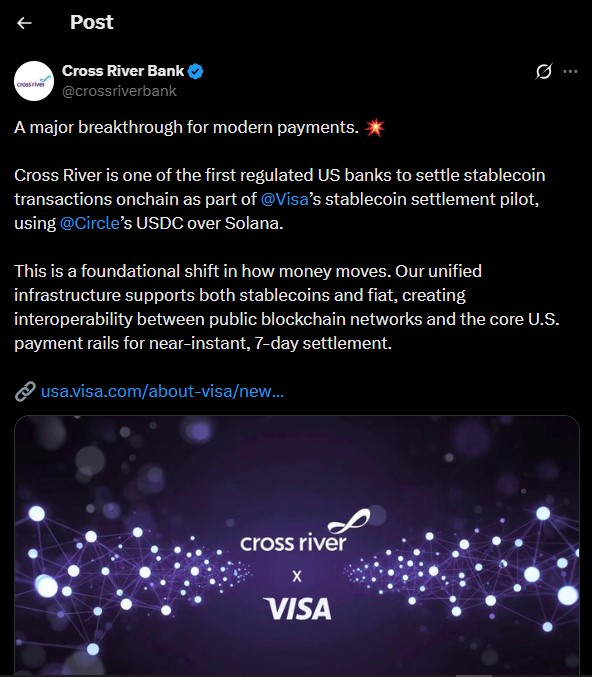
The momentum extends beyond traditional banks, with Cross River Bank noting that fintech and crypto firms are increasingly seeking to embed stablecoins into existing payment products. Against that backdrop, Cross River Bank and Lead Bank have become the first US institutions to go live, settling transactions in USDC over the Solana blockchain.
Lead Bank pointed to the importance of continuous settlement and clearer liquidity timing for fintech clients.
Cross River’s Head of Crypto, Luca Cosentino, emphasized infrastructural interoperability, stating that, “For stablecoins to realize their full potential, they must operate within unified systems. Cross River’s infrastructure is built to bring on-chain settlement safely into mainstream financial services”.
Visa further buttresses Lead’s CEO Jackie Rese’s statement, saying that partner interest has moved from experimentation to modernised execution, as the collaboration “helps card-issuing financial institutions modernize treasury and unlock new services while retaining the transparency and trust that USDC is known for”, said Nikhil Chandhok, Circle’s Chief Product and Technology.
From Settlement to Infrastructure Expansion
Beyond settlement itself, Visa is deepening its infrastructure relationship with Circle. The payments giant will serve as a lead design partner for Circle’s Arc blockchain and plans to support USDC settlement on the network, including operating a validator node once it launches. Arc is currently in public testing and is designed as an enterprise-focused blockchain for regulated digital asset issuance and settlement.
To support adoption, Visa Consulting & Analytics has launched a Stablecoins Advisory Practice, offering strategic guidance on stablecoin use cases, implementation, and regulatory considerations.
The US stablecoin rollout also builds on Visa’s broader work with tokenized money and central bank digital currencies. Since 2021, Visa has participated in Central Bank Digital Currencies (CBDC) pilots and sandboxes with central banks, including those in Brazil and Hong Kong, contributed to policy and interoperability research through global forums, and tested tokenized settlement, positioning its network to support sovereign digital currencies if and when they launch.
As stablecoins gain traction as programmable, always-on payment rails, Visa’s US launch reinforces its strategy of integrating regulated digital dollars into mainstream settlement without altering how consumers pay.