


- •More than 199 million Ethereum addresses hold ETH, but exactly how many people hold Ethereum remains unknown.
- •The ETH2 Deposit Contract records validator deposits and displays more than 88 million ETH, but this figure does not represent the amount currently staked.
- •Rain Lõhmus is the largest individual ETH holder with 250,000 ETH, but he has lost access to his private keys.
- •Vitalik Buterin is the largest individual holder with access to his ETH, holding approximately 224,000 ETH.
- •Exchanges account for many of Ethereum’s largest holders, with Coinbase holding approximately 4.09 million ETH across identified wallets.
- •Ethereum treasury company BitMine holds approximately 5.77 million ETH, while US spot Ethereum ETFs collectively hold approximately 5.41 million ETH.
Ethereum has spent most of its history just behind Bitcoin, maintaining its position as the 2nd-largest cryptocurrency by market capitalization. It has dominated the Layer 1 blockchain space since its launch, and despite several competitors being labelled “Ethereum killers”, none has managed to take its place.
With such a large following, a common question that everyone is eager to learn more about is: How many people hold Ethereum?
While there is no single answer, we have gathered information from different sources to provide an estimate of the number of Ethereum holders, who holds the most Ethereum, and a few more interesting facts about Ethereum holders that we were able to extract from the data.
| Statistic | Latest Figure |
|---|---|
| Total Ethereum addresses | 327M+ |
| Ethereum addresses holding ETH | 199M+ |
| Estimated Ethereum owners | Unknown |
| New Ethereum addresses per day | 120K+ on average |
| Daily active Ethereum addresses | 500K–600K |
| Daily Ethereum transactions | 2.46M+ |
| ETH held by public companies | 7.426M ETH |
| ETH held by US spot ETFs | 5.41M ETH ($9.97B) |
| Largest US spot Ethereum ETF, BlackRock ETHA | 2.87M ETH ($5.28B) |
| Largest identified exchange holder, Coinbase | 4.09M ETH |
| Largest publicly identified individual wallet, Vitalik Buterin | 224,183 ETH |
| Largest public-company holder, BitMine | 5.77M ETH |
How Many People Own Ethereum?
More than 199 million Ethereum addresses currently hold ETH, according to Glassnode data. However, this does not mean that 199 million individual people own Ethereum.
The number of Ethereum owners cannot be calculated directly because blockchain data tracks addresses rather than people. One person can control several addresses, while one exchange address can hold ETH for millions of customers. Therefore, 199 million is the closest available on-chain estimate, but the actual number of individual holders is unknown.
More Than 327 Million Ethereum Addresses Have Been Used
More than 327 million Ethereum addresses have been recorded on-chain. Of these, over 199 million currently hold a positive ETH balance, while approximately 128 million currently have a zero ETH balance.
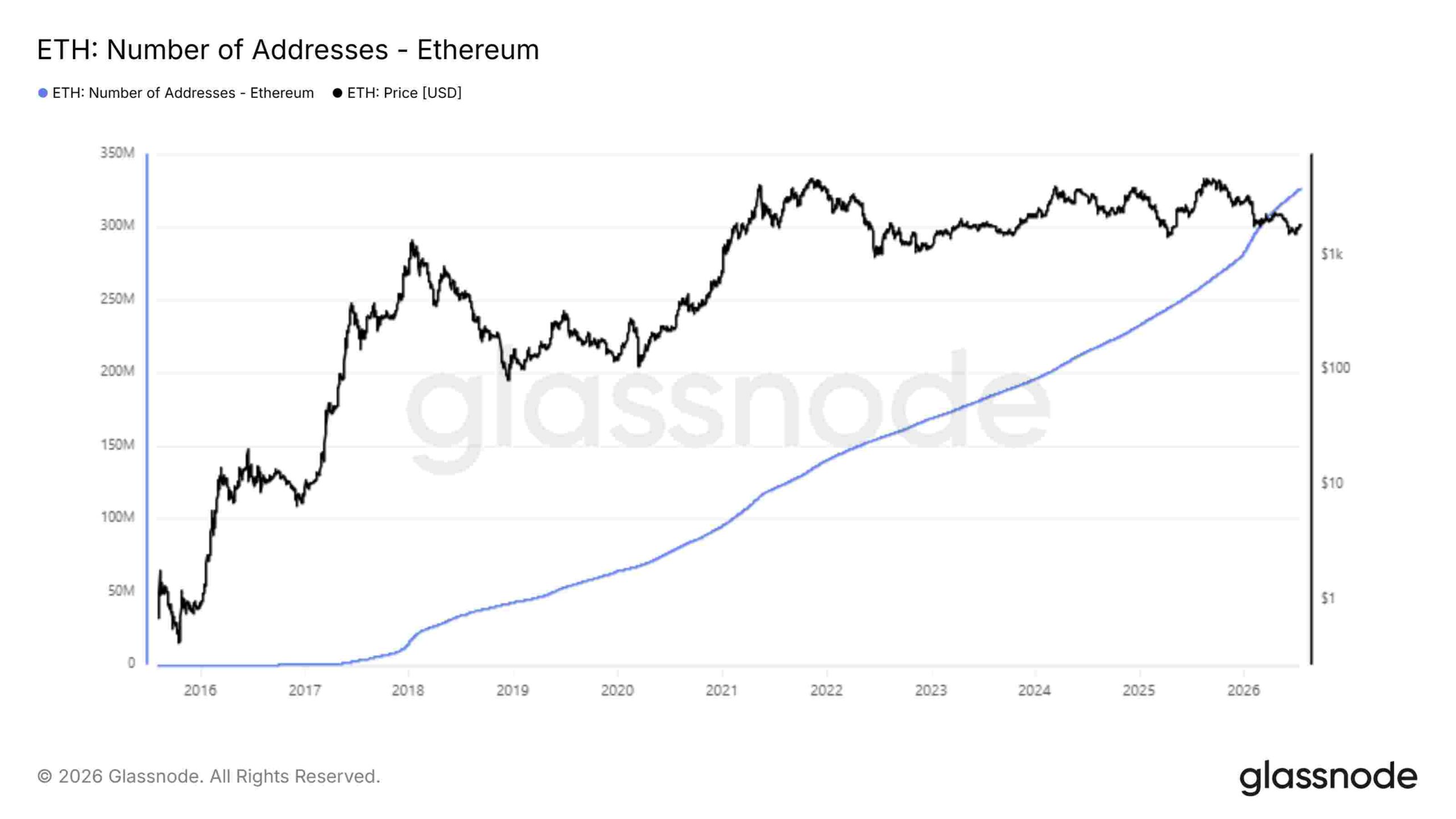
This means around 61% of all Ethereum addresses recorded by Glassnode currently hold some ETH. However, these figures include personal wallets, exchange wallets, smart contracts and other blockchain addresses.
More Than 120,000 New Addresses Are Recorded Daily
An average of more than 120,000 new Ethereum addresses are being recorded per day in 2026. These are addresses appearing in an ETH transaction for the first time, rather than confirmed new users.
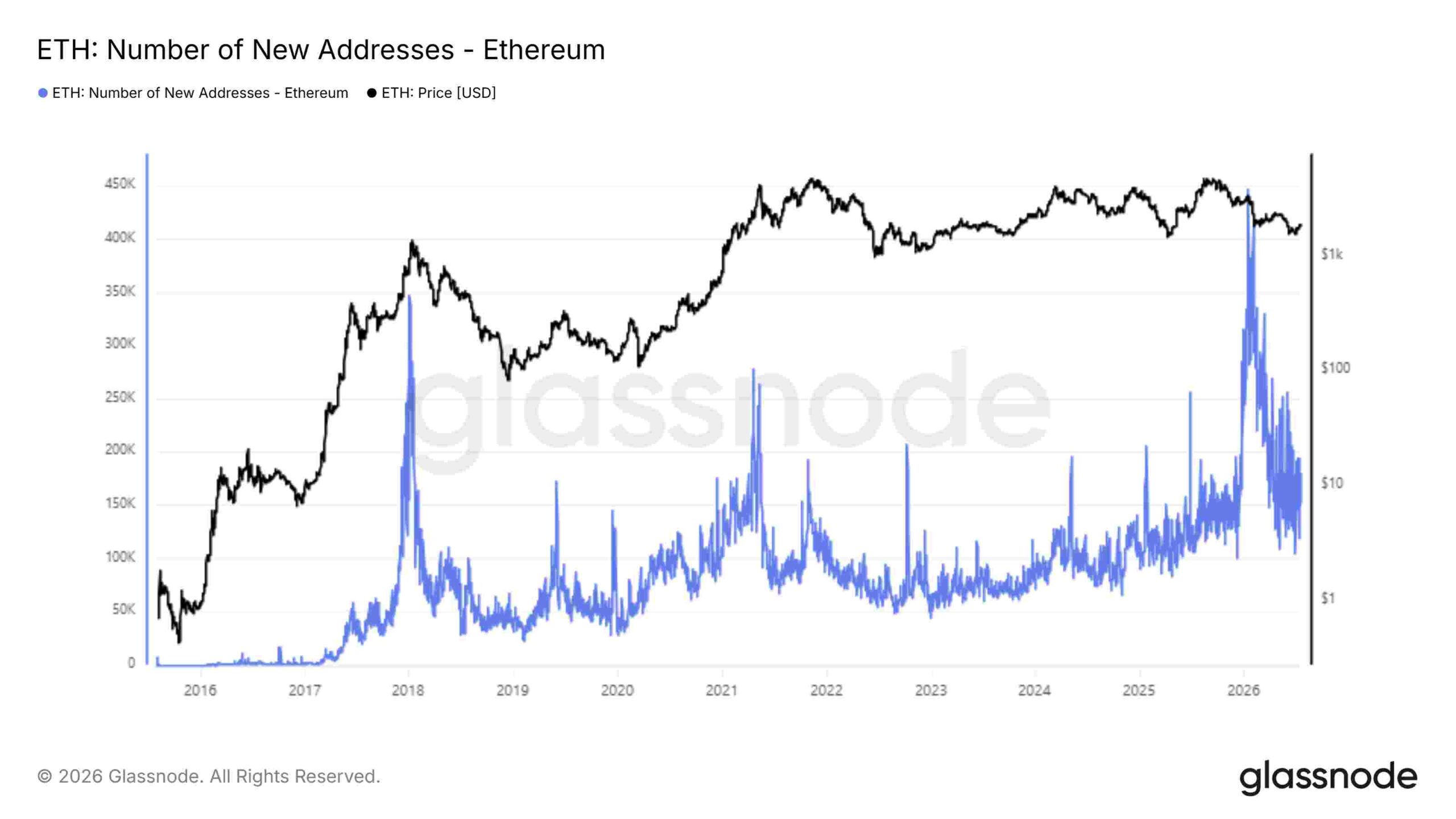
Creating an Ethereum wallet is easy, and existing users frequently generate new addresses. Someone may use one wallet to store funds, another for DeFi, and separate wallets for airdrops, trading or higher-risk transactions. As a result, growth in addresses does not translate directly into the same number of new Ethereum owners. Glassnode new-address data
Ethereum Records Over 500,000 Daily Active Addresses
Ethereum typically records between 500,000 and 600,000 daily active addresses. An address is considered active when it participates in a transaction as a sender or receiver.
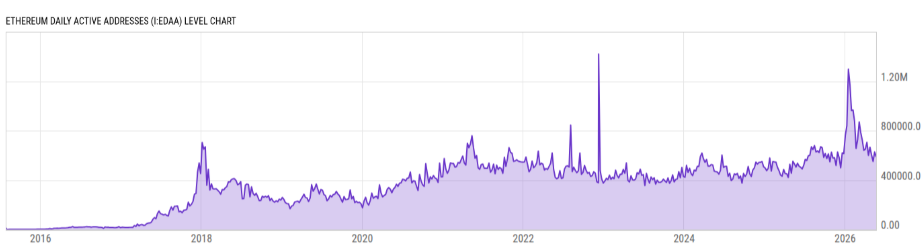
According to Etherscan, Ethereum recently processed more than 2.46 million transactions in a single day. These numbers show that Ethereum has a large active user base, but they still cannot reveal how many individual people are using the network. One user can operate several active addresses and make multiple transactions in the same day.
So, How Many Ethereum Holders Are There?
The available data gives us the following picture:
- More than 327 million Ethereum addresseshave been used.
- Over 199 million addresses currently hold ETH.
- More than 120,000 new addressesare recorded on an average day.
- Around 500,000 to 600,000 addressesare active daily.
If every positive-balance address belonged to a different person, Ethereum could have more than 199 million holders. In reality, the number is lower because many people control multiple wallets. At the same time, exchange wallets hold ETH for large numbers of customers who do not have separate on-chain addresses.
For this reason, there is no exact count of Ethereum owners. The most accurate conclusion is that over 199 million addresses hold ETH, while the number of individual holders remains unknown.
Who Owns the Most Ethereum?
No single person is known to own the most Ethereum. The largest Ethereum balances generally belong to staking contracts, exchanges, investment funds and other services holding ETH for many users.
The Beacon Deposit Contract
The largest address listed on Etherscan is the Ethereum Beacon Deposit Contract; 0x00000000219ab540356cBB839Cbe05303d7705Fa, with more than 88 million ETH recorded against it. The contract is part of Ethereum’s staking system and records ETH deposited by validators. Its Etherscan balance includes cumulative deposits, including ETH that may have since been withdrawn and deposited again. Therefore, the balance should not be interpreted as the amount currently staked or as the holdings of a single owner.
Ethereum Is Held by Different Types of Owners
Ethereum ownership is distributed among individual investors, exchanges, public companies, ETFs and other institutions. Some large addresses also belong to smart contracts, including Wrapped Ether contracts and DeFi protocols.
This makes Ethereum’s largest-address list different from a list of its largest owners. For example, Coinbase and Binance hold millions of ETH, but much of it belongs to their customers. Similarly, ETF custodians hold ETH on behalf of fund investors rather than owning the entire balance themselves.
To understand how Ethereum ownership is distributed, we can examine the largest identified holders in each category.
Top 5 Individuals by Estimated ETH Holdings
Several of Ethereum’s largest wallets belong to exchanges, custodians and smart contracts. After removing those addresses, the following are the largest wallets connected to known individuals, public ENS identities or early Ethereum holders.
| Rank | Wallet Holder | Address | ETH Balance |
|---|---|---|---|
| 1 | Rain Lõhmus | 0x2B6eD29A...51080Ffb9 |
250,000 ETH |
| 2 | Vitalik Buterin | 0x220866B1...268cA3A9D |
224,183 ETH |
| 3 | Anonymous genesis holder | 0x1b3cB81E...ac763A7C2 |
133,299 ETH |
| 4 | edwardpark.eth | 0xA580E49d...6e6F64D30 |
90,000 ETH |
| 5 | mivenezuela🇻🇪.eth | 0xFB4ABaF0...7f4eff184 |
86,497 ETH |
Rain Lõhmus reportedly lost the private key to his wallet and cannot access his 250,000 ETH. Vitalik Buterin is therefore the largest publicly identified individual who can still access his holdings.
The final 3 entries should be read as individual wallets rather than complete ownership estimates. The 3rd address received ETH during Ethereum’s genesis allocation, but its owner remains anonymous. The 4th and 5th use the public ENS names edwardpark.eth and mivenezuela🇻🇪.eth. Their transaction histories indicate that these primary wallets also fund separate, unlabelled vault addresses.
Top 5 Exchanges by Estimated ETH Holdings
Cryptocurrency exchanges hold large amounts of ETH for their customers. These balances are spread across cold wallets, hot wallets, staking addresses and custody accounts, so they should not be treated as ETH owned directly by the exchanges.
Data collected by Arkham shows that Coinbase and Binance are the two largest identified exchange holders, with more than 4M+ ETH each.
| Rank | Exchange | ETH Holdings |
|---|---|---|
| 1 | Coinbase | 4,088,318 ETH |
| 2 | Binance | 4,040,450 ETH |
| 3 | Upbit | 1,685,969 ETH |
| 4 | Robinhood | 1,644,152 ETH |
| 5 | OKX | 1,174,796 ETH |
Top 5 Public Companies by Estimated ETH Holdings
Public companies have also started adding Ethereum to their balance sheets. Some hold ETH as a treasury asset, while others stake it to earn rewards or use it as part of their wider Ethereum-based operations.
According to BitcoinTreasuries, the five largest tracked public-company holders collectively hold more than 7.36 million ETH.
| Rank | Public Company | ETH Holdings |
|---|---|---|
| 1 | BitMine Immersion Technologies | 5,770,038 ETH |
| 2 | SharpLink | 887,174 ETH |
| 3 | The Ether Machine | 495,362 ETH |
| 4 | Bit Digital | 162,081 ETH |
| 5 | BTCS | 55,064 ETH |
Top 5 ETFs by Estimated ETH Holdings
US spot Ethereum ETFs hold ETH on behalf of investors who purchase shares through traditional brokerage accounts. According to data from SoSoValue, these are the five largest US spot Ethereum ETFs by estimated ETH holdings:
| Rank | Ethereum ETF | Estimated ETH Holdings |
|---|---|---|
| 1 | BlackRock iShares Ethereum Trust ETF (ETHA) | 2,834,830 ETH |
| 2 | Grayscale Ethereum Staking Mini ETF (ETH) | 841,760 ETH |
| 3 | Grayscale Ethereum Staking ETF (ETHE) | 771,161 ETH |
| 4 | Fidelity Ethereum Fund ETF (FETH) | 485,674 ETH |
| 5 | BlackRock iShares Ethereum Staking ETF (ETHB) | 287,681 ETH |
Why Is Ethereum Valuable?
Ethereum is valuable because it is one of the most trusted and established Layer 1 blockchains. It provides the infrastructure for thousands of applications, digital assets and financial services while remaining decentralized and available worldwide.
A Trusted and Secure Layer 1 Blockchain
Every Layer 1 blockchain faces the blockchain trilemma: decentralization, security and scalability. Increasing speed and reducing transaction costs can sometimes require compromises in decentralization or security.
Ethereum has generally prioritized security and decentralization at its base layer. Instead of making the main blockchain less decentralized to increase speed, Ethereum relies heavily on Layer 2 networks to process transactions faster and at lower costs.
Ethereum is secured by validators located around the world, making it difficult for any single company, government or individual to control the network.
Ethereum Has the Largest Blockchain Ecosystem
Ethereum is more than a cryptocurrency. It is the foundation for a large ecosystem of decentralized applications, stablecoins, DeFi platforms, NFTs, games and Layer 2 networks.
Developers can create applications using Ethereum smart contracts, while ETH is used to pay transaction fees and secure the network through staking. Many other blockchains also support Ethereum-compatible applications, extending the reach of Ethereum’s technology beyond its main network.
This large ecosystem creates continuous demand for ETH from users, developers, validators and institutions.
Banks and Financial Institutions Are Using Ethereum
Banks, asset managers and other financial institutions are increasingly using Ethereum for tokenization and blockchain-based financial products.
J.P. Morgan launched its first tokenized money-market fund on the public Ethereum blockchain in December 2025. The bank has also reported that most tokenized money-market fund assets are issued on Ethereum.
BlackRock also operates Ethereum investment products and views Ethereum as part of the growing infrastructure for tokenized financial assets. These developments show that Ethereum is increasingly being used for more than crypto trading.
Best Exchanges to Buy Ethereum
Ethereum is available on most major cryptocurrency exchanges. The right platform depends on where you live, whether you want to stake your ETH and whether you prefer a centralized or decentralized trading environment.
Binance
With high liquidity, competitive trading fees and several ETH-earning options, Binance suits both active traders and long-term holders. Its liquid-staking service lets users earn staking rewards while retaining a tradable token representing their staked ETH.
Bybit
Users interested in liquid staking can use Bybit to stake as little as 0.01 ETH. In return, they receive liquid-staking tokens that continue earning rewards while remaining available for other supported activities.
Coinbase
For US users, Coinbase provides an accessible way to buy and stake Ethereum. Its straightforward interface is suitable for beginners, although staking availability depends on the user’s state and eligibility.
Bitunix
Those who prefer optional identity verification within certain account limits may consider Bitunix. It supports Ethereum spot and derivatives trading, along with earning options for users who want to generate returns from their ETH. Withdrawal limits and verification requirements vary by account and location.
Hyperliquid
For users who prefer a decentralized environment, Hyperliquid offers non-custodial, on-chain trading with strong liquidity and direct ETH spot markets. However, connecting a wallet and moving funds on-chain can make the platform more technical for beginners.
Bottom Line
If you came here looking for a precise number, the honest answer is that nobody knows exactly how many people own Ethereum. What we can confirm is that more than 199 million Ethereum addresses currently hold ETH. That figure is not the same as 199 million people because individuals may control several wallets, while exchanges can hold funds for millions of customers. Still, the data makes one thing clear: Ethereum ownership reaches far beyond a small group of founders and whales. It is held across personal wallets, exchanges, companies, ETFs and institutions around the world, making ETH ownership genuinely widespread.
FAQs
1. How Many People Own at Least 1 ETH?
The exact number of people is unknown, but more than 1.46 million Ethereum addresses hold at least 1 ETH. One person may control multiple addresses.
2. Who Owns the Most Ethereum?
BitMine is the largest identified entity, holding 5.77 million ETH. Among individuals, Rain Lõhmus holds 250,000 ETH but has reportedly lost access to his wallet.
3. How Many Ethereum Wallets Exist?
More than 327 million Ethereum addresses have been recorded on-chain. The actual number of wallets may be higher because unused addresses are not visible on the blockchain.
4. How Much Ethereum Does Vitalik Own?
Vitalik Buterin holds an estimated 224,000 ETH, making him the largest identified individual holder who can still access his holdings.
5. Do Ethereum ETFs Hold Real ETH?
Yes. US spot Ethereum ETFs purchase and hold real ETH through custodians. Futures and leveraged Ethereum ETFs may use derivatives instead of holding ETH directly.