


- •Regulation and exchange access remain the primary risks shaping ZEC’s liquidity, volatility, and overall price direction.
- •Treasury-style accumulation and ETF activity have reduced liquid supply and introduced longer-term capital into ZEC.
- •ZEC’s upside depends on privacy adoption aligning with institutional access, not short-term speculation alone.
Zcash operates in a different lane from most cryptocurrencies, focusing on private value transfer rather than broad application layers. Recent institutional activity, supply shifts, and regulatory attention have pushed ZEC back into active market discussion. To understand current zcash price predictions, it helps to look beyond short-term price moves and focus on what is changing beneath the surface. This section sets the context for how ZEC is being valued today and what may influence its direction ahead.
Historical Pattern: Volatility, Cycles, and Survival
Zcash has lived through cycles where price was driven mainly by narrative and speculative liquidity. In earlier years, ZEC also carried a “niche tech” profile, which limited long-term capital compared to assets positioned as settlement rails or smart-contract platforms. Over time, privacy coins faced extra exchange pressure, and ZEC often traded with thinner order books than large-cap names. That is why it can move aggressively in both directions when buyers show up, then retrace quickly when liquidity fades.
What makes 2025 different is the kind of attention Zcash attracted. Instead of only retail-led spikes, you now have a treasury-style buyer profile and public ETF activity, both of which tend to extend market memory and support longer holding periods.
Zcash (ZEC)
New TokenToken Symbol
ZEC
Current Price
Loading...
Daily Change
Loading...
All-Time High
Loading...
Daily Low
Loading...
Daily High
Loading...
24h Volume
Loading...
Market Cap
Loading...
FDV
Loading...
Total Supply
Loading...
Max Supply
Loading...
What’s Really Moving ZEC: The Fundamental Drivers
ZEC is being priced around a few specific drivers right now. If you focus on those, Zcash price predictions become easier to evaluate, even when volatility is high.
Bullish Catalysts
Recent developments around ZEC have introduced a different class of buyer into the market. In late 2025, reports confirmed that Cypherpunk Technologies adopted a Zcash-focused Digital Asset Treasury approach, an idea that quickly gained attention after being linked to backing from the Winklevoss twins. This framing matters because a DAT strategy reflects balance-sheet allocation rather than short-term trading behavior. When capital is deployed with a treasury mindset, holding periods tend to be longer, and circulating supply can tighten faster than markets expect.
According to Cypherpunk’s official disclosure, the firm purchased an additional $18 million worth of ZEC, bringing its total holdings to roughly $150 million at the time of reporting, equal to more than one percent of circulating supply. From a market structure perspective, purchases of this size reduce available float and can amplify price reactions when new demand enters.
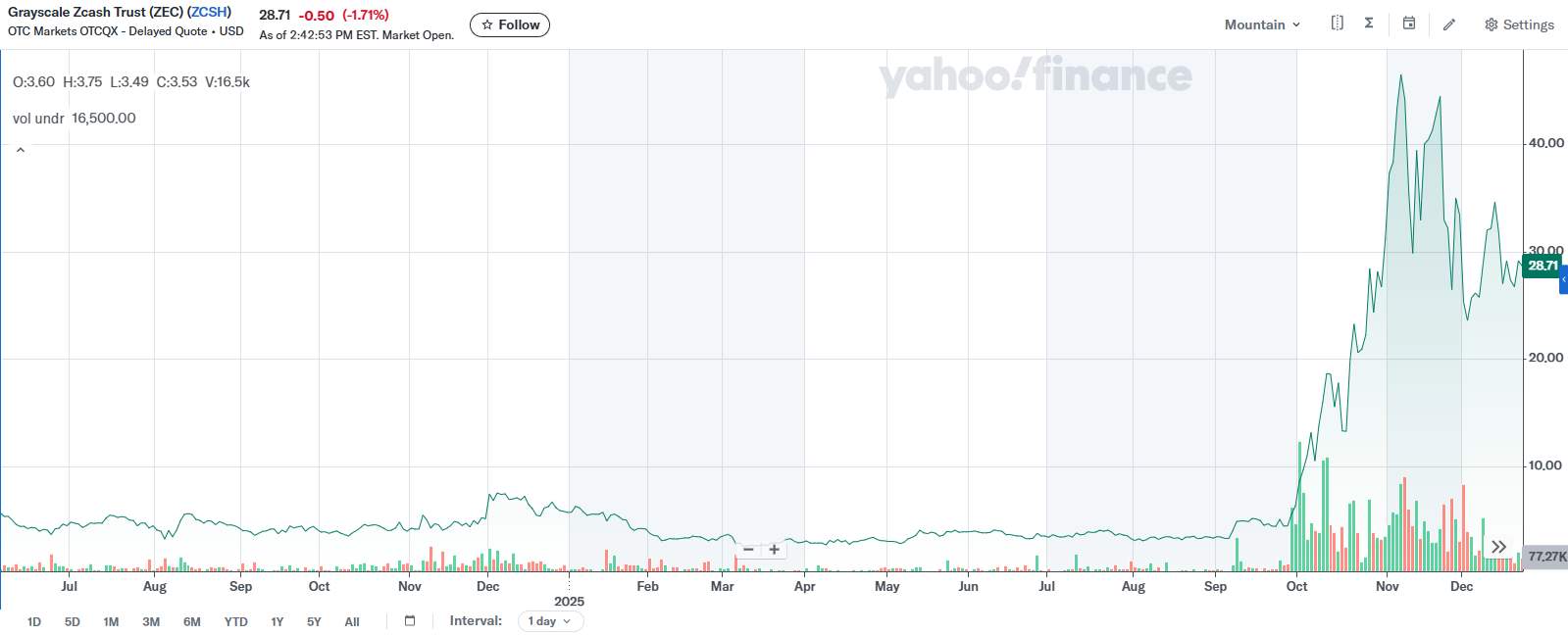
At the same time, institutional positioning around Zcash expanded beyond direct ownership. On November 26, 2025, Grayscale filed an S-3 registration statement with the U.S. Securities and Exchange Commission to convert its Zcash Trust into a spot ETF. If approved, this would represent the first U.S. exchange-traded product tracking ZEC. While approval is not guaranteed, the filing itself signals that Zcash is being evaluated for inclusion inside regulated investment wrappers, a step that historically broadens investor access and changes how assets are priced.
Alongside these developments, Zcash has increasingly been described as an “encrypted Bitcoin”, not in terms of protocol origin, but in function. Bitcoin enforces monetary scarcity but leaves transaction history fully visible, while Zcash offers optional shielded transfers and selective disclosure, allowing private value movement when needed. This framing has gained traction through repeated references to the idea that Bitcoin protects against fiat risk, while Zcash protects against full ledger transparency. The narrative resurfaced strongly in 2025 and contributed to renewed attention on ZEC across broader crypto discussions.
Bearish Pressures
Regulatory risk does not go away just because institutions are buying. Privacy-focused assets face unique scrutiny, and exchange access is part of the investment thesis whether you like it or not. If listings tighten in key jurisdictions, liquidity drops, spreads widen, and price can gap down.
There is also competitive pressure since Zero-knowledge research is now a wider field. Zcash still has a strong privacy product, but it is no longer the only project using advanced cryptography. That means the market can rotate quickly if a new “privacy with compliance” story becomes easier for exchanges and institutions to support.
Finally, do not ignore execution risk. Treasury buying and ETFs can lift attention, but long-term support is stronger when product usage expands in a way you can measure on-chain.
Technical Analysis: ZEC’s Current Market Setup
ZEC has shown the kind of volatility you expect from a thinner-liquidity asset moving into a new narrative phase. That is not good or bad by itself. It just tells you the market is repricing, and repricing is rarely smooth.
Current Price and Market Position
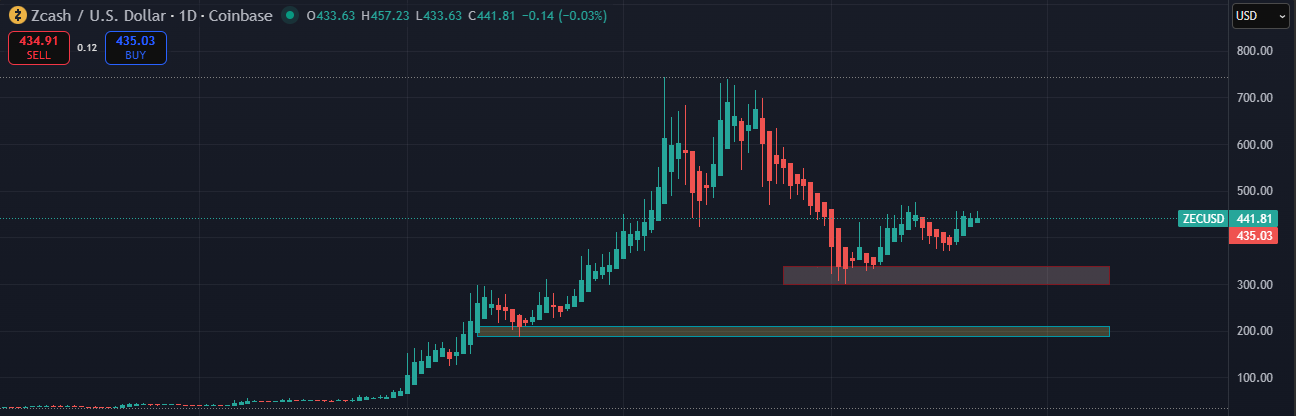
By Q4 2025, ZEC had already completed a major expansion move, rising from levels near $58 earlier in the year to highs around $740. Since that surge, price action has cooled and shifted into a broad consolidation range, with ZEC trading mostly between $320 and $480. This behavior is typical after a rapid upside move of that scale.
For ZEC price, this range matters because it shows where buyers and sellers are currently in balance. Strong year-to-date gains can pull future returns forward, which often leads to pauses or retracements as momentum resets. Rather than focusing only on the peak, it is more useful to watch whether capital continues to support the market within this range or begins to exit during periods of weakness.

Technical Setup
Market commentary throughout November 2025 pointed to several bullish reversal structures forming during the advance, including inverse head-and-shoulders patterns and consolidation zones beneath major resistance levels. You do not need to agree with every technical label to understand the takeaway.
Traders were clearly focused on specific breakout areas during the rally and are now paying equal attention to downside invalidation levels inside the current range. That focus helps explain why ZEC reacted strongly when price approached certain thresholds, both on the way up and during consolidation.
Sentiment and Participation Trends
Interest around Zcash increased sharply relative to its historical baseline, which helped push it back into broader crypto discussions during late 2025. At the same time, the tone of that discussion shifted. ZEC was no longer framed only as a niche privacy coin, but increasingly as a candidate for institutional exposure through treasury strategies and potential investment products. That shift matters because it changes who is participating in the market and how long capital is likely to stay committed.
There was also a short-lived controversy that added to visibility. Online speculation suggesting that Daira-Emma Hopwood, a core Zcash developer, could be linked to the identity of Bitcoin’s creator spread quickly across social platforms. There is no evidence supporting this claim, and it remains a rumor. Even so, it pulled Zcash into mainstream debate for a brief period, which temporarily increased attention and engagement around the asset. If referenced at all, it should be treated strictly as speculation rather than a factor driving long-term valuation.
Price Outlook Based on Current Conditions
The near-term outlook for ZEC is tied to whether institutional accumulation continues and whether ETF momentum stays alive. The medium-term outlook depends on exchange access and the regulatory tone toward privacy assets. Long-term ZEC price predictions depend on whether Zcash keeps its role as usable digital cash, not just a symbol. If shielded usage grows and liquidity broadens rather than narrows, the asset can support higher valuations with less fragility.
Short-Term Outlook for 2025
Technically, ZEC is no longer in expansion mode after its rapid move from the $50s to the $700 area in the early of 2025 Q4. Momentum has cooled meaningfully, with price now consolidating inside a wide $320–$480 range.
- Bear case: A sustained loss of the $320 support zone would suggest that post-rally distribution is still in progress. In that scenario, ZEC could revisit deeper levels around $260–$280, especially if broader crypto sentiment weakens or regulatory headlines hit privacy-focused assets.
- Base case: Continued consolidation between $320 and $480 remains the most realistic outcome. Institutional accumulation and reduced liquid supply may limit downside, but without a fresh catalyst, upside attempts could fade near range highs. This would reflect a market digesting gains rather than reversing trend.
- Bull case: A clean breakout above $480 with strong volume would signal that buyers have regained control. If that move is supported by continued treasury accumulation or progress on ETF-related narratives, ZEC could make another attempt toward the $600–$700 region before year-end, or in Q1 2026.
Even with these scenarios, volatility should be expected. ZEC has already shown how quickly it can move in both directions during 2025, and wide weekly swings remain part of its market structure. If you plan to buy Zcash, it helps to accept that progress is more likely to come in uneven steps rather than in a straight line, with timing and risk control playing a bigger role than chasing momentum.
Future Outlook and ZEC Price Predictions
These scenarios are not promises. They are structured outcomes based on how the big drivers could play out, especially regulation, institutional wrappers, and adoption of private transfers.
| Year | Bear Case | Base Case | Bull Case |
|---|---|---|---|
| 2026 | $450 | $700 | $1,000 |
| 2027 | $520 | $850 | $1,350 |
| 2028 | $600 | $1,000 | $1,600 |
| 2029 | $680 | $1,200 | $1,850 |
| 2030 | $750 | $1,400 | $2,100 |
Bottom Line
The current setup around ZEC sits at the intersection of privacy demand and institutional packaging rather than simple price speculation. You are not only watching a chart, especially if you are active in day trading, but tracking whether treasury-style buyers continue to accumulate, whether the ETF effort moves forward, and whether the market treats the “encrypted Bitcoin” idea as a lasting use case instead of a passing theme. Upside becomes easier to justify when supply tightens while liquidity improves at the same time. Risk does not disappear, though. Regulatory action that limits listings or access could still disrupt flows quickly. If you are considering exposure, position sizing and timing should be part of your thinking from the start, not something added later.
FAQs
1. What factors influence the price of Zcash?
Zcash’s price is mainly influenced by regulation around privacy coins, exchange listings or delistings, institutional interest, on-chain usage of shielded transactions, and overall crypto market conditions led by Bitcoin.
2. What are the long-term price predictions for Zcash?
Long-term Zcash price predictions depend on regulation, exchange access, and whether institutional demand continues. Scenario-based estimates for 2030 range from below $1,000 in weaker conditions to around $2,000 if adoption and liquidity remain supportive. These outcomes are not guaranteed.
3. Is investing in Zcash a good idea?
Zcash can be a high-risk, speculative investment. It has strong privacy technology and growing institutional interest, but price volatility and regulatory uncertainty mean it may not suit conservative investors.
4. What could ZEC be worth in 2026?
Under current conditions, ZEC may test levels near $900 in 2026, while moves toward $1,000 or above would depend on sustained institutional interest and supportive market conditions.
5. Can ZEC reach $1,000?
Reaching $1,000 would imply a ZEC market capitalization of roughly $14–15 billion based on current circulating supply, compared with about $7 billion today. That scale is not unrealistic in crypto terms, but it would still require sustained demand, stable exchange access, and supportive regulation.