

- •GMX ist eine dezentrale, auf Personenhandel basierende DEX, die einen Hebel von bis zu 100x ohne KYC-Anforderungen bietet.
- •Die Transaktionen werden gegen Liquiditätspools anstatt gegen Orderbücher ausgeführt, wodurch die Ausführung vollständig auf der Blockchain stattfindet.
- •Unterstützt mehr als 107 Dauerverträge und mehr als 24 Spot-Assets in mehreren unterstützten Netzwerken.
- •Die Gebühren sind dynamisch, wobei sie für Derivate bei etwa 0.04 % bis 0.06 % liegen und für Swaps je nach Poolauswirkung variieren.
- •Das GMX-Konto ermöglicht den Handel mit gemeinsam genutzter Liquidität, während im Wallet-Modus die Gelder selbst verwahrt werden.
- •Smart Contracts werden geprüft, allerdings war GMX zuvor mit einem GLP-Preisausnutzungsvorfall konfrontiert.
- •GMTrade erweitert das Modell auf Solana mit höherer Hebelwirkung, agiert aber unabhängig.
Der dezentrale Handel entwickelt sich rasant, da immer mehr Trader ihre Aktivitäten privat halten und ihre Abhängigkeit von zentralisierten Börsen reduzieren möchten. Jede neue Plattform verfolgt einen anderen Ansatz. GMX beispielsweise führt ein Multi-Asset-Liquiditätspool-Modell ein, das ein vertrautes Handelserlebnis bieten und gleichzeitig den DeFi-Prinzipien entsprechen soll. In diesem GMX-Testbericht gehen wir auf die Börse, ihre Funktionen, Hebelwirkung, Sicherheit und das allgemeine Handelserlebnis ein, um Ihnen bei der Entscheidung zu helfen, ob sie Ihren Handelsbedürfnissen entspricht.
| Stats | GMX |
|---|---|
| 🚀 Gegründet | 2021 |
| 🌐 Hauptsitz | - |
| 🔎 Gründer | - |
| 👤 Aktive Benutzer | 742 + |
| 🪙 Unterstützte Kryptos | 24+ |
| 🪙 Futures-Kontrakte | 107+ |
| 🔁 Netzwerkunterstützung | 8+ |
| 🔁 Spot-Gebühren (Hersteller/Abnehmer) | 3.75% / 3.75% |
| 🔁 Futures-Gebühren (Hersteller/Nehmer) | 0.04% / 0.04% |
| 📈 Maximaler Hebel | 100x |
| 🕵️ KYC-Verifizierung | Nicht benötigt |
| 📱 Mobile-App | Nein |
| ⭐ Bewertung | N / A |
GMX-Übersicht
GMX ist eine dezentrale Perpetual-Börse, die 2021 gegründet wurde und zunächst auf Arbitrum startete, bevor sie auf Avalanche expandierte. Sie entstand aus dem Zusammenschluss früherer Projekte und konzentriert sich auf den Handel mit Hebelwirkung in einer vollständig On-Chain-Umgebung, ohne auf Verwahrungskontrolle oder KYC-Anforderungen angewiesen zu sein.
GMX basiert im Kern auf einem Multi-Asset-Liquiditätspool-Modell, bei dem Händler mit gebündelter Liquidität anstatt mit traditionellen Orderbüchern interagieren. Dadurch kann die Plattform sowohl Spot- als auch Derivatehandel unterstützen und die Ausführung vollständig auf der Blockchain gewährleisten.
Die Plattform unterstützt bis zu acht Netzwerke, wobei Arbitrum über GMX-Konten als zentrale Anlaufstelle dient. Der reine Wallet-Handel erweitert den Zugang zu weiteren unterstützten Blockchains. Nutzer können über 24 Spot-Assets handeln, größtenteils in Wrapped-Form, und über 107 Perpetual-Kontrakte mit Sicherheiten wie WETH, USDC oder GMX und einem Hebel von bis zu 100x nutzen. Das tägliche Handelsvolumen von Perpetual-Kontrakten auf GMX beträgt rund 51.89 Millionen US-Dollar. TVL übersteigt 261.65 Millionen US-Dollarwas eine stetige Liquidität und eine gleichbleibende Nutzung in allen Märkten widerspiegelt.
Die Gebühren auf GMX sind dynamisch und hängen davon ab, wie sich Ihr Handel auf das Gleichgewicht des Liquiditätspools auswirkt. Beim Derivatehandel beginnen die Gebühren für Market Maker und Market Taker bei etwa 0.04 %. Im Spothandel verwendet GMX Atomic Swaps, die mit höheren Kosten verbunden sind. Die Swap-Gebühren können aufgrund der direkten Poolausführung bis zu 3.75 % betragen.
GMX legt großen Wert auf die Sicherheit von Smart Contracts, die für ein Protokoll, das gehebelten Handel und gebündelte Liquidität abwickelt, von entscheidender Bedeutung ist. Die Verträge wurden von Unternehmen wie beispielsweise [Name des Unternehmens/der Organisation] geprüft. Guardian-Audits, Dedaub, Zellic und Sec3. Das Protokoll betreibt außerdem ein Bug-Bounty-Programm auf Immunefi, bei dem Belohnungen bis zu 5 Millionen Dollar betragen.
GMX war in seiner früheren Version V1 von einem Sicherheitsvorfall betroffen. Dabei handelte es sich um einen Reentrancy-Angriff, bei dem der Angreifer den Preismechanismus des GLP-Tokens manipulierte, um Gelder aus dem Liquiditätspool abzuziehen. Der anfängliche Verlust belief sich auf rund 42 Millionen US-Dollar, wovon jedoch nach einer Vereinbarung über eine 10%ige Belohnung durch einen White-Hat-Angreifer etwa 40 Millionen US-Dollar zurückerstattet wurden.
GMX Vor- und Nachteile
| 👍 GMX-Profis | 👎 GMX Nachteile |
|---|---|
| ✅ Bis zu 100-fache Hebelwirkung auf Täter | ❌ Die Gebühren können hoch und dynamisch sein. |
| ✅ Das Liquiditätspoolmodell reduziert den Slippage | ❌ Setzt stark auf Wrapped Tokens. |
| ✅ Verdienen Sie durch Staking und Pools | ❌ Kein Orderbuch für fortgeschrittene Händler |
| ✅ Hergestellt aus Arbitrum mit niedrigerem Gasgehalt | ❌ Es bestehen weiterhin Risiken durch Smart Contracts |
| ✅ Transparente On-Chain-Ausführung | ❌ Benutzeroberfläche und Einrichtung können Anfänger verwirren |
| ✅ Geringer Schlupf | |
| ✅ Multi-Chain-Zugänglichkeit |
GMX KYC und Anmeldung
GMX ist eine dezentrale, nicht-verwahrende Plattform. Das bedeutet, dass Nutzer mit einer kompatiblen Wallet sofort handeln können, ohne KYC-Verifizierung oder E-Mail-Registrierung. Der Zugriff erfolgt ausschließlich über die Wallet, und Nutzer behalten jederzeit die volle Kontrolle über ihr Guthaben. So verbinden Sie Ihre Wallet mit GMX und starten den Handel:
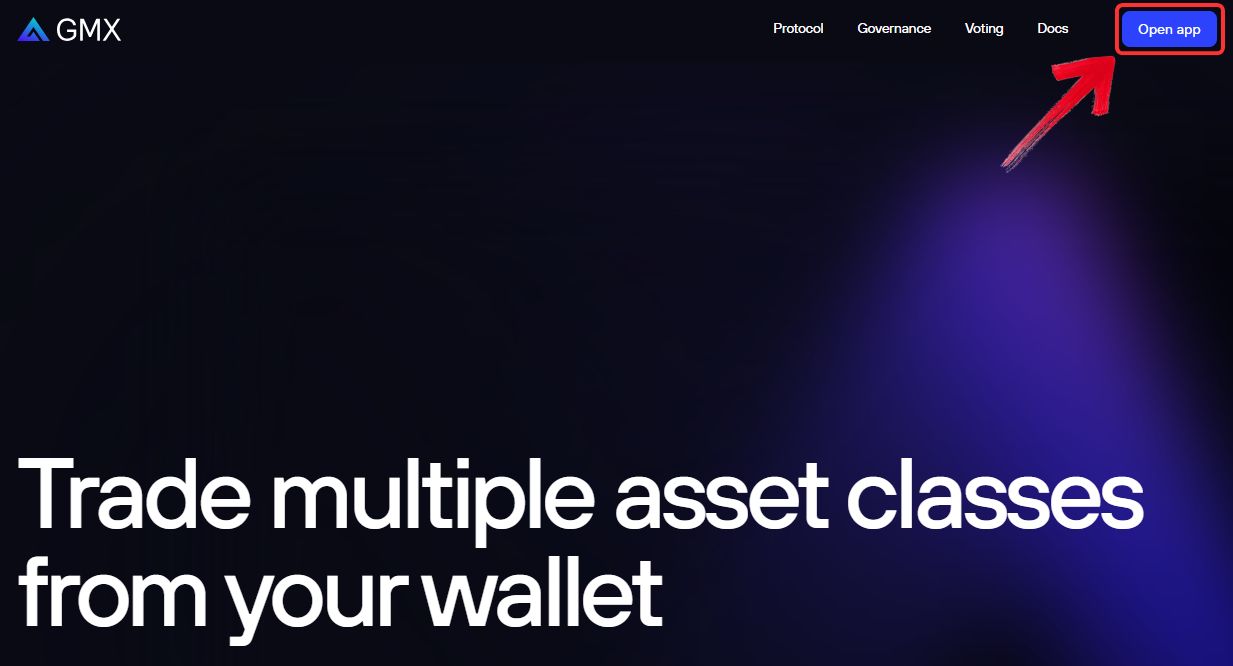
Schritt 1: Gehen Sie zunächst zur offiziellen GMX Website und klicken Sie auf „App öffnen“ um auf die Handelsplattform zuzugreifen.
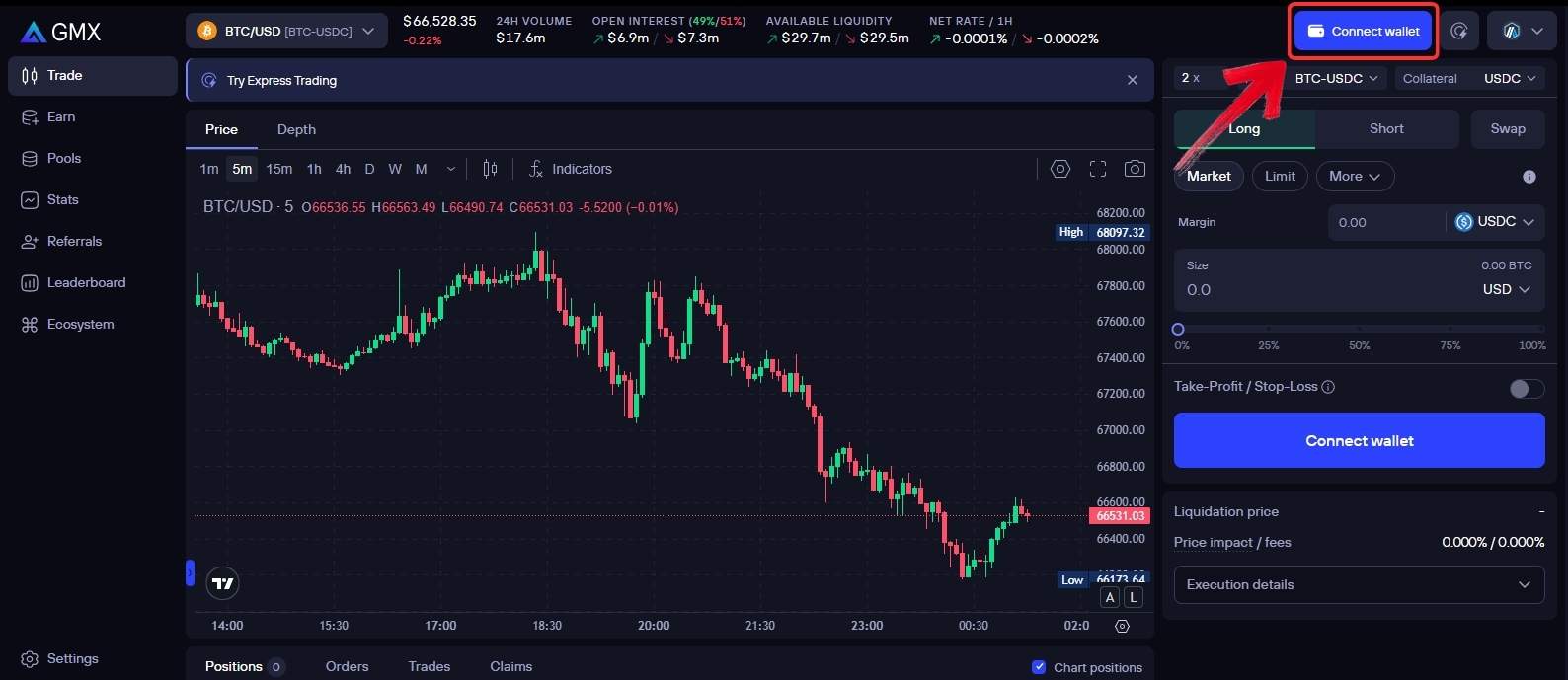
Schritt 2: Sobald Sie sich auf der Plattform befinden, klicken Sie auf „Geldbörse verbinden“ Um mit der Verknüpfung Ihrer Wallet zu beginnen.
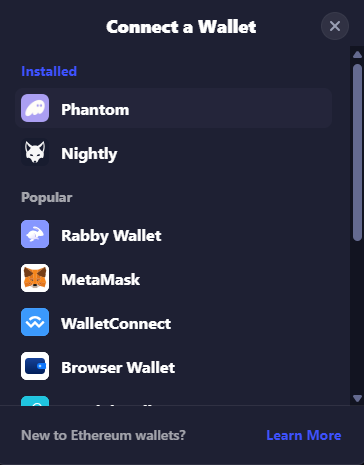
Schritt 3: GMX unterstützt mehrere Netzwerke, daher benötigen Sie eine kompatible Wallet. Wählen Sie Ihre bevorzugte Wallet aus den verfügbaren Optionen.
Schritt 4: Nach Auswahl Ihrer Wallet erscheint ein Pop-up-Fenster, in dem Sie um Ihre Unterschrift gebeten werden. Unterschreiben Sie die Nachricht, um die Verbindung abzuschließen.
Sobald Ihre Wallet verbunden ist, ist die Registrierung abgeschlossen. Um mit dem Handel zu beginnen, müssen Sie Ihre Wallet mit unterstützten Kryptowährungen aufladen.
Unterstützte Netzwerke
GMX unterstützt derzeit bis zu acht Netzwerke, die in zwei Kategorien unterteilt sind: Wallet-only und Wallet & GMX-Konto.
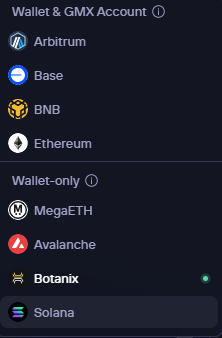
Das GMX-Kontomodell ermöglicht Nutzern den Handel mit gemeinsam genutzter Liquidität auf der zentralen Handelsplattform, vorwiegend Arbitrum, und gleichzeitig die Interaktion mit unterstützten Blockchains wie Ethereum, Base und BNB Chain. Die Preisberechnung erfolgt über Chainlink Data Streams für eine präzisere Ausführung.
Im Wallet-only-Modus handeln die Nutzer direkt auf unterstützten Blockchains wie Avalanche, Botanix und MegaETH, wobei netzwerkspezifische Gebühren anfallen.
GMX hat außerdem über eine separate Plattform namens Kontakt zu Solana. GMTradeDies funktioniert auf einer anderen Domäne mit eigener Infrastruktur und ermöglicht den On-Chain-Handel mit höherer Hebelwirkung, wird jedoch unabhängig verwaltet und erfordert eine separate Wallet-Verbindung.
Ein- und Auszahlungsmethoden bei GMX
Beim Handel auf GMX hat das gewählte Netzwerk direkten Einfluss darauf, wie Sie Ihr Konto aufladen, Trades ausführen und auf Funktionen wie Hebelwirkung zugreifen.
Wenn Sie das GMX-Konto nutzen möchten, müssen Sie Guthaben über unterstützte Netzwerke wie Arbitrum, Ethereum, Base und BNB Chain einzahlen. Welche Assets Sie einzahlen können, hängt vom gewählten Netzwerk ab. Auf Ethereum können Nutzer beispielsweise ETH, USDT, LINK und andere unterstützte Token auf ihr GMX-Konto einzahlen. Dieses Guthaben wird dann für den Handel über die bereitgestellte Liquidität der Plattform verwendet.
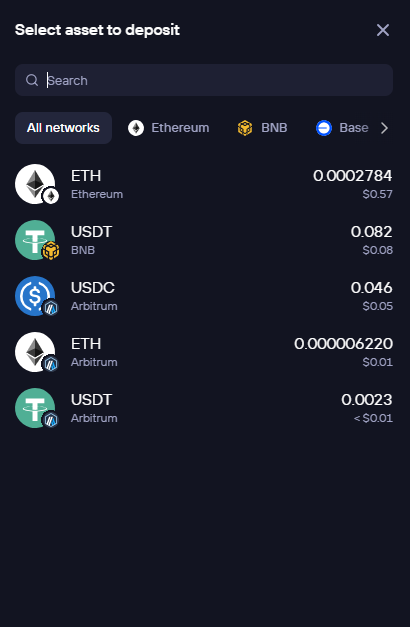
Wenn Sie hingegen kein Guthaben auf ein GMX-Konto einzahlen möchten, können Sie über das Wallet-Only-Modell direkt mit Ihrer Wallet handeln. In diesem Fall bleiben Ihre Guthaben in Ihrer Wallet, und die Transaktionen werden über unterstützte Netzwerke wie MegaETH, Arbitrum, Avalanche, Botanix oder Solana ausgeführt.
Auszahlungen erfolgen nach demselben Verfahren. Bei GMX-Konten können Guthaben auf das ursprüngliche Netzwerk zurücküberwiesen werden. Beim reinen Wallet-Trading gibt es keinen separaten Auszahlungsprozess, da die Vermögenswerte durchgehend in Ihrer Wallet verbleiben.
GMX Trading
GMX bietet eine Handelsoberfläche, die Nutzern zentralisierter Börsen vertraut vorkommt. Das übersichtliche Layout ist darauf ausgelegt, das typische Handelserlebnis einer CEX (Central Exchange Exchange) nachzubilden. Die Oberfläche ist nicht anpassbar, enthält aber alle wesentlichen Komponenten für die Orderausführung. Im Zentrum stehen Charts von TradingView, die die Nutzung von Indikatoren und technischen Analysetools ermöglichen. Zusätzlich bietet die Oberfläche ein Order-Panel und einen Bereich für die Handelshistorie.
Es gibt jedoch kein herkömmliches Orderbuch, da die Transaktionen direkt gegen die Liquiditätspools von GMX ausgeführt werden. Anstatt zwischen Kauf- und Verkaufsangeboten zu wählen, wählen die Nutzer den Liquiditätspool aus, gegen den sie handeln möchten. Jeder Pool verfügt über eigene Finanzierungsraten und Parameter, die sich dynamisch an die Marktbedingungen und die Nachfrage nach den jeweiligen Vermögenswerten anpassen.
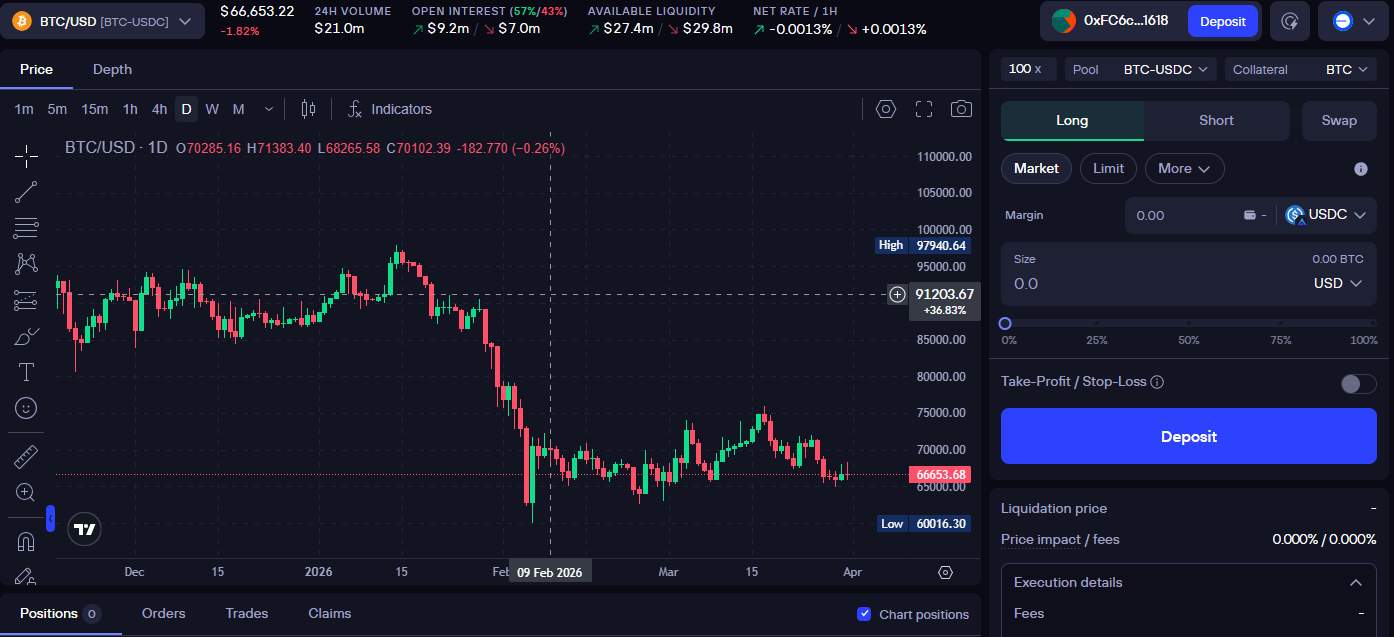
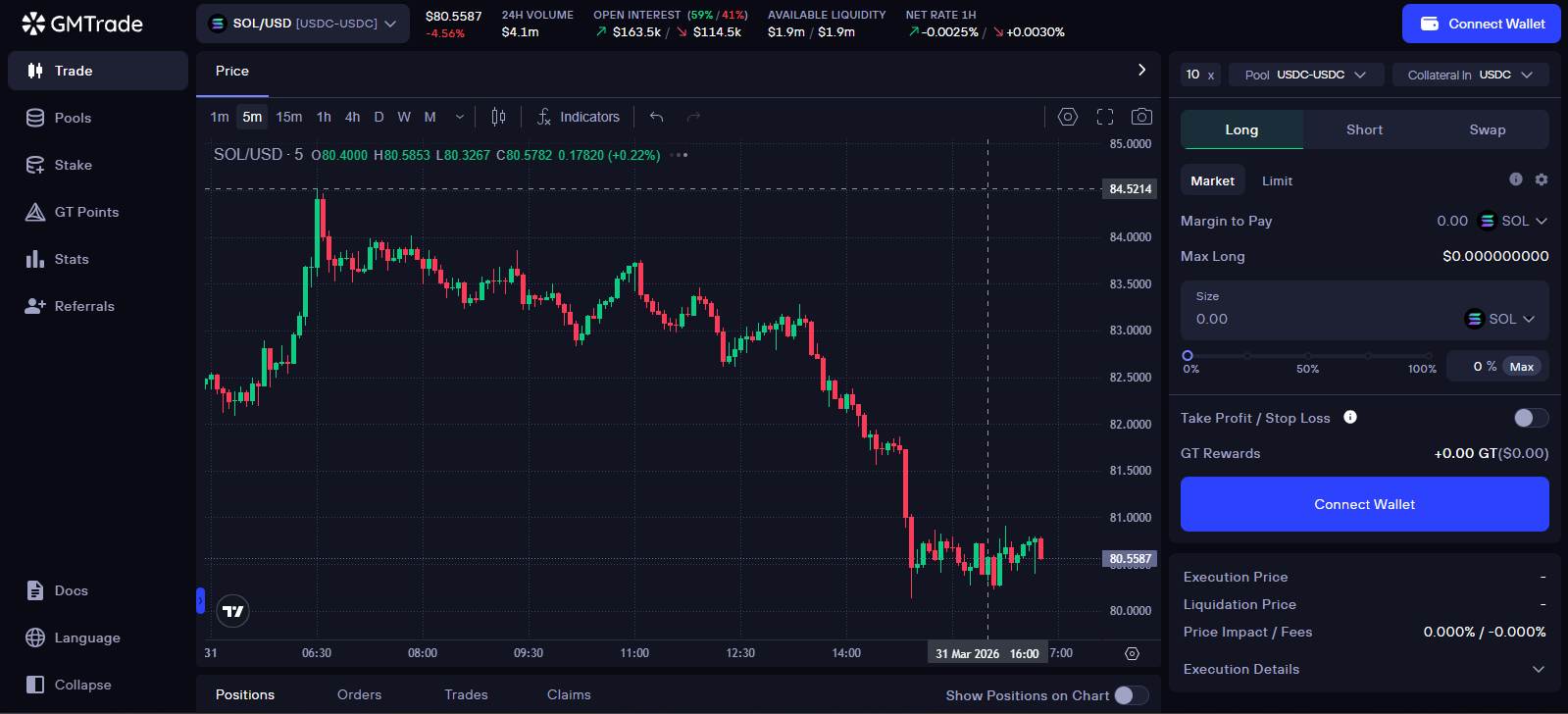
GMX unterstützt sowohl Derivate- als auch Spot-Trading. Nutzer haben Zugriff auf über 107 Perpetual-Kontrakte, während Spot-Trading über die Swap-Funktion mit über 24 unterstützten Assets möglich ist. Der Hebel auf GMX beträgt bis zu 100x. Zusätzlich bietet die separate Plattform GMTrade, basierend auf Solana, höhere Hebeloptionen, operiert jedoch unabhängig.
Die Ordertypen sind relativ begrenzt und umfassen Market- und Limit-Orders sowie erweiterte Optionen wie Stop-Market und TWAP. Das Handelserlebnis hängt zudem vom gewählten Modus ab. GMX-Konten ermöglichen die Ausführung mit einem Klick, während der reine Wallet-Handel manuelle Genehmigungen und ein sorgfältiges Slippage-Management erfordert.
GMX Gebühren
Werfen wir einen genaueren Blick auf die Gebühren, die beim Handel auf GMX anfallen.
Handelsgebühren
Handel Gebühren auf GMX Die Gebühren sind dynamisch und nicht fix. Das bedeutet, sie passen sich an, wie sich Ihr Handel auf das Gleichgewicht des Liquiditätspools auswirkt. Bei Derivaten liegen die Positionsgebühren zwischen 0.04 % und 0.06 % der Positionsgröße. Trägt Ihr Handel zu einem Ausgleich der offenen Long- und Short-Positionen bei, zahlen Sie die niedrigere Gebühr. Für Trades, die das Ungleichgewicht erhöhen, fallen etwas höhere Gebühren an.
Die Gebühren für Swaps variieren je nach Marktlage. Standard-Swaps liegen typischerweise zwischen 0.05 % und 0.07 %, während Stablecoin-Swaps deutlich günstiger sind. Atomare Swaps hingegen sind mit einer höheren Gebühr von rund 3.75 % verbunden, da sie in einer einzigen Transaktion gegen den Pool ausgeführt werden. Insgesamt sind die Gebühren auf GMX eng an die Liquiditätslage gekoppelt und nicht statisch.

Spotgebühren
0.05 % – 0.07 % (Standard-Swaps)
Bis zu 3.75 % (Atom-Swaps)
Futures-Gebühren
0.04% – 0.06%
Dynamisch (poolbasiert)
Einzahlungen und Abhebungen
Ein- und Auszahlungen bei GMX unterliegen einer mehrstufigen Gebührenstruktur anstelle eines festen Gebührensatzes. Jede Transaktion beinhaltet eine Ausführungsgebühr, die die Gaskosten für die Bearbeitung Ihrer Anfrage durch die Verwahrer deckt. Die Benutzeroberfläche überschätzt diese Kosten in der Regel; nicht genutzte Beträge werden automatisch erstattet.
Darüber hinaus erhebt GMX Gebühren für Ein- und Auszahlungen, die prozentual berechnet werden und je nach Markt- und Poolbedingungen variieren. Bei Nutzern von Multi-Token-Pools können sich Ein- und Auszahlungen zudem auf den Kurs auswirken, da sie das Poolguthaben beeinflussen. Bei Single-Token-Pools fallen diese Kosten jedoch nicht an.
GMX-Produkte und -Dienstleistungen
GMX hat sich von einer reinen Derivatehandelsplattform zu einer Plattform mit zusätzlichen Funktionen wie Tresoren, Copy-Trading und weiteren Tools entwickelt. Sehen wir uns an, was GMX seinen Nutzern bietet.
GMX-Handelsplattform
Die GMX-Handelsplattform ist der zentrale Bereich für den Handel mit Perpetual-Token und Spot-Swaps. Über eine einzige Benutzeroberfläche können Sie Long- oder Short-Positionen eröffnen, Token tauschen, Slippage anpassen sowie Positionsgröße, Hebelwirkung und Sicherheiten verwalten. Die Benutzeroberfläche umfasst TradingView-Charts, das Orderpanel und Details zu offenen Positionen und ist daher vertraut, wenn Sie bereits Erfahrung mit zentralisierten Börsen haben.
Nutzer können mithilfe des Hebel-Selektors, des Positionsgrößen-Reglers und des Margin-Bereichs ihr Risiko präziser steuern. Für eine schnellere Ausführung lässt sich der Ein-Klick-Handel in den Einstellungen aktivieren, während Express-Trading auf unterstützten Blockchains verfügbar sein kann. Es ist außerdem wichtig zu prüfen, welchen GM- oder GLV-Pool Ihr Markt verwendet, da dies Liquidität und Gebühren beeinflusst.
GMTrade
GMTrade ist eine separate Plattform, die unabhängig von der GMX-Hauptanwendung agiert. Sie basiert auf Solana und ermöglicht Nutzern den Pool-basierten Handel in einem von GMX inspirierten Setup. Auf dieser Plattform können Nutzer Solana-basierte Assets handeln und einen Hebel von bis zu 500x nutzen. Da sie nicht Teil der Standard-GMX-Oberfläche ist, läuft sie auf einer eigenen Domain, verwendet separate Wallet-Verbindungen und wird unabhängig verwaltet.
Für Nutzer, die hauptsächlich auf Solana handeln, dient es als alternativer Zugang zu einem ähnlichen Handelsmodell.
GMX Token
Der GMX-Token ist der native Token des Protokolls und dient hauptsächlich der Governance und der Teilnahme am Belohnungssystem der Plattform. Nutzer können GMX kaufen und im Bereich „Verdienen“ staken, um einen Anteil der protokollgenerierten Belohnungen zu erhalten. Er ermöglicht es Nutzern außerdem, sich an Governance-Entscheidungen rund um das Protokoll zu beteiligen. Im Gegensatz zu vielen zentralisierten Börsen-Token fungiert GMX nicht als Gebührenzahlungstoken, das direkte Rabatte auf Handelsgebühren gewährt. Seine Rolle ist stärker mit Staking, Governance und der Teilnahme am Ökosystem verbunden als mit der Reduzierung von Ausführungskosten.
Laden...
Rang #Tokensymbol
-
Allzeithoch
-
Aktueller Preis
-
Marktkapitalisierung
-
Gesamtangebot
-
Stats
Im Statistikbereich können Nutzer die Protokollaktivitäten und Marktdaten verfolgen. Dort werden üblicherweise Kennzahlen wie das gesamte Handelsvolumen, das offene Interesse, die verfügbare Liquidität, die generierten Gebühren und die Kreditzinsen angezeigt.
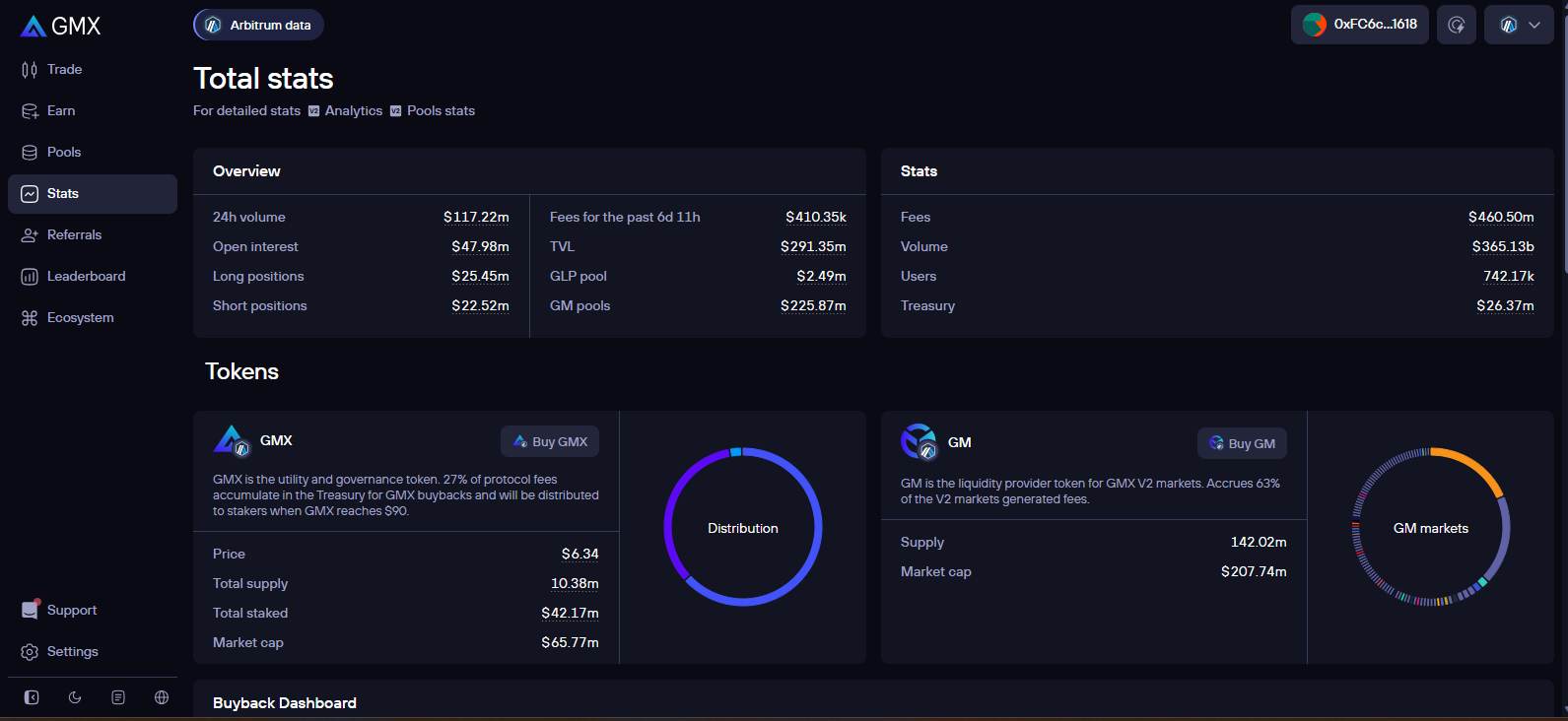
Dieser Abschnitt ist hilfreich für Nutzer, die sich vor dem Handel oder der Bereitstellung von Liquidität einen besseren Überblick über die Aktivität der Plattform verschaffen möchten. Er kann auch beim Vergleich von Märkten, der Überprüfung der Nachfrage oder dem Verständnis des aktuellen Handelsvolumens auf GMX hilfreich sein.
Pools
Der Bereich „Pools“ richtet sich an Nutzer, die Liquidität bereitstellen möchten, anstatt aktiv zu handeln. GMX bietet hier GM Pools und GLV Vaults an. GM Pools ermöglichen ein direkteres, marktspezifisches Engagement, sodass Nutzer einen Pool auswählen können, der an einen bestimmten Handelsmarkt gebunden ist. GLV Vaults sind weniger aufwändig und verteilen die Liquidität auf mehrere Pools, wodurch der manuelle Verwaltungsaufwand für die Allokationen reduziert wird.
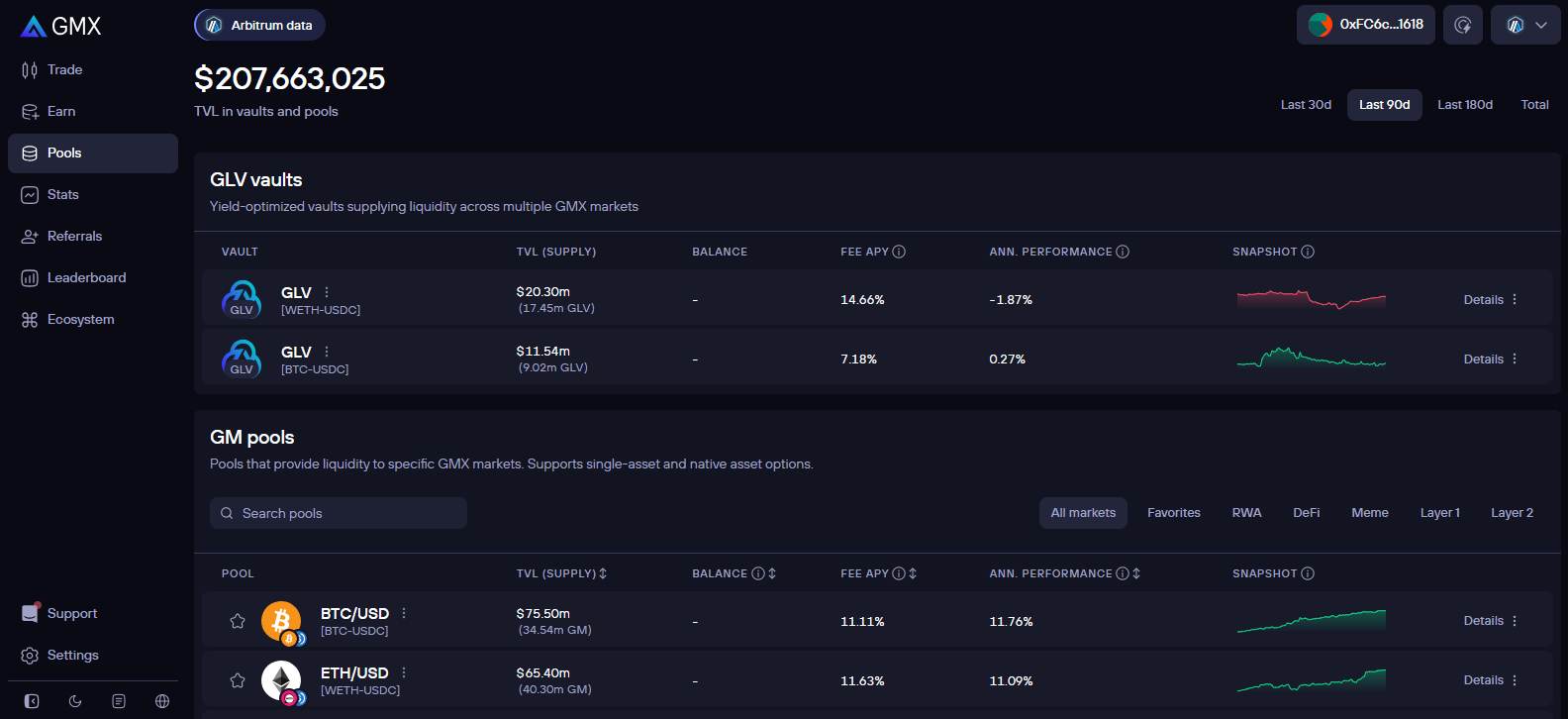
In diesem Bereich können Nutzer Liquidität einzahlen, abheben oder zwischen unterstützten Pools verschieben. Vor dem Beitritt empfiehlt es sich, die Poolgröße, die Auslastung, die Gebühren und den Long-Short-Saldo zu prüfen, da diese Faktoren das Verhalten des Pools und Ihr Risiko beeinflussen.
Verdienen Sie
Der Bereich „Verdienen“ bündelt die passiven Aspekte von GMX. Hier können Nutzer GMX-Token staken, in Pools einzahlen und die Belohnungen einsehen, die sie durch Protokollaktivitäten generieren. Er bietet eine kombinierte Übersicht über Einnahmen, geschätzte jährliche Renditen und Positionen, die mit Staking oder Liquiditätsbereitstellung verbunden sind.
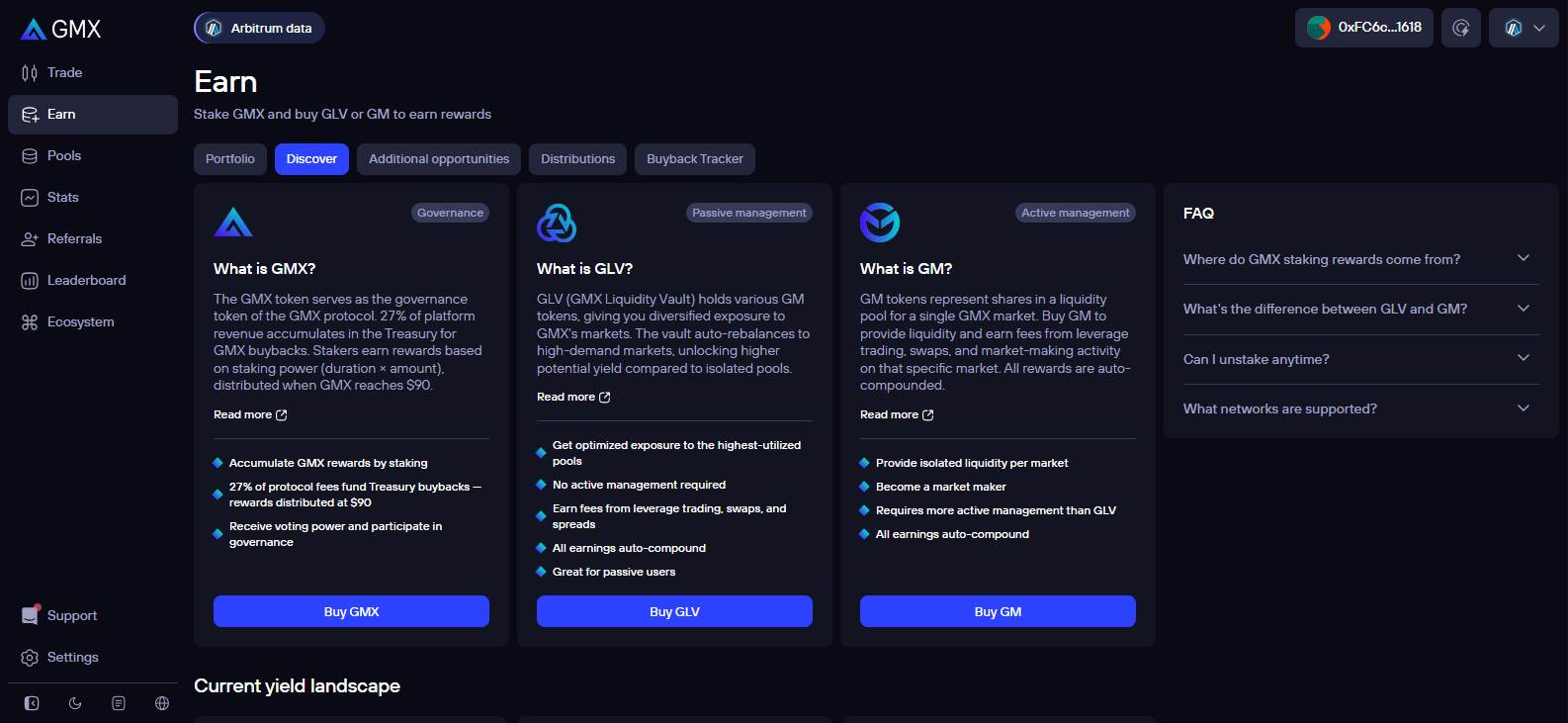
Dieser Abschnitt richtet sich an Nutzer, die in GMX investieren möchten, ohne ständig neue Positionen zu eröffnen. Im Vordergrund steht weniger die Ausführung von Transaktionen, sondern vielmehr die Verfolgung von Renditen, Staking-Belohnungen und liquiditätsbasierten Erträgen auf der Plattform.
GMX Sicherheit
GMX ist eine dezentrale Self-Custodial-Plattform. Das bedeutet, dass Nutzer die volle Verantwortung für die Sicherheit ihrer Wallets und die Genehmigung von Transaktionen tragen. Im Gegensatz zu zentralisierten Börsen gibt es keine Kontowiederherstellung oder interne Schutzebene. Daher sind Nutzer Risiken wie Phishing, manipulierten Signaturen oder der Kompromittierung ihrer Wallets ausgesetzt. Es ist wichtig, Vertragsinteraktionen zu überprüfen, vertrauenswürdige Schnittstellen zu verwenden und idealerweise Speicher- und Handels-Wallets zu trennen, wenn man mit DeFi-Plattformen interagiert.
Protokollseitig minimiert GMX Risiken durch kontinuierliche Tests, die Überwachung von Smart Contracts und ein aktives Bug-Bounty-Programm, das das Aufdecken von Sicherheitslücken belohnt. Nutzer werden zudem angehalten, ausschließlich mit offiziellen Verträgen zu interagieren und Transaktionsdetails vor der Unterzeichnung zu prüfen, wodurch gängige Angriffsvektoren reduziert werden. Im Bereich der Sicherheitsprüfung wurde GMX bereits mehrfach von Unternehmen wie Guardian Audits, ABDK, Certora, Dedaub und Sherlock geprüft. Laufende Audits decken neuere Upgrades und Protokolländerungen ab.
GMX-Kundendienst
GMX bietet keinen herkömmlichen Kundensupport wie zentralisierte Börsen. Es gibt weder einen Live-Chat noch ein spezielles Hilfecenter mit strukturierten Anleitungen. Stattdessen erfolgt der Support hauptsächlich über die Discord-Community, wo Nutzer Fragen stellen und Hilfe von Moderatoren oder anderen Nutzern erhalten können.
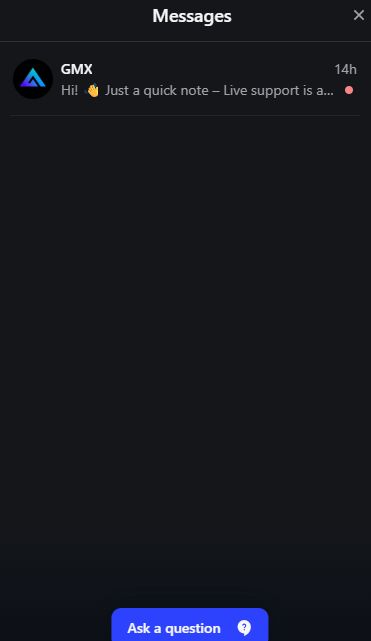
Auch wenn dies zunächst begrenzt erscheinen mag, verfügt GMX im Vergleich zu vielen anderen DeFi-Plattformen über eine relativ lange Betriebsgeschichte, und die meisten häufig auftretenden Probleme werden bereits in den Community-Kanälen und der Dokumentation besprochen.
GMX-Alternativen
GMX ist möglicherweise nicht für jeden Trader geeignet, insbesondere aufgrund seiner Struktur, der Netzwerkauswahl und der Gebühren. Hier sind einige Alternativen zu GMX, die Sie sich ansehen können:
1. Hyperflüssig: Die Platform Hyperliquid ist derzeit führend im Bereich der Perp DEXs und bietet eine breitere Palette von Vermögenswerten an, darunter tokenisierte Aktien und Rohstoffe sowie gasloses Trading.
2. Aster:Ein weiterer Täter, der auf der BNB-Chain basiert, wo Aster bietet eine hohe Hebelwirkung und eine mobile App für Nutzer, die unterwegs handeln möchten.
| Funktion | GMX | Aster | Hyperliquid |
|---|---|---|---|
| Etabliert | 2021 | 2025 | 2024 |
| Spotgebühren | 0.05 %–0.07 % / bis zu 3.75 % | 0.10% / 0.04% | 0.04% / 0.07% |
| Futures-Gebühren | 0.04 %–0.06 % (dynamisch) | 0.010% / 0.035% | 0.015% / 0.045% |
| Max Leverage | 100x | 1001x | 50x |
| KYC erforderlich | Nein | Nein | Nein |
| Unterstützte Kryptowährungen (Spot) | 24+ | 8+ | 238+ |
| Futures-Kontrakte | 107+ | 93+ | 173+ |
| Kein KYC-Auszahlungslimit | Unlimited | Unlimited | Unlimited |
| 24-Stunden-Futures-Volumen | $ 51.89M + | 2.33 Mrd. USD + | 6.03 Mrd. USD + |
| Hauptfunktionen | • Poolbasierter Handel • Kein Orderbuch • GLP/GLV-Tresore |
• 1001-facher Hebel (BTC/ETH) • Grid-Trading-Tools • Multi-Chain-Handel |
• Benutzerdefinierte L1-Kette • Keine Gasgebühren • Tresore + HYPE-Staking |
| Jetzt registrieren | Jetzt handeln | Jetzt registrieren | Jetzt registrieren |
Fazit
GMX ist eine der ältesten dezentralen Börsen für Perp-Trading und bietet eine solide Alternative zu zentralisierten Börsen ohne Orderbuch. Sie nutzt Liquiditätspools für reibungslosere Liquidationen, selbst bei hoher Volatilität. GMX bietet Perp-Trading, Spot-Trading und Pools und deckt damit die meisten Funktionen ab. Top-DEX-Plattformen für TäterAllerdings könnten Handelsgebühren, die Verwaltung von Vermögenswerten und die eher bescheidenen Renditen für Limited Partners (LPs) Sie dazu veranlassen, nach besseren Alternativen zu suchen. Wenn Ihr Hauptziel darin besteht, das Risiko zentralisierter Börsen (CEX) zu vermeiden und anonym mit Selbstverwahrung zu den niedrigen Gebühren von Arbitrum zu handeln, bleibt GMX eine zuverlässige und unkomplizierte Wahl.
Häufig gestellte Fragen
1. Ist die Verwendung von GMX sicher?
GMX ist eine Self-Custodial-Plattform, daher hängt die Sicherheit davon ab, wie Sie Ihre Wallet und Transaktionen verwalten. Das Protokoll selbst wird geprüft und bietet ein Bug-Bounty-Programm, dennoch besteht ein Restrisiko für die Nutzer.
2. Ist für GMX eine KYC-Prüfung erforderlich?
Nein, GMX erfordert keine KYC-Prüfung. Sie können eine kompatible Wallet verbinden und mit dem Handel beginnen, ohne ein Konto zu erstellen oder persönliche Daten anzugeben.
3. Welche Gebühren erhebt GMX?
GMX verwendet dynamische Gebühren. Die Gebühren für den dauerhaften Handel liegen zwischen 0.04 % und 0.06 %, während die Swap-Gebühren typischerweise zwischen 0.05 % und 0.07 % liegen, wobei die Gebühren für atomare Swaps bis zu 3.75 % betragen können.
4. Kann ich Spot-Handel auf GMX betreiben?
Ja, GMX unterstützt Spot-Trading über seine Swap-Funktion, mit der Benutzer direkt über die Benutzeroberfläche zwischen mehr als 24 unterstützten Assets tauschen können.
5. Wie hoch ist die maximale Hebelwirkung bei GMX?
GMX bietet auf seiner Hauptplattform einen Hebel von bis zu 100x an, abhängig vom jeweiligen Vermögenswert und den Marktbedingungen.